Living Room Furniture Arrangement for Every Shape: L-Shaped, Long, Square & Awkward Rooms

If you’ve ever had to move a sofa three times and it still doesn’t feel right, you may have a room shape problem, not a furniture problem. A typical room layout in the form of a square 14×14 is an entirely different animal when it’s something long, like a 12×20 space. The issue is that most basic layout advice acts like every room is the same shape and ignores irregular or long rooms that need zone setups. Square rooms do well when furniture is pulled away from the walls. While L-shapes need each leg treated like its own space, and open-concept rooms work best when the sofa back becomes the wall. Here’s how to read the shape of your room first, then arrange the furniture to match, so even if you have an awkward, sloped, or weird room design, the floor plan makes sense.
Why you should read your living room layout first
Before adding any furniture, there are a few things that help tell you how the room wants to be arranged:
- The traffic pattern. This is where people walk in, and where they end up. Furniture should never block that line, so there is uninterrupted traffic flow.
- The fixed features. The fireplace, TV wall, window walls, and doorways are all fixed features. These don’t move, and everything else you add has to respect them.
- The shape of the rectangle (or whatever it is). Whether you’ve got a room that is long, square, L-shaped, or odd-shaped, each one may do best with a different layout philosophy. Get this wrong, and the room will never feel right to you.
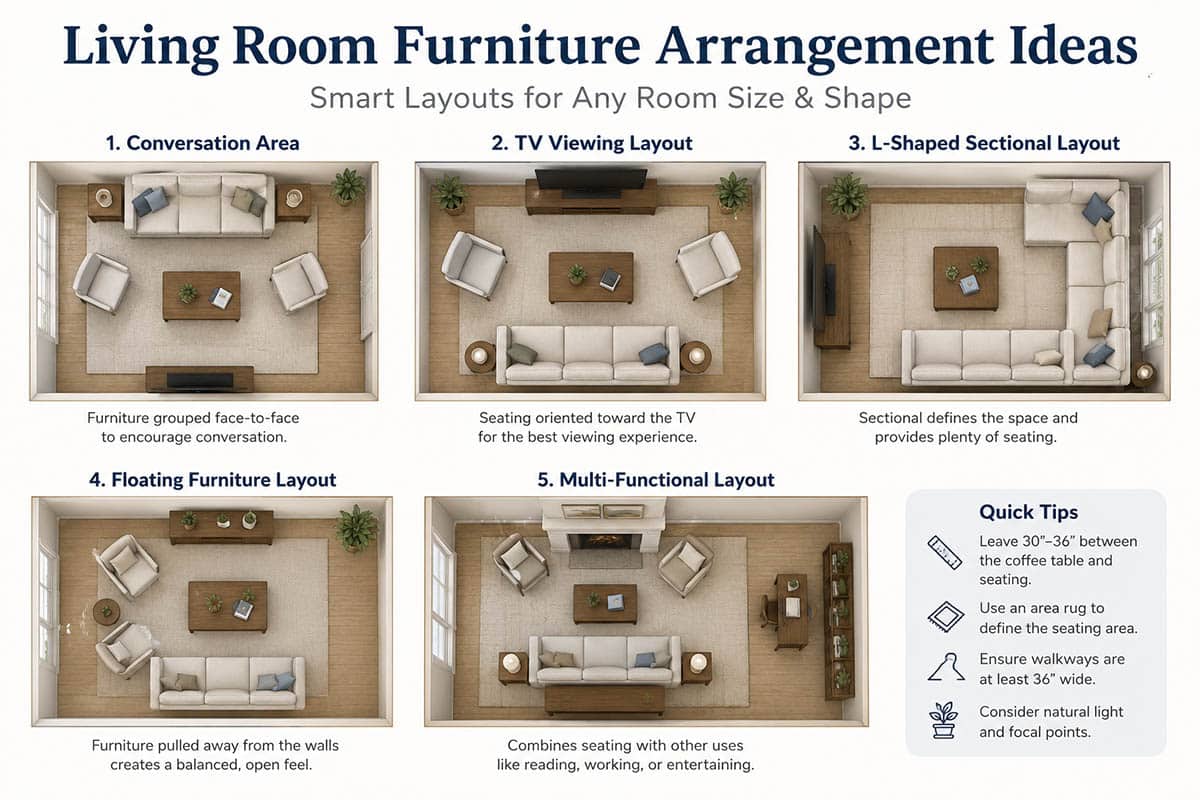
If you want to check your room size against the recommended functional minimums, the living room dimensions guide has the numbers. Here are 5 of the primary ways to setup a living room for most tasks. Below you’ll also see advice for handling different room shapes.
Conversation Area
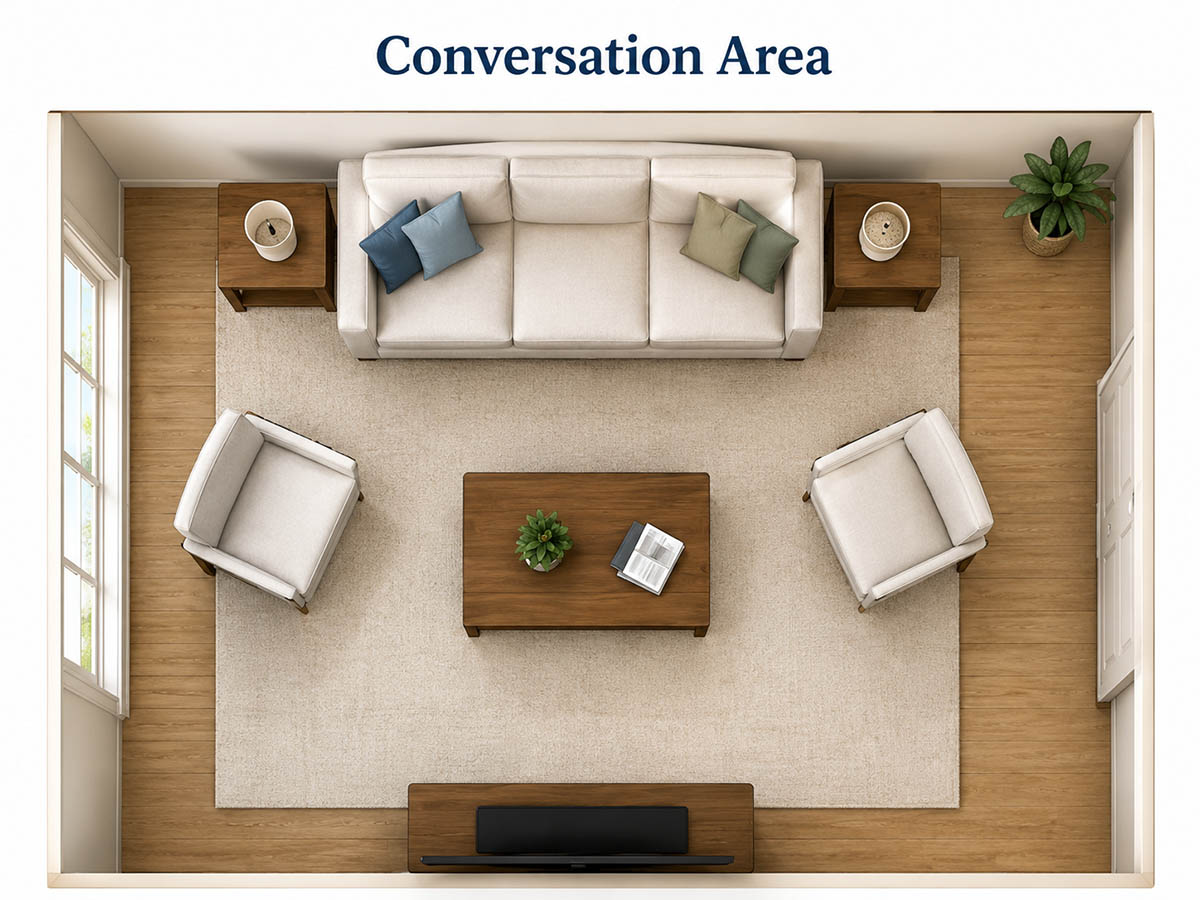
The conversation layout is a furniture arrangement that’s designed to encourage face-to-face interaction. It is set up to promote social interaction and often works well as a formal living space near the home’s entry. By placing a sofa with two chairs facing toward each other, you can more easily facilitate direct communication. See more conversation-focused sitting room layouts here.
Multi-Functional Layout
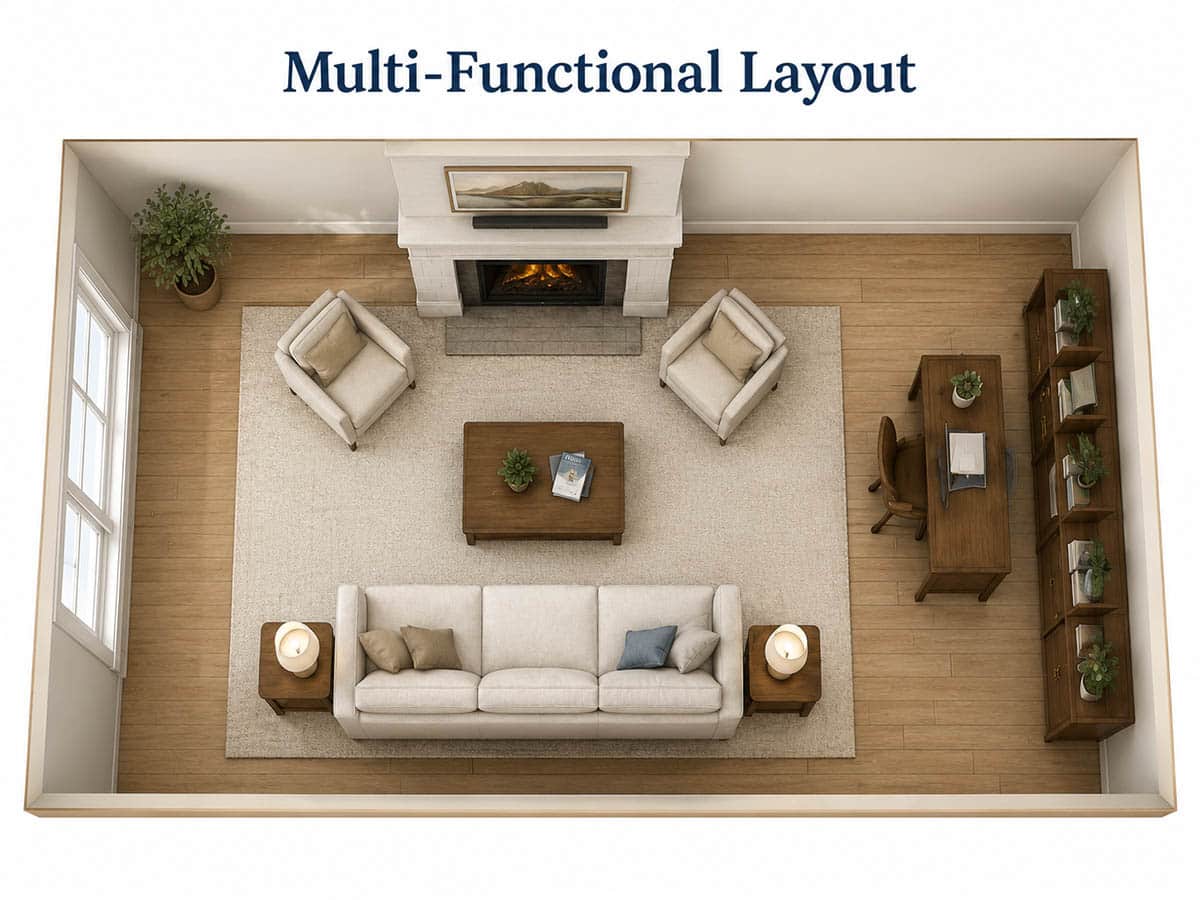
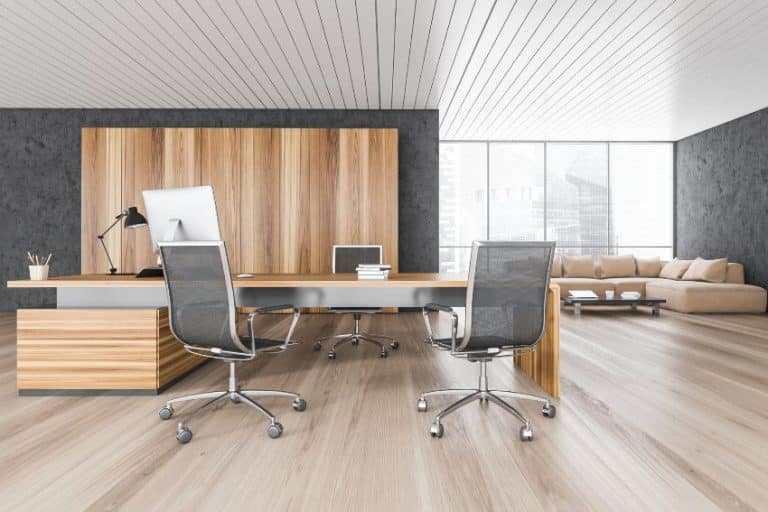
A multi-functional room design is one that combines seating with another use, such as working, reading, or entertaining. The one shown above adds a desk for a work-from-home setup that works well for those who don’t have a designated room for this purpose.
Floating Furniture Layout
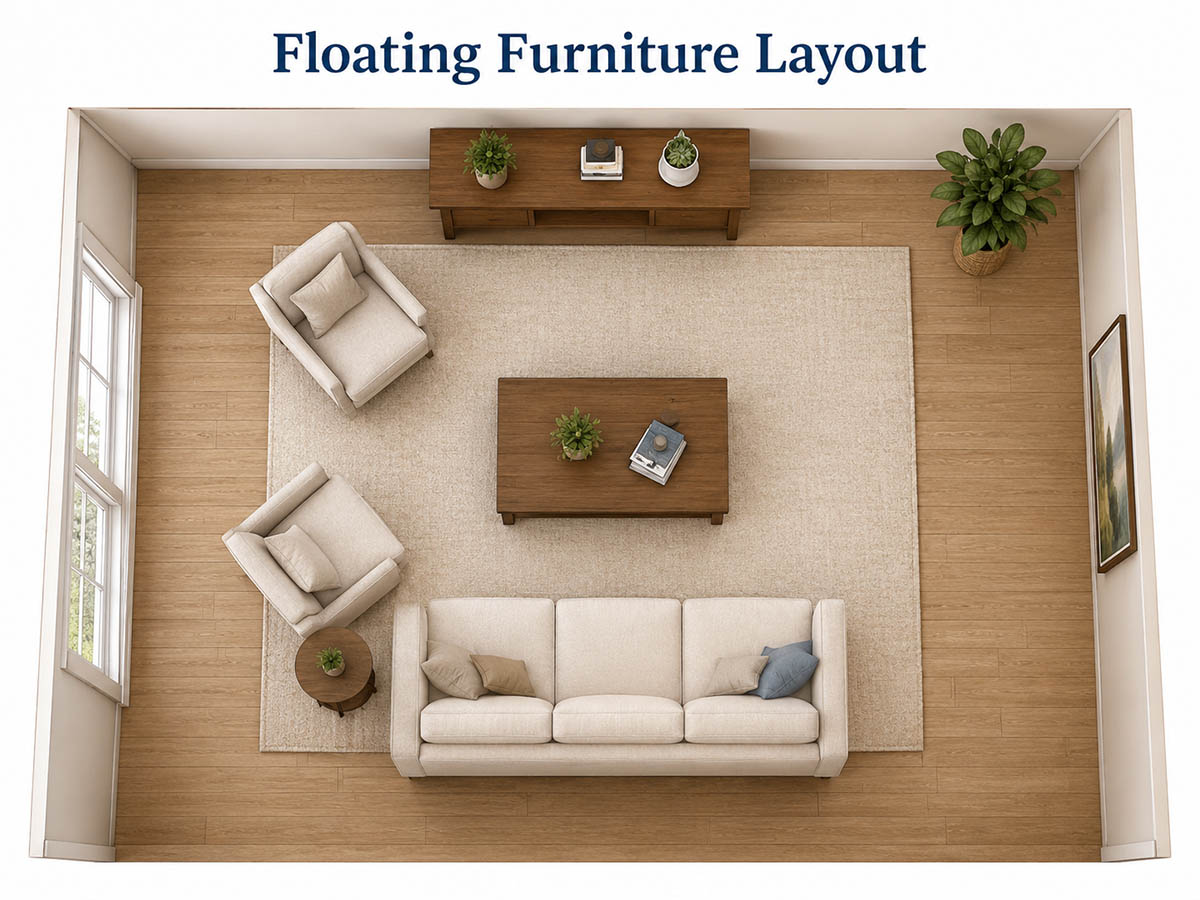
This arrangement has the furniture placed away from the walls, which gives it the ‘floating’ name. This setup works well if you want traffic flow along the perimeter of the furniture and can improve traffic flow and visually separate the living area in an open floor plan.
TV Viewing Layout
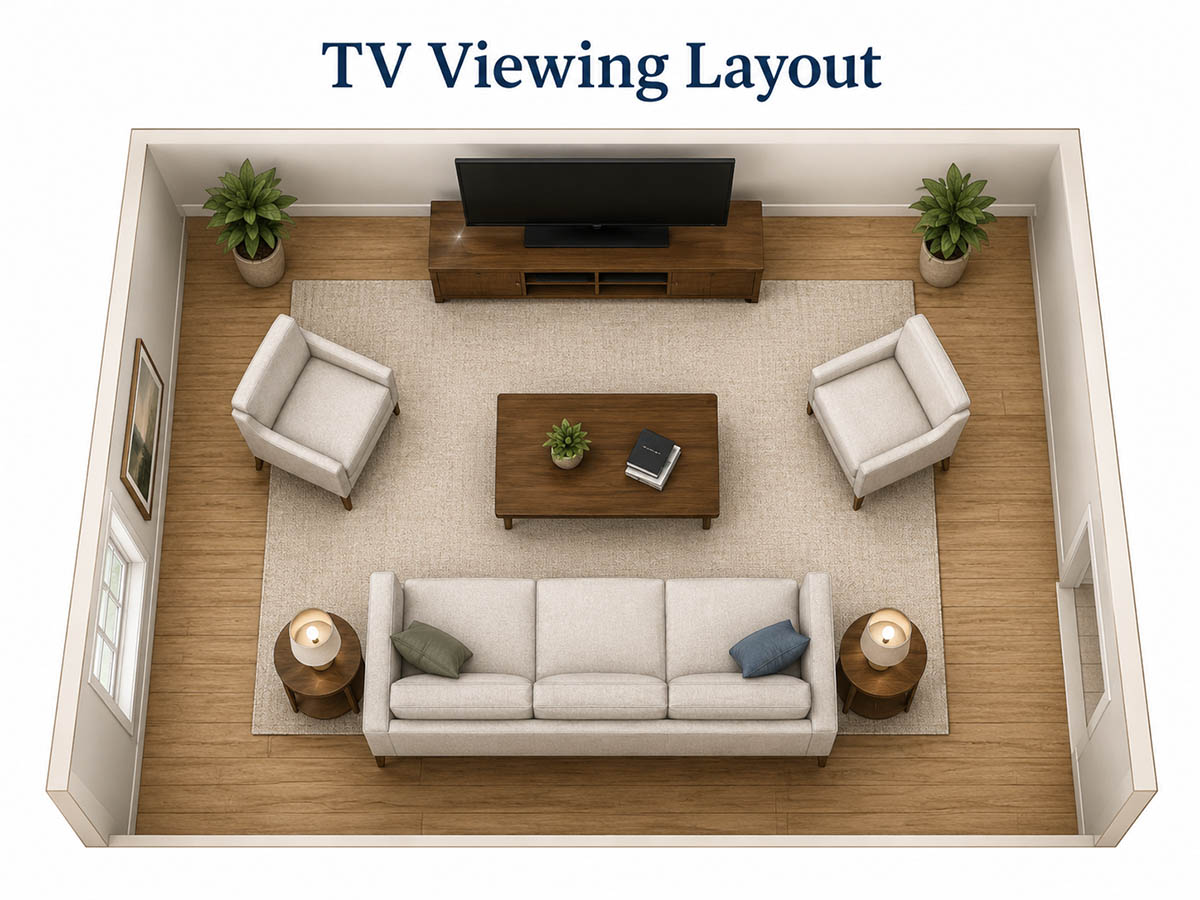
This plan is aimed at those wanting a seating arrangement oriented toward the television for comfortable viewing. The main seating is directed at the screen, with others being slightly placed facing towards the viewing area. Walkways are often left open behind the seating to prevent interruptions and ensure a clear view toward the TV.
Layouts by room shape, at a glance
- Long and narrow: split into zones, never line furniture against the long walls.
- Square: pull furniture off the walls, anchor with a rug.
- L-shaped: treat each leg as its own zone.
- Open-concept: use the sofa to define the room boundary.
- Small (under 150 sq ft): one focal point, no oversized pieces.
- Large (over 350 sq ft): multiple conversation areas, not one giant ring.
- Awkward or irregular: start with the odd feature and work outward.
- Corner fireplace: angle the seating, not the room.
Long and narrow living rooms
The classic problem is when you have a long and narrow room, because with furniture added, it can interrupt the natural foot path. A 12×20 or longer room wants to be treated like one big space, but can seem disjointed if not careful. The fix is to split it into two zones. Long living room layout ideas cover the full breakdown.
- Two-zone rule: main conversation area on one end, secondary use (reading nook, desk, second seating) on the other. A console table or open shelving makes the visual break.
- Furniture orientation: arrange the seating perpendicular to the long walls when possible. By pushing everything against the long walls, it can make long rooms feel like hallways.
- Sofa choice: a regular sofa works better than a sectional in long-narrow rooms. Sectionals fight the geometry.
- Rug placement: two smaller rugs, one per zone, beat one giant rug. The rug seam reinforces the zone break.
Narrow and rectangular rooms have their own variants to consider. Narrow living room layouts covers the under-12-feet-wide case where you don’t even have the option of perpendicular seating.
Square living rooms
Square rooms are the easiest shape to arrange, but are still easy to get wrong. The mistake is pushing everything to the walls, which makes things look awkward. Square living room layouts with a TV shows some tips you can use to get it right.
- Pull furniture off the walls: 6 to 12 inches of breathing room between sofa and wall makes a square room feel bigger, not smaller. The instinct to push back is often wrong with this room shape.
- Anchor the center: a large rug under the front legs of all major seating defines the conversation area. Square rooms need this so that everything doesn’t float out by iteself.
- Symmetric seating works: two facing sofas with a coffee table in the middle is the most balanced setup in a square room. An L-shaped sectional in a corner also works but you’ll want to get the correct size for your space.
- The TV question: if the TV and fireplace are on different walls, pick one as the focal point and accept that the other will be off-axis. Don’t try to face both with the same seating cluster, or it will appear off balance.
L-shaped living rooms
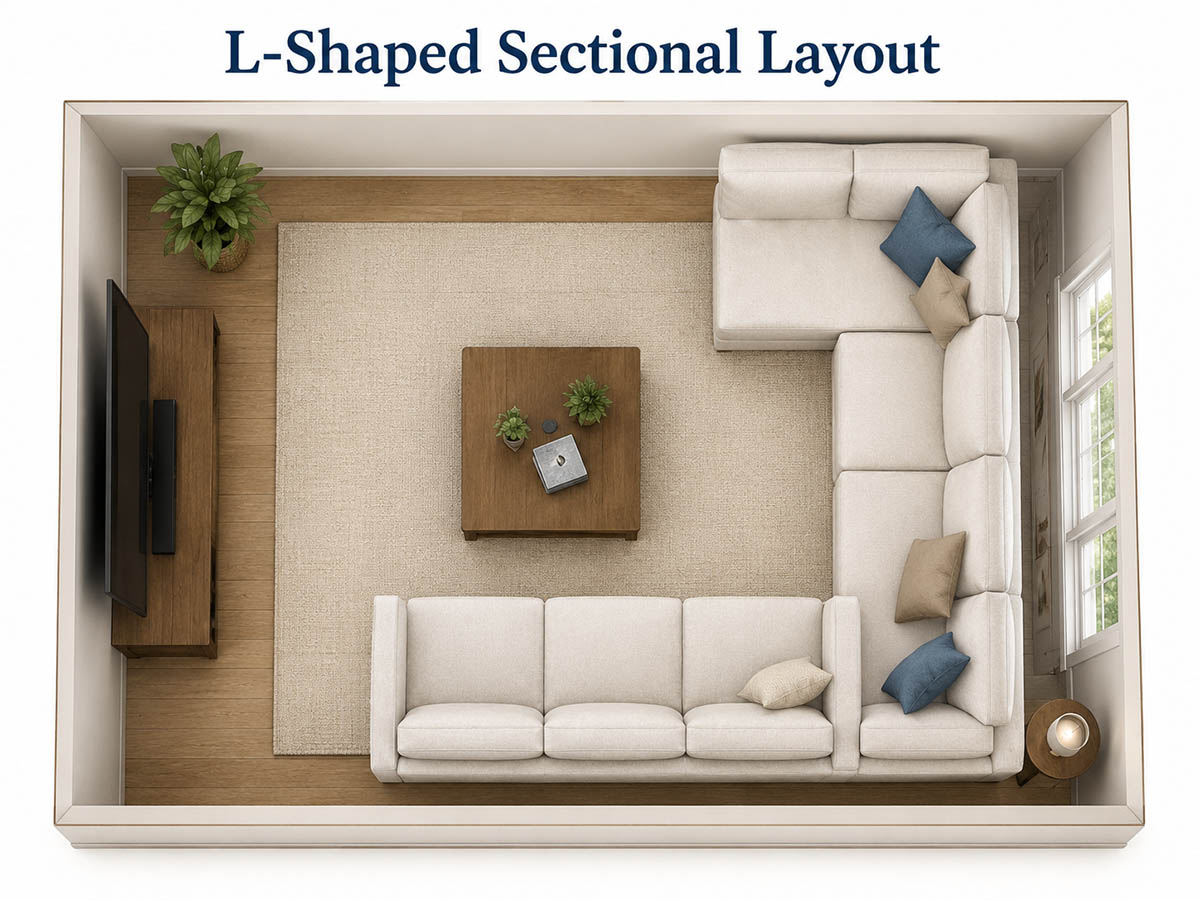
L-shaped rooms are usually a main living area with a shorter leg branching off, often into a dining or office zone. The instinct to make it feel like it’s all part of one room is wrong. For best results, treat each of the legs as two related but separate spaces.
- Main leg gets the conversation furniture: sofa, chairs, coffee table. This is the room’s primary purpose for a conversation space.
- Short leg gets a single function: reading corner, desk, dining set, or media console. One job, one piece of furniture.
- The inside corner is the hardest spot: it usually wants a tall plant, a floor lamp, or a corner cabinet. Leaving it empty can make the room feel awkward.
- Rug strategy: one rug per leg, in matching tones, and different shapes. Don’t try to span the L with a single rug, as it never lays right.
- Sightlines: you should be able to see from the entry into the main seating area without the eye getting caught on a sofa back. If a sofa back is the first thing you see, flip the layout.
Open-concept living rooms
Open-concept means no walls, which means the furniture acts as the wall. Open-concept living room layouts breaks down the full approach. The open vs closed living room comparison is worth a read if you’re still deciding.
- The sofa defines the boundary: a sofa back facing the kitchen or dining area becomes the visual wall. This is an important furniture position in an open-concept room.
- Rug placement is non-optional: the living room rug tells everyone where the living room ends and delineates the space at a glance. Without it, the whole space reads as one undifferentiated zone.
- Lighting at multiple heights: overhead lighting alone makes an open room feel like a warehouse. Bring in floor lamps, table lamps, and pendants over key zones to add lighting layers.
- Open-concept with a kitchen island: the large open-concept with island layout guide covers how to position the sofa relative to the island, which is the most common arrangement question.
- Smaller open-concept variant: small open-concept kitchen and living room floor plans show how to make it work in apartments and starter homes.
Small living rooms (under 150 square feet)
Small rooms reward restraint and need one focal point. Smaller spaces thrive on one main seating piece, with no clutter. The small living room furniture layout and space-saving small living room layouts with a TV both cover the discipline that this takes.
- Skip the sectional: a regular sofa plus one armchair feels lighter and gives more flexibility than a sectional in a tighter room.
- Lift the furniture: visible legs on the sofa and chairs let light pass underneath. Skirted furniture can make small rooms feel heavier.
- Vertical storage: a tall bookshelf takes less floor space than a wide credenza and adds the storage you need without eating up the room.
- One pattern, one statement: a patterned rug or one bold wall is enough. Avoid using both at once in small rooms, which can make it feel chaotic.
- Dimension-specific advice: 10×10 living room layouts and 12×12 living room layouts show actual arrangements for the most common small-room sizes.
Large living rooms (over 350 square feet)
The drawback of designing big living rooms is that they often have one giant ring of furniture around the perimeter, with a coffee table by itself in the middle. Large living room layouts with a TV shows how to avoid it.
- Multiple conversation areas: a primary seating group plus a smaller secondary zone (reading chairs, game table) makes a large room feel planned out instead of empty.
- Larger furniture, not more furniture: scale matters in big rooms, and a deep sectional will look better than three regular sofas spread around the perimeter.
- Anchor with a real rug: large rooms need 9×12 or bigger rugs to anchor the main seating zone. Using anything smaller, and the room will look unfurnished.
- The empty-corner problem: large rooms have at least one corner that benefits from a tall plant, a sculpture, or a reading chair with a floor lamp.
Awkward and irregular living rooms
Sloped ceilings, jutting walls, oddly placed doors, sunken floors, and weird offsets all fall into the ‘awkward’ category. The first step with any irregular room is to stop fighting it and lean into what makes it unique.
- Start with the odd feature, not the furniture: position the main seating to face the unusual feature (the angle, the dormer, the sunken pit) or to be perpendicular to it. Trying to ignore hardly ever works.
- Sunken living rooms: sunken living room ideas shows how the level change defines the seating arrangement automatically. Lean into the conversation pit design.
- Corner-fireplace rooms: living room layouts with a fireplace in the corner covers the most common awkward feature. The trick is angling the seating to face the corner directly, not the walls.
- Decorating a corner you can’t avoid: decorating a corner of a living room has solutions for the standard problem corners.
- Dual-purpose rooms: if your living room also needs to be a bedroom (living room bedroom combo) or you’re turning a living room into a bedroom, the shape rules still apply. Layout around the primary function first.
- Formal living rooms with no clear use: alternative uses for a formal living room covers the awkward “we have this space but never use it” situation that sometimes comes up.
Furniture arrangement rules that apply to every shape
Some design principles don’t care what shape the room is. The maximize space layout guide covers most of them.
- Seats face seats: people sit down to talk, not to face a wall. The main seating should face other seating, not just the TV.
- Coffee table within reach: 14 to 18 inches from the front of the sofa. Closer and you can bang your shins, and farther and it’s useless. Use this tool to find the best coffee table size.
- Walking paths of 30 inches minimum: anywhere people regularly walk through. Less than that and the room feels cramped no matter how nice the furniture is.
- Two sofas can work: arranging two sofas in a living room and mixing two different sofas are good references for the L-shape or facing-pair setups.
- Sectional plus recliner is its own layout: the living room floor plan with sectional and recliner guide covers the most common multi-piece setup. The sectional sofa layout guide handles the sectional-only case.
- Rug under sectional: use the right rug placement under a sectional (front legs on, or fully under). Half-and-half looks accidental.
When the fireplace and TV are both in play
A fireplace and a TV are the two strongest focal points a room can have. When both exist, the arrangement has to pick one as the winner. Living room layouts with fireplace and TV covers the major options.
- Stacked layout: TV mounted above the fireplace, is the easiest to arrange, but can be hard on your neck if mounted too high. Use a long arm TV mount if you have this issue.
- Side-by-side layout: the TV next to the fireplace on the same wall offers the cleanest viewing experience. TV in a living room with fireplace shows the configurations.
- Perpendicular walls: fireplace on one wall, TV on the adjacent wall. For this scenario, use an L-shaped or sectional seating arrangement to face both at roughly 90 degrees.
- Living room arrangements with the TV as the focal point: living room arrangements with TV shows the seating-position-first version where the fireplace becomes secondary.
The arrangement mistakes that wreck any shape
The fastest way to fix a layout is to locate what you’re already doing wrong. Mistakes to avoid in living room layouts has the full list. Here are some of the big ones:
- Furniture against every wall: the most common mistake, as this makes the room feel like a waiting area with a large open center area.
- Rug too small: if the rug doesn’t reach under the front legs of the main seating, it doesn’t anchor anything.
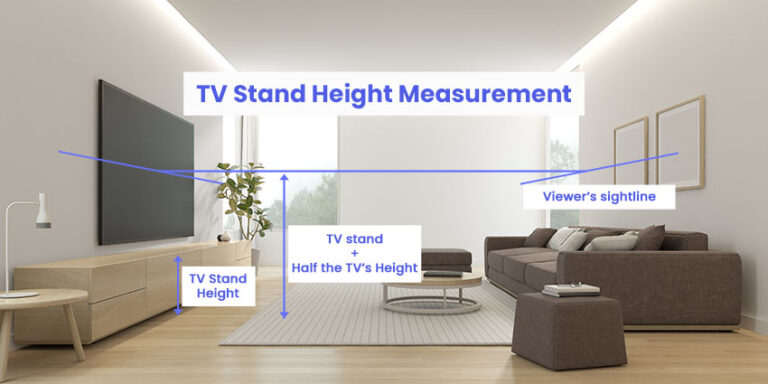
- TV way too high: eye-level seated means the center of the TV is about 42 inches off the floor. Most mounted TVs are 12 inches too high, so use a flexible mount to correct this.
- No side tables: if you entertain, every seat should have a place to put a drink within arm’s reach.
- Coffee table is the wrong size: should be about two-thirds the length of the sofa it sits next to. Smaller and it looks lost in the space, while if it’s too big, it dominates.
How to pick the right layout for your room
If the room shape is forcing your decision, here’s the short version of what each one wants:
- Long and narrow: two zones, perpendicular seating, two small rugs.
- Square: pull off walls, anchor with one large rug, symmetric seating works best.
- L-shaped: treat each leg as its own zone with one job.
- Open-concept: sofa back becomes the wall, rug becomes the boundary.
- Small: one focal point, lifted furniture, vertical storage.
- Large: two seating zones, big-scale pieces, no perimeter ring.
- Awkward / irregular: start with the odd feature, build around it.
- Corner fireplace: angle the seating to face the corner directly.
The bottom line
Every room shape has its own rules, and they are all different from each other. The room only feels right when the arrangement follows the rules for that shape. Most living rooms that don’t work fail at the geometry stage, rather than the décor stage. The fix is usually not getting new furniture; it’s positioning it in a different place, or creating zones so it all flows better.
Stand at the doorway. Look at the room. The shape will tell you what it wants if you stop trying to override it.
To showcase highly specific designs, some images on this website use advanced AI-generation software to illustrate ideas and room inspiration. See our editorial policy to learn more.