Hardwood Floors in the Kitchen (Pros and Cons)

A common question asked is, can I use hardwood floors in the kitchen, and what are the pros and cons? Often thought of as the ultimate flooring choice, hardwood is beautiful, durable, and never goes out of style. Many homeowners desire to extend their wood floors from their living room, hallway, or dining room to their kitchen space to provide consistency throughout. A major concern is the amount of damage and wear and tear a kitchen can have on their expensive flooring. However, with the right care hardwood can be a beautiful addition to the kitchen space.
Is Hardwood Flooring Good for a Kitchen?
Hardwood flooring refers to the use of timber that is manufactured to be used as flooring for both aesthetic and structural purposes. Solid hardwood is commonly used as a material for flooring because of its quality, ability to be restored, and durability. These kinds of floors are perpendicularly installed to wooden support beams of buildings which are otherwise regarded as the bearers or joists.
Many homeowners prefer hardwood flooring in their homes; thus, it is the reason that this kind of flooring will never go out of style. Wood floors enhance the natural beauty of the kitchen. It provides warmth and a good ambiance to the area. Hardwood handles the odd splash and spill better than people expect. And when it finally starts to look tired, you sand it and start over. That’s something no other kitchen floor lets you do.
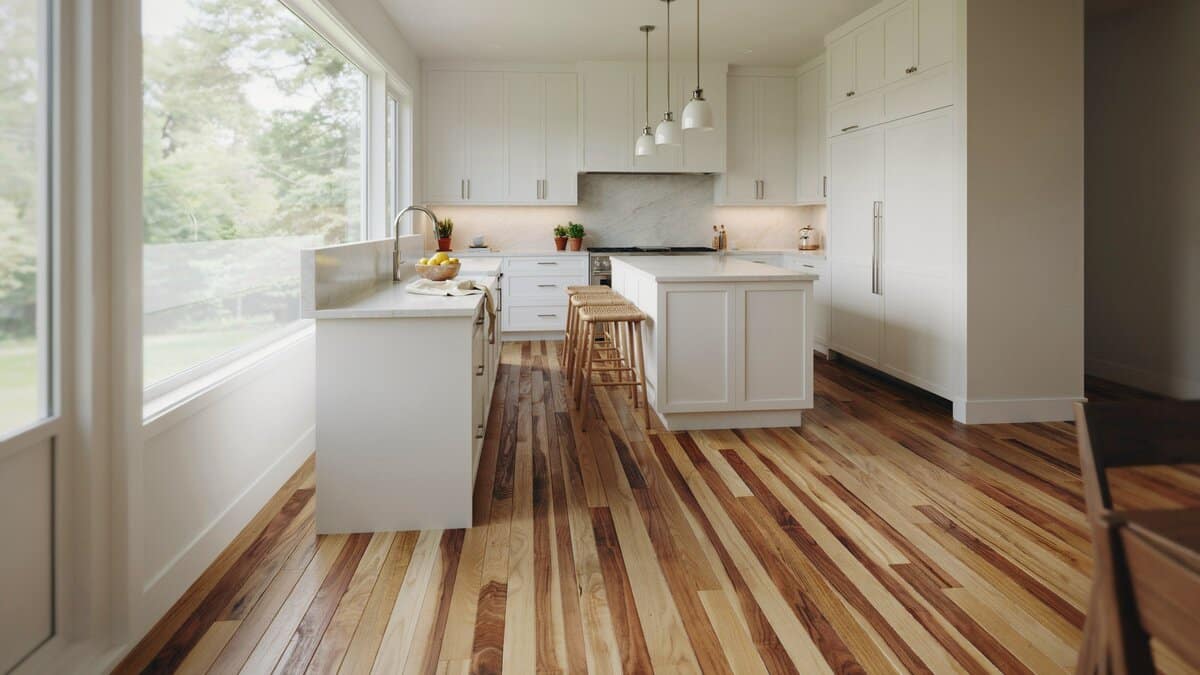
Hickory is the floor I point people toward when they want some personality underfoot. The planks swing from pale blonde to deep coffee, and all that variation hides a surprising amount of everyday kitchen mess. I’ve specified wood floors in a lot of kitchens, and the regret I hear is almost never about the wood itself. It’s about the finish, or the color being darker than it looked in the showroom.
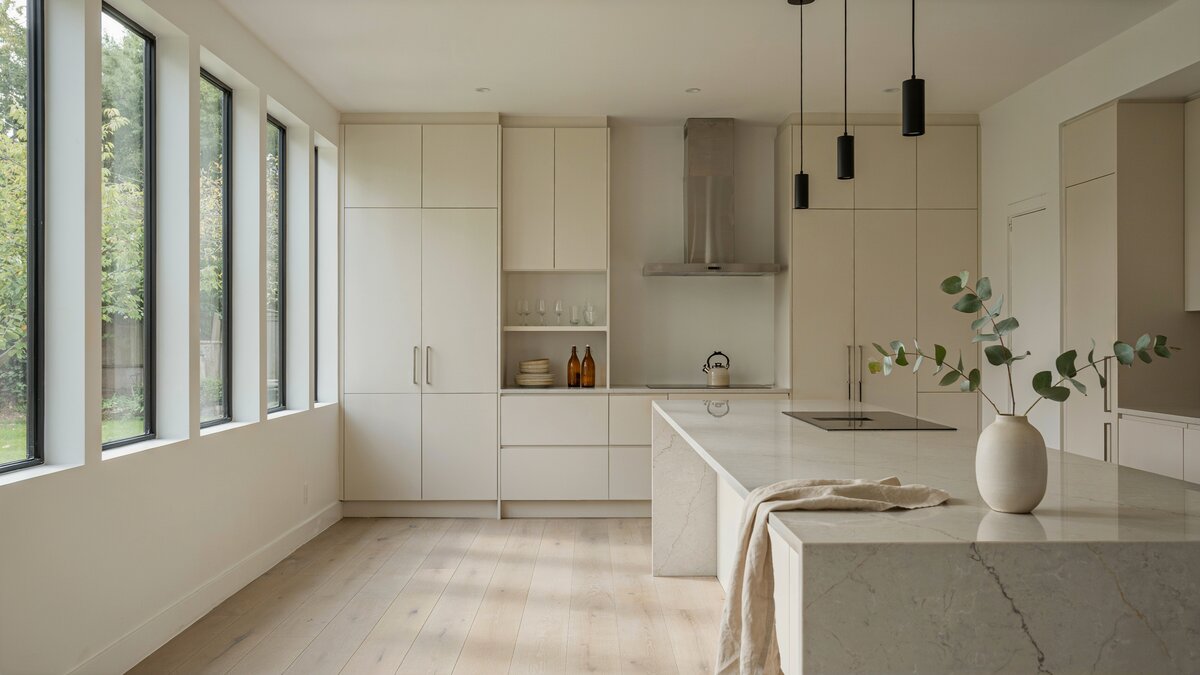
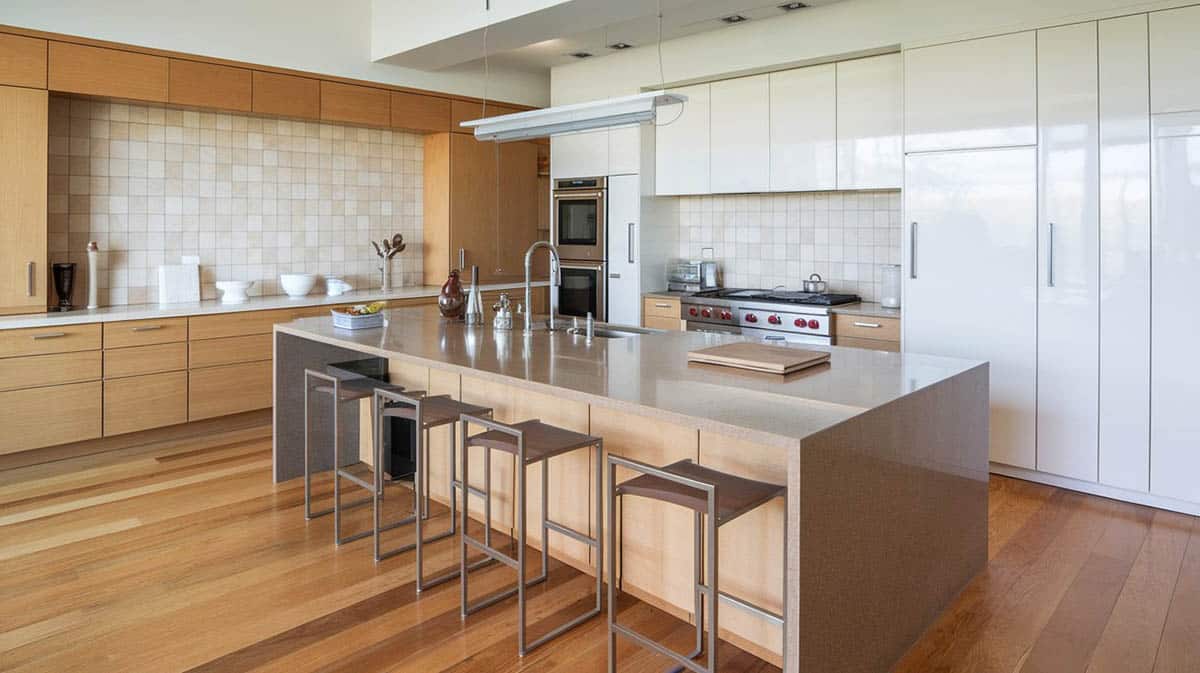
White oak reads calm and almost neutral, which is why it holds up in a kitchen this bright. The grain is there when you look for it, but it never competes with the counters or the cabinets.
Hardwood Floors in Kitchen Pros
- Hardwood floors look beautiful, warm, and inviting.
- It provides a seamless look, especially between the kitchen and the other parts of the house.
- Wood floors are easy to maintain by sweeping or vacuuming when they are dirty, and with an occasional application of wood cleaner to maintain its attractive appearance.
- Wood floors are versatile and match almost any kitchen style. You can change the look of the room by adding a new area rug or two to give it a whole new feel.
- With proper maintenance, hardwood floors are durable and can be used for many years and still look amazing.
- Hardwood is well regarded as a good investment because it helps in increasing the house’s value.
- Hardwood floors are much better for allergy sufferers than those with carpets. This is especially true for pet owners and those affected by pet dander, hair and dust.
- Wood floors can be repaired if they get scratched by re-sanding and refinishing them so they regain their original look.
Hardwood Flooring in Kitchen Cons
- It is susceptible to various kinds of damage from water, spills, scratches, and leaks.
- It’s expensive. Solid hardwood runs roughly $11 to $25 per square foot installed, and the exotics like teak or rosewood sit at the top of that range.
- It needs to be cleaned frequently, sanded, and refinished to maintain its appearance.
- Wood floors are susceptible to moisture fluctuations and require careful attention to maintain the beauty of the floor.
- Wood floors can be cold in the winter months or for those who reside in colder climates.
- These types of floors can be noisy with increasing amounts of creaks as the flooring ages.
- Dogs slip on wood floors. Older dogs especially, and a satin finish helps more than a glossy one.
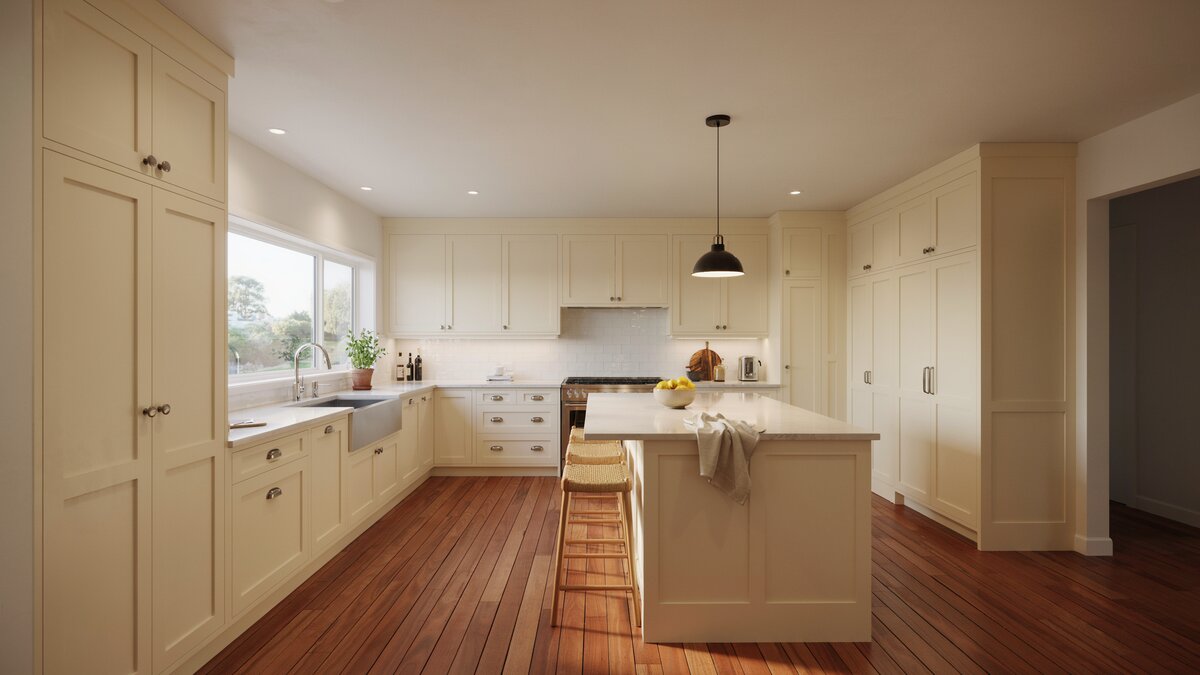
American cherry starts out a soft pinkish tan and deepens into that warm russet over a few years. If you love the color on day one, know that it is only going to get richer.
What Water Actually Does to a Kitchen Floor
A dropped glass of water is not the problem. Wipe it up and nothing happens. The finish is doing its job. The problems are the slow ones. A dishwasher supply line that weeps for six months. A sink trap dripping into the cabinet base. Those soak the subfloor from underneath, and by the time you see cupping in the planks, the repair is a section replacement, not a mop. The other one nobody warns you about is wet mopping. Standing water works its way into the seams between planks over years of cleaning, and the edges swell and lift. Use a damp mop and a wood floor cleaner. Not a bucket.
Two things worth doing while the floor is going in:
- Put a leak detector in the cabinet under the sink and behind the dishwasher. They cost about as much as a takeout dinner and they’ll catch the leak that ruins the floor.
- Ask for an extra coat of finish in the sink and dishwasher zone. Most installers will do it if you ask before they start.
Engineered handles all of this better than solid. The cross-layered core doesn’t swell and cup the way a single piece of wood does. There’s also waterproof engineered hardwood now, built with a sealed core, which is worth pricing out if the kitchen sees a lot of traffic. Just know that waterproof means it survives spills, not standing water.
Types of Hardwood Floors for the Kitchen
Solid Hardwood – It is being milled from a piece of wood with the process of sanding and refinishing repetitions. Wood including the bamboo is among this type that provides a natural look. It has susceptibility to humidity so it is not being installed in spaces which are damp. Oftentimes, the solid hardwood is stapled, nailed, or glued to a wooden subfloor.
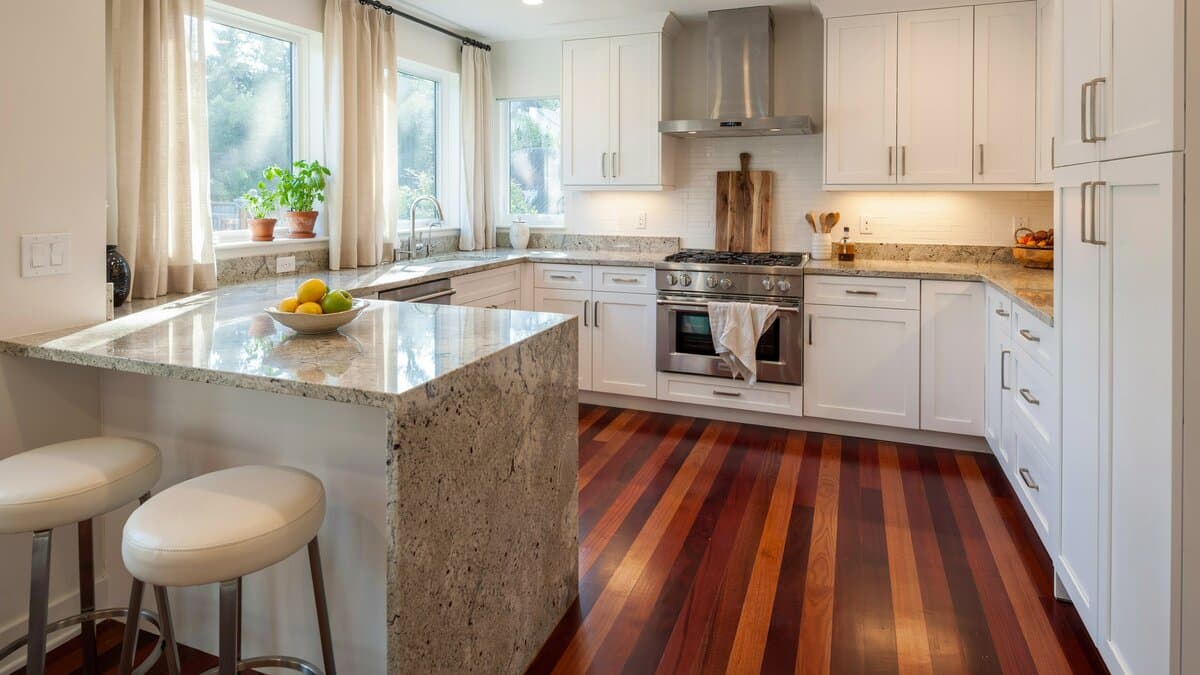
Jatoba, sold as Brazilian cherry in most showrooms, is one of the hardest floors you can put down. That deep red looks dramatic against white cabinets, though it does make a room feel a little cozier.
Engineered Hardwood – this is made out of layers of hardwood. It is a lot more stable and is able to withstand the humidity. Its installation over the concrete subfloors is possible. It comes pre-finished most of the time.
Moreover, it offers greater flexibility when it comes to installation during stapling, gluing, or floating. (Engineered lands around $9 to $20 per square foot installed, so it usually comes in under solid wood, though not by as much as most people assume.) Read more about engineered hardwood in the kitchen here.
What you’ll actually pay, installed
Engineered hardwood: $9 to $20 per square foot
Solid hardwood: $11 to $25 per square foot
True parquet: $13 to $40 per square foot
Materials are only about half of that. Labor runs $4 to $8 per square foot on its own, and it climbs fast if your subfloor needs work. Run your own numbers with our flooring cost calculator.
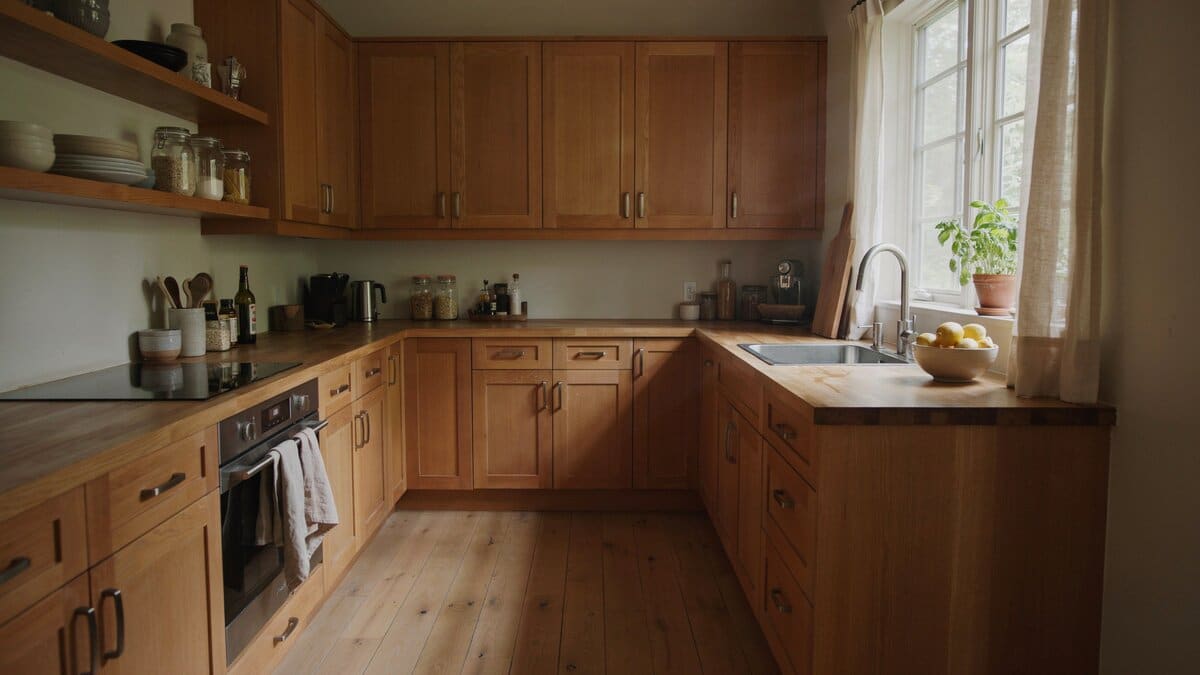
Maple keeps things light and even-toned, which is a good match for wood cabinets that already have plenty going on. It dents easier than oak, so it suits a kitchen that does not take a daily beating.
Engineered Hardwood Pros and Cons
Pros
- Costs much less than solid wood flooring
- Engineered wood looks just like real wood floors
- Many different styles and finishes are available
- Does better with changes in weather, humidity, and moisture than real wood
- Can be sanded and finished
- Installing wood flooring can increase resale value
Cons
- Not real wood – may impact resale value
- Can not be sanded as many times as solid wood
- Less lifespan than real wood.
Hardwood vs. the Other Kitchen Floors
Nobody chooses hardwood in a vacuum. You’re weighing it against tile, vinyl plank, and laminate, so here’s the honest version.
| Floor | Where it wins | Where it loses |
|---|---|---|
| Hardwood | Warmth underfoot, resale value, and it’s the only one you can sand and refinish | Cost, and slow leaks |
| Tile | Genuinely waterproof, lasts decades | Cold, hard on your back, grout |
| Vinyl plank | Waterproof, cheap, softer underfoot | Adds nothing at resale, dents under appliances |
| Laminate | Cheapest wood look, scratch resistant | Swells at the seams, can’t be refinished |
The short version: pick hardwood if you’re staying put and you want the floor to run through the whole main level. Pick tile or vinyl if the kitchen is the hardest-working room in a house full of kids. See how the materials stack up in our guide to flooring durability by room, or browse the full range of kitchen flooring types. If you like the look but not the upkeep, there are decent wood flooring alternatives and laminate options for kitchens worth a look.
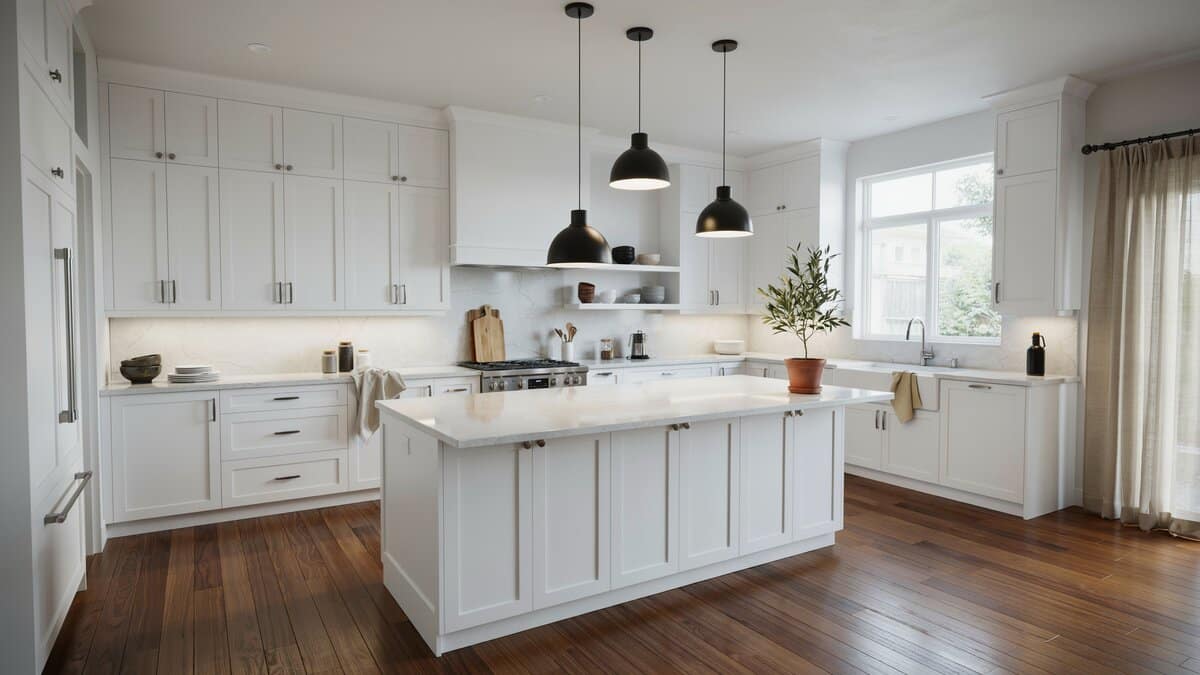
Walnut is the splurge floor. That chocolate brown looks incredible under white cabinets, but it is softer than oak and it shows dust more than you would expect.
What to Consider When Selecting Hardwood Flooring
Species – this refers to the wood’s quality including its stability, hardness, color, and graining. Oak is regarded as the most commonly used for domestic species. Other species include the maple, cherry, hickory, walnut, and birch. Exotic hardwoods are also highly sought after such as teak, Tigerwood, jatoba, and Brazilian cherry.
Here’s the part most guides skip. Every species on that list behaves differently underfoot, and the number that tells you how differently is the Janka rating. It measures how much force it takes to dent the wood. Red oak sits at 1,290 and the whole industry uses it as the benchmark, so read every other number as harder or softer than red oak.
Higher isn’t automatically better. A very hard floor resists dents but it’s also brittle underfoot and harder to refinish. Somewhere in the 1,200 to 1,800 range is the sweet spot for most kitchens.
| Wood | Janka | The look | Best for |
|---|---|---|---|
| Brazilian teak (cumaru) | 3,540 | Golden brown, tight grain | Busy kitchens that take real abuse |
| Jatoba (Brazilian cherry) | 2,350 | Deep red, darkens with age | White cabinets that need warmth |
| Tigerwood | 1,850 | Bold dark striping | Rooms where the floor is the feature |
| Hickory | 1,820 | Blonde to coffee in the same floor | Hiding crumbs, dust, and daily life |
| Hard maple | 1,450 | Pale, quiet, very even | Calming down busy wood cabinets |
| Bamboo (natural) | 1,380 | Tight linear grain | A dark floor look on a budget |
| White oak | 1,360 | Pale, slightly cool, subtle grain | Modern kitchens, and resale |
| Red oak | 1,290 | Pinkish undertone, open grain | Budgets, and matching existing floors |
| Yellow birch | 1,260 | Pale cream, fine grain | Narrow galley kitchens that need light |
| Teak | 1,155 | Warm honey, naturally oily | Moisture resistance, at a price |
| Black walnut | 1,010 | Rich chocolate brown | Looks, if you’ll baby it |
| American cherry | 950 | Pinkish tan, deepens to russet | Formal kitchens, low traffic |
Janka figures from the Janka hardness rating chart.
If you want one recommendation, it’s white oak or hickory. They’re hard enough for a kitchen, they refinish well, and neither one is going to look dated in eight years.
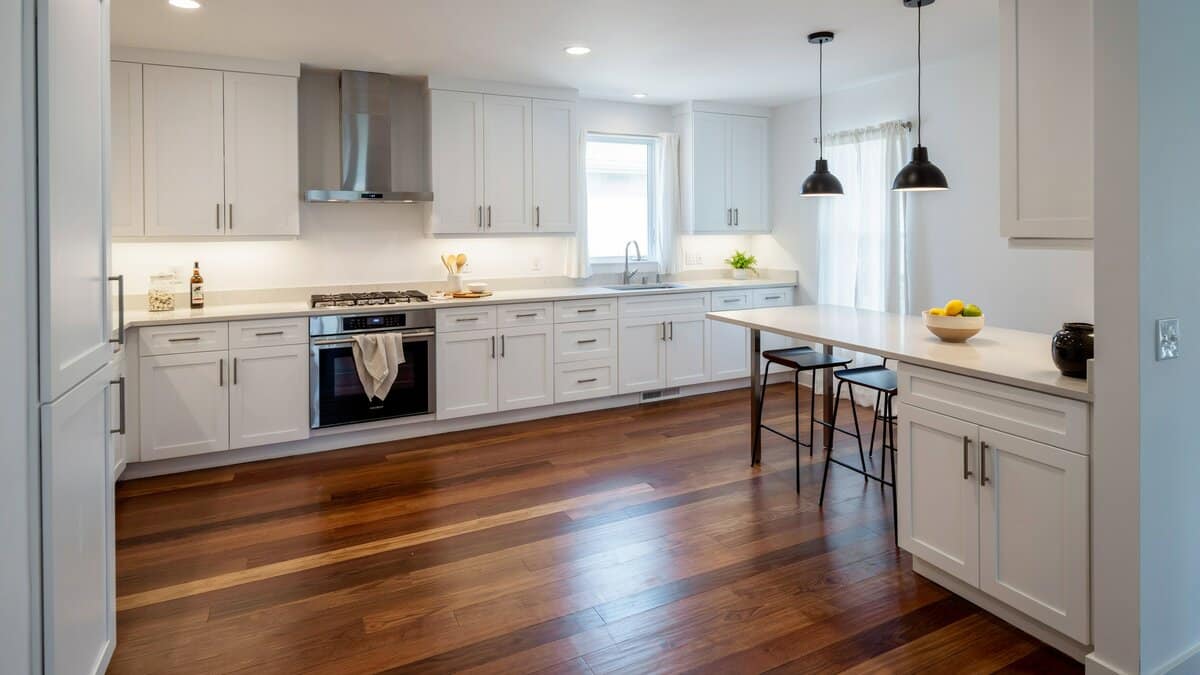
Bamboo stained to a walnut tone gives you the dark floor look for less money. The grain runs tighter and more linear than real hardwood, which some people love and some people never warm up to.
Width – Those that are over three inches are the wide planks and they offer a rustic style to country ambiance to the kitchens. Those that are less than three inches are the strips, which offer a sleeker style ideal for contemporary spaces. Parquet floors are used for formal kitchens.
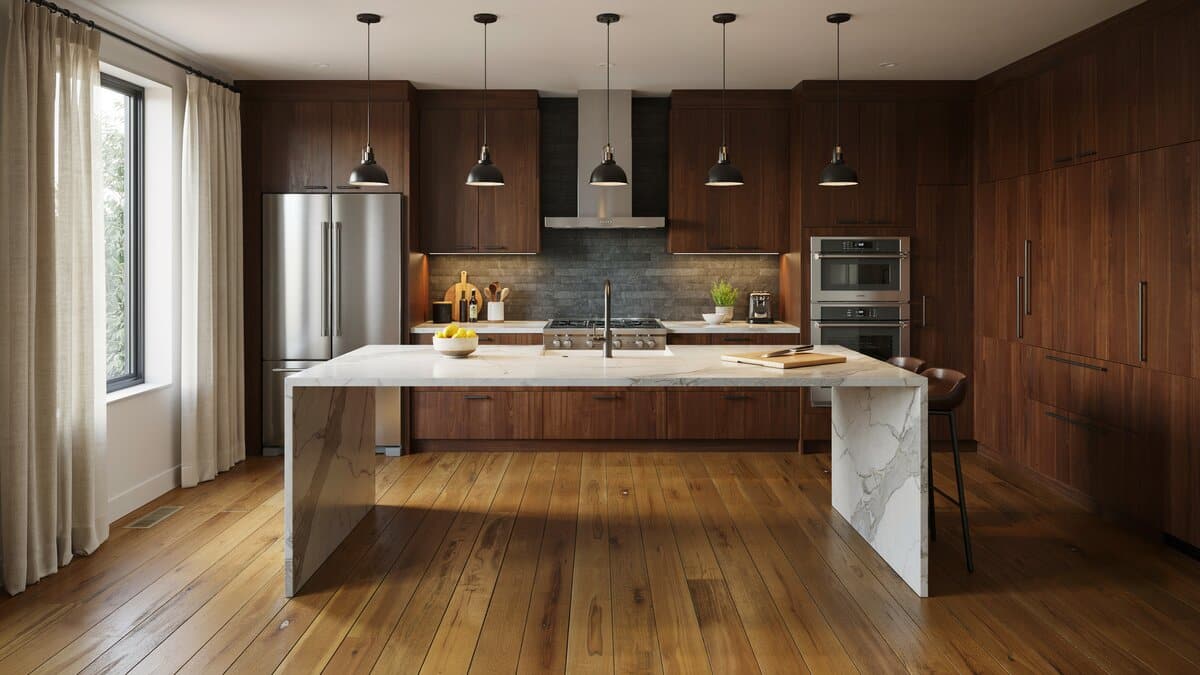
Brazilian teak, also sold as cumaru, is dense enough to shrug off a dropped pan. The golden brown warms up dark cabinets without making the room feel closed in.
Texture – Its appearance provides a historical and heritage look as the hardwood is being hand-scraped, wire-brushed, and chattered.
Color – It has a lot of variety like caramel, blond, brown, burgundy, and black depending on your preference. Read more about matching wood floors with paint on this page.
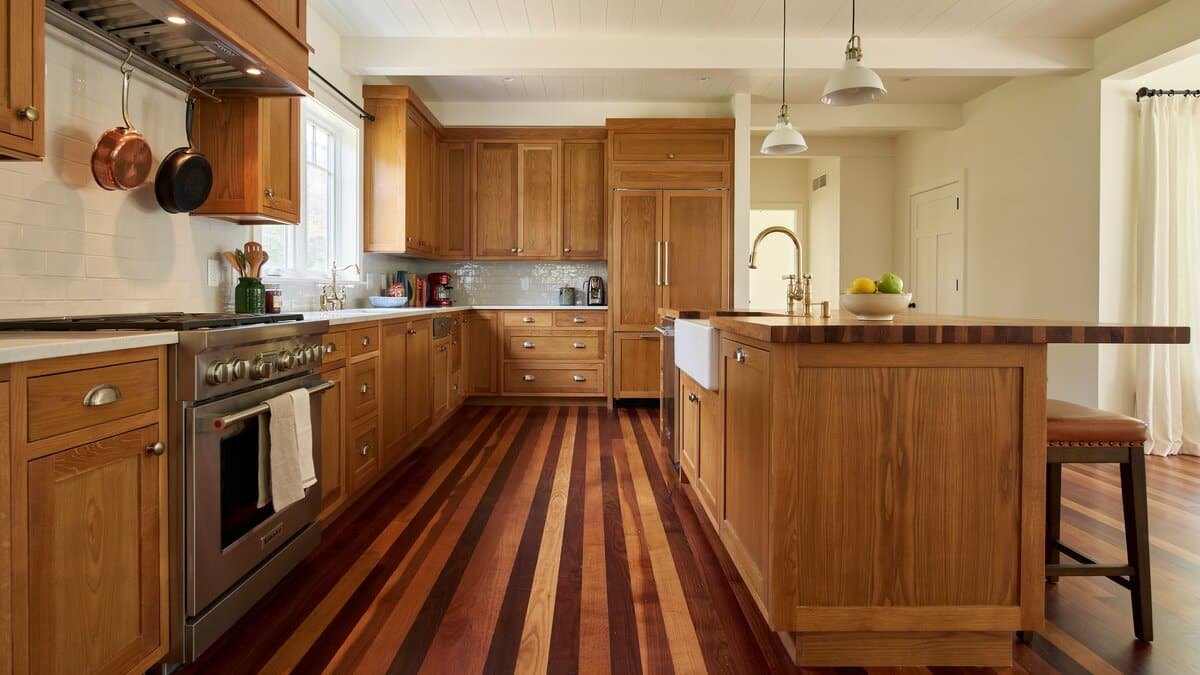
Tigerwood earns its name, and those bold dark stripes are impossible to ignore. It is a strong choice, so let the floor be the star and keep everything else quiet.
How to Choose the Right Hardwood for Your Kitchen
- Dark woods tend to show wear and tear, pet hair, and dirt more readily than lighter color floors. Choose a light color if you don’t want to freak out 5 minutes after the maid leaves.
- Glossy finishes can act like a magnifying glass for dust particles. Many recommend choosing a satin or matte finish to stop imperfections and dust from being so noticeable.
- Hardwood floors will deepen and darken in color over time. When selecting a hardwood style remember it will get darker as you apply oil and through normal wear.
- Get a sample board and leave it on the kitchen floor for a week. Look at it at night under your actual lights. Showroom lighting flatters everything, and half the color regret I see comes from skipping this step.
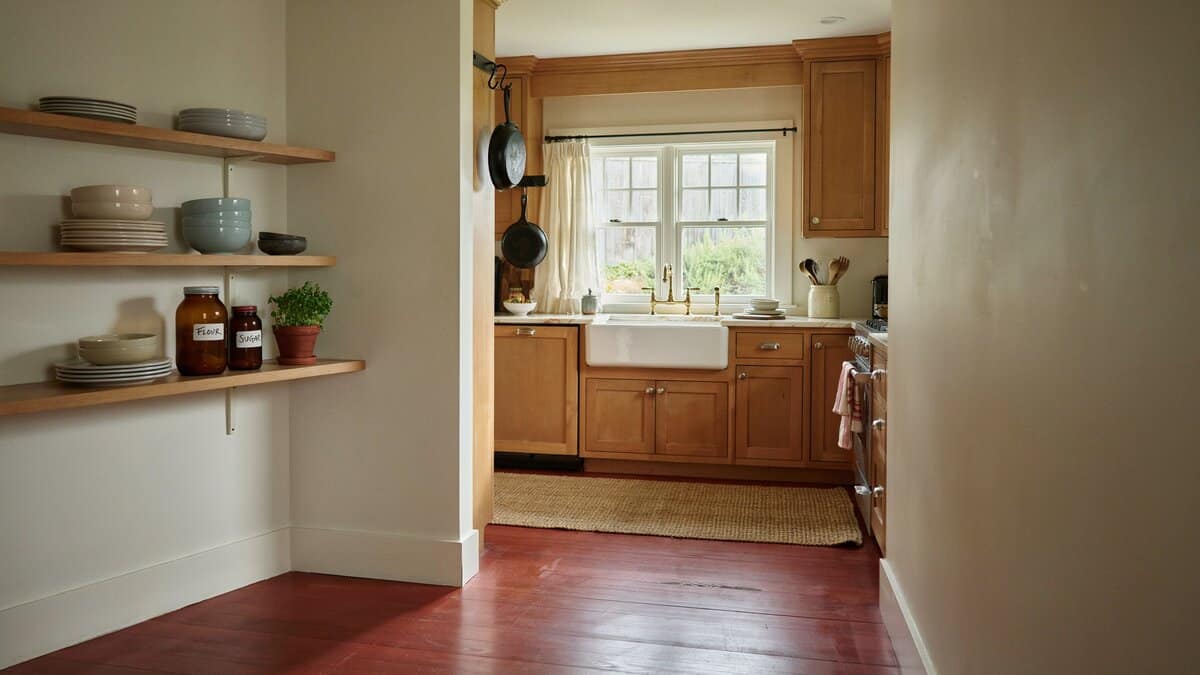
Red oak is the workhorse of American kitchens for good reason. It is affordable, it takes stain well, and that pinkish undertone plays nicely with honey-colored cabinets.
Ways to Keep Your Hardwood Surfaces Looking Great
- Using a polyurethane finish will help protect the surface of your wood and make it easier to maintain
- Choose site-finished floors over pre-finished as they seal the wood in place after installation.
- When using natural exotic wood floors make sure to finish it with oil regularly to maintain its ability to breathe.
- Felt pads under every stool and chair leg, replaced once a year. They flatten out and grind grit into the finish, and that’s what causes most of the scratching people blame on the wood.
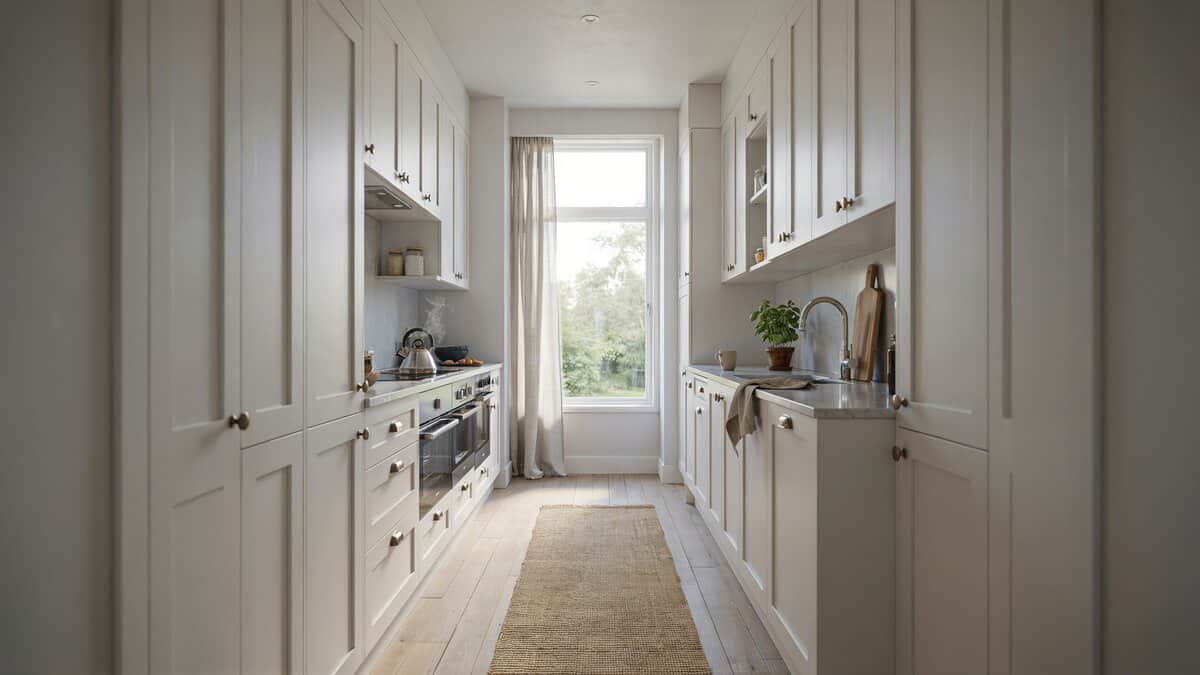
In a galley this narrow, a pale birch floor is doing real work. It bounces light down the length of the room and keeps the walls from feeling like they are closing in.
Hardwood Kitchen Floor Questions
Is hardwood a bad idea in a kitchen?
No, and it’s one of the most common floors in American kitchens. The caveat is that it needs a finish in good shape and a leak you’d catch early. If either of those is a stretch, look at tile or vinyl.
What’s the best wood floor for a kitchen?
Engineered white oak or hickory. Both are hard enough to take the traffic, the engineered construction handles humidity swings, and neither looks trendy enough to date badly.
Should the hardwood run under the cabinets?
Usually not. Installing up to the cabinet base saves material and makes it easier to reconfigure the layout later. Running it underneath is only worth it if you might move the island someday.
How long will it last in a kitchen?
Solid hardwood will go 30 years or more if you refinish it every decade or so. Engineered depends entirely on the wear layer. A 4mm to 6mm veneer can be sanded a couple of times, and a 2mm one is a one-and-done floor.
Do I need rugs on it?
One in front of the sink, absolutely. That’s where the water lands and where you stand longest. Use a rug with a breathable backing, because solid rubber traps moisture against the finish.
Will a dark floor make my kitchen look smaller?
A bit, yes, and it will show every crumb and every dog hair. If your kitchen is small or north-facing, go lighter and thank yourself later.
If you’re on the fence, here’s the decision in one line. Hardwood makes sense when you want the kitchen to feel like part of the house instead of a separate utility room, and when you’ll actually keep up with a damp mop and the odd refinish. If that sounds like you, go engineered white oak in a satin finish and stop researching. For everything else in the running, see our guide to the types of kitchen flooring.
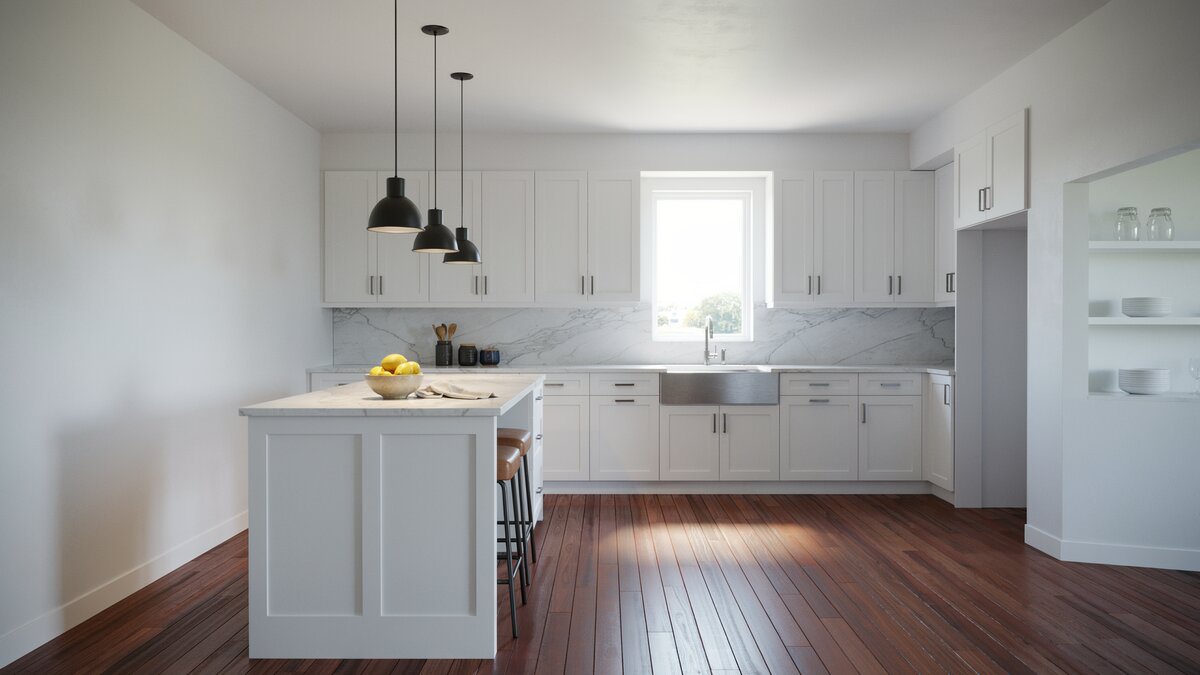
Brazilian cherry against an all-white kitchen is a pairing that never really dates. The floor brings all the warmth, so the cabinets get to stay simple.
To showcase highly specific designs, some images on this website use advanced AI-generation software to illustrate ideas and room inspiration. See our editorial policy to learn more.