9 Best Shed Design Software with Comparison Chart to Help You Choose

A shed can be a useful addition to your home for storing garden tools and keeping things organized and out of sight. You can buy one premade, but it can be helpful and unique to make your own design with your exact dimensions in mind. However, not everyone is a professional designer, which can confuse and overwhelm the design process. The good news is that there are plenty of applications and software made to help the average homeowner design features such as sheds and garages. These apps guide you through the process of shed design with various levels of detail. Below, we will take a closer look at some of your design software options.
A shed is one of many types of outdoor structures worth planning properly before you buy materials. For the wider view across every room and project, start with our guide to home design software.
Shed Design Software Compared
Nine tools, and they are not really competing with each other. Some are full 3D modelers you will spend a weekend learning. Others are manufacturer configurators that hand you a price in ten minutes. Here is the short version before you read the reviews.
| Software | Price | Works on | 2D or 3D | Cost estimate | Best for |
|---|---|---|---|---|---|
| SketchUp | Free web tier. Go $10.75/mo, Pro $33.25/mo, Studio $68.25/mo, billed annually | Web and iPad, desktop from Pro up | 3D, plus 2D via LayOut on Pro | No | Detailed custom builds you will frame yourself |
| Home Designer | Annual subscription | Windows and Mac | 3D with 2D plan views | Yes | DIYers who want a materials list out the other end |
| Tuff Shed Design Tool | Free | Any browser, desktop or tablet | 3D | Yes, live price tracker | Buying a prefab shed with real US pricing |
| Sweet Home 3D | Free, open source | Windows, macOS, Linux, browser | 2D plan with live 3D view | No | Offline DIY planning with no subscription |
| CAD Pro Platinum | Under $70, one time | Windows desktop | 2D drafting | No | Dimensioned drawings for the permit office |
| StudioShed | Free to use | Browser | 3D | Yes, quoted by zip code | Premium prefab studios, not budget garden sheds |
| Shed Boss and Fair Dinkum | Free | Browser, iOS, Android | 3D | Yes, in Australian dollars | Playing with proportions and roof styles |
| Udesignit 3D Garage Shed | Was free | Was iOS and Android | 3D | Yes | Offline as of 2024, listed here for reference |
SketchUp
The first software we will look at is SketchUp. This program allows you to create 3D models for a variety of applications, including interior design, architecture, and even video game design. The goal of this software is to allow you to create anything you can think of, down to meticulous details. This level of detail does come with a downside. Since there are so many features and tools, trying to get to know the software can seem daunting. While it can be complex if you want to create something extremely detailed, the basics are easy to grasp.
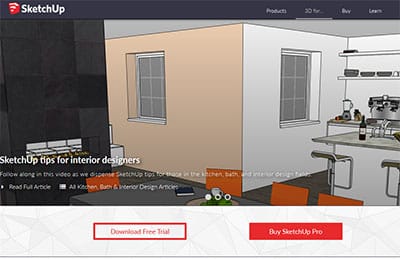
To start, you’ll be prompted with a simple rectangle, which you can drag to create the right dimensions. The complexity comes in when you are trying to add in the details that a professional would, including features such as studs and plywood. For the most part, the app guides you through the important tasks in a step-by-step manner.
What it costs in 2026: SketchUp runs on subscriptions now. Go is $10.75 per user per month billed annually, Pro is $33.25, and Studio is $68.25. There is still a free tier, but it is narrower than most people expect. You get SketchUp for Web and iPad only, with no desktop app, no layout for 2D drawings, no Extension Warehouse, and no commercial use rights. If you want the desktop modeler and proper construction documents for your shed, Pro is where that starts. Trimble also offers a 7 day free trial of the full toolset, and annual plans can be refunded within 14 days, so you can find out whether you will actually use it before the money is gone. Full details are on the SketchUp plans and pricing page.
Pros
● 2D and 3D models
● Enormous 3D Warehouse library of 3D models
● Allows you to control details such as lighting effects and textures
● Autosave and manually save to keep updated copies of your plan
● Works on Windows and MAC OS
● Tablet version available for both iPhones and Android
● Available in 10 languages
● Free web and iPad tier, non-commercial use only
● Video tutorials
Cons
● Free tier has no desktop app, no layout and no extensions
● Problems with freezing and crashing with heavy files
● Plans can only be shared
Visit Sketchup website
Home Designer (formerly Home Designer Suite)
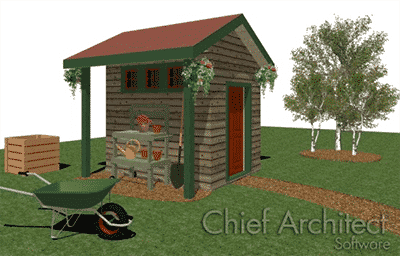
Chief Architect offers a variety of software to their customers, one of which is Home Designer Suite. This software is a 3D option with 2D features as well, giving you more control over the fine details of your shed planning. It is made for DIY designers who don’t necessarily have the skills and training of a professional.
Heads up if you have read about this one before. Chief Architect retired the separate Home Designer Suite, Architectural and Pro titles after the 2025 version, and now sells a single product called Home Designer. It also moved from a one time purchase to an annual subscription starting with the 2026 release, which changes the math if you were planning to buy once and use it for five years.
That being said, there is a learning curve when it comes to Home Designer Suite. It comes with a lot of tools and controls that can take a while to get the hang of.
You will also need to be patient with the software because it isn’t designed to come up with a quick idea for your shed. Each time you start to create a new design plan, you’ll have to answer a series of prompts from the House Builder Wizard. This will include questions about size, style, exterior siding, framing defaults, and the like. The good news is that this patience rewards you with a very detailed and useful design.
Pros
● Professional-quality designs
● Thousands of library items
● Built-in templates
● Cost estimates
● Virtual 3D tour
● 30-day refund warranty
● Can be used with Mac or PC
● You can save your designs to the Cloud
Cons
● Subscription only as of the 2026 release, no perpetual license
● Significant learning curve
● Can only be used on one computer at once
Learn more on their website
Shed Boss App
Worth knowing up front: Shed Boss is an Australian manufacturer, so the catalogue and the pricing are AU based.
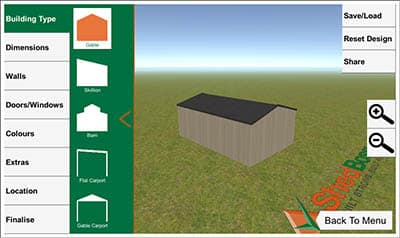
Shed Boss is another software that is made for DIY projects and design clients trying to plan out what they want. Unlike choices like Home Designer Suite, however, the Shed Boss App is rather straightforward. With less of a learning curve, you can start making plans for your shed faster.
This app guides you step-by-step through the design process. To start, you’ll select the option of creating a shed, and the process moves forward from there. The app will ask you questions about features such as dimensions and building types. You won’t be able to skip these as they are imperative to creating a realistic model.
The tools on this app are rather basic, and they can all be found on the left side of your screen. You can also zoom in and out on your plan by either pinching a touchscreen or using the scroll wheel on a mouse.
This app, unfortunately, trades its ease for a rather basic selection of design features.
Pros
● Easy to use
● Free to use
● Available online, Google Play, and the Apple Store
● 3D design features
● Augmented Reality (AR) allows you to see your structure in its actual location
● Photo Mode allows you to capture an image of your shed in AR
● You can share your plans directly on Facebook or Twitter
● The software offers tips on shed location
Cons
● Limited features
● Can’t customize
● When putting in dimensions, only whole numbers are recognized, which doesn’t allow for perfect precision
Try out the Shedboss app on this website
Fair Dinkum Sheds Designer
Same caveat as Shed Boss. This is an Australian company, and the quotes come back in Australian dollars.
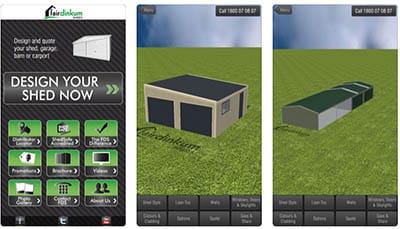
The Fair Dinkum Sheds Designer app is created, unsurprisingly, by Fair Dinkum Sheds. This software is meant for the designing of not only sheds but barns, garages, and carports as well.
Much like Shed Boss App, you can locate the features you need on the left side of the screen. The first thing you should do when using it is setting the dimensions which have a good amount of customization to allow you to be precise.
There are a lot of features with this app, but they aren’t hard to get a handle on. You can change details such as colors and cladding. You can’t zoom in and out of the plans made on this app but you can change the angle you are looking at your plans from by clicking and dragging the cursor.
The app also offers cost estimates on jobs, but some users complained that they were much more expensive than what other software told them for similar plans.
Pros
● 3D design
● Plenty of features to use
● Allows you to share your creation through email, Facebook, and Twitter
● Easy to use
● Free to use
● Available on Google Play and the Apple Store
Cons
● Can’t zoom
● Users struggled with the cost estimate feature
See the download options on their website
Udesignit 3D Garage Shed
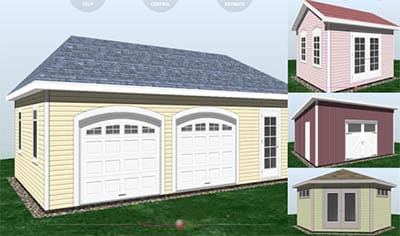
Udesignit 3D Garage Shed is a rather basic design app to help you plan your dream garage or shed. It is made to be simple to use, even for those who haven’t worked with any sort of software before.
If you get lost while you are using the Udesignit 3D Garage Shed software, the “Help” menu is a valuable resource. It is full of tips that can help guide you to the shed of your dreams. Some users did find that some functions such as undoing actions were hard to control.
To get started on this application, you only need to choose the system unit you want and set up the dimensions. From here, you can use the feature icons that are located on the edges of the screen to customize your structure the way you want.
Pros
● Easy to use
● Plenty of features such as windows, paint color, roofing, and doors
● Material cost estimation feature
● Tips from the Help menu guide you through the creation process
Cons
● Undoing actions can be difficult
● Installation for Android and iPhone only
See on the App Store (offline as of 2024)
Sweet Home 3D
Since Udesignit went offline, this is the free tool that fills the same slot and still works. Sweet Home 3D is open source under the GPL, free for personal and commercial use, and it runs on Windows, macOS and Linux. There is a browser version too if you would rather not install anything.
The split screen is the reason to use it. You draw the shed footprint in 2D and the 3D view builds itself alongside, updating as you go. That makes it easy to catch the things that ruin a first draft: a door that will not clear the workbench, headroom that disappears under a low roof pitch, a window placed exactly where the shelving needs to go.
It is a general home design program rather than a shed specialist, which cuts both ways. There is no materials list and no price estimate. But it runs fully offline, adds no watermark to your renders, and costs nothing, which is more than the free tier of most paid tools can say. If you are planning something bigger, the same approach works with garage design software.
Pros
● Free and open source, no watermark and no upsell
● Runs on Windows, macOS and Linux, plus a browser version
● 2D plan and 3D view update together
● Works entirely offline
● Free for commercial use as well as personal
Cons
● No materials list or cost estimate
● Interface looks dated next to SketchUp
● Built for interiors, so shed specific features are thin
Download it from the Sweet Home 3D website
StudioShed
Studioshed is specialized in creating and designing sheds. The software is free to use on their website and guides you step-by-step through the design process. The first thing that you’ll be asked is your zip code. This will help Studioshed give you an accurate estimate to build the shed you create. Then, you’ll choose the dimensions of your shed, but there are rather limited choices. From there, you will choose the interior and exterior layout, sidings, colors, services, and foundation of the shed. Once you’re finished, Studioshed will give your final estimate for your shed. It’s possible to view the shed from different angles by choosing below the model and zooming by scrolling.
Pros
● Easy to use
● Free to use
● Immediate cost estimate
● Installation choices
Cons
● Limited features
● Not a very detailed model
Learn more about Studio Shed on their website
One thing to set expectations on. These are premium prefab studio buildings with finished interiors and floor to ceiling glass, not budget garden sheds. The configurator is a pleasure to use and the estimate is real, but it will land well above what a stock shed kit costs.
Tuff Shed Design Tool
This is the one most US homeowners should try first. It runs in any browser with nothing to install, and it does the thing every other free tool on this list refuses to do. It tells you what your shed costs while you are still designing it.
You start by picking a building style and model, set the size, then choose paint and shingle colors. From there you add the extras: windows, vents, a ramp, shelving, a loft. A price tracker updates with every single choice, so you find out immediately that the loft you wanted adds more than the two windows did. That feedback loop is the whole point. Most people design a shed they cannot afford, then work backwards. This lets you work forwards.
When you are happy with it you can save a no obligation quote or buy the building outright. Use a desktop or a tablet if you can. The 3D view gets cramped on a phone and you will spend more time pinching than designing.
Pros
● Free, browser based, nothing to install
● Live price tracker updates with every option you add
● Real 3D model you can spin
● Save a quote or buy directly
● US pricing and US product range
Cons
● Only builds Tuff Shed models, so it is not a general design tool
● No materials list for a DIY build
● Cramped on a phone screen
Try it on the Tuff Shed design page
CADPro
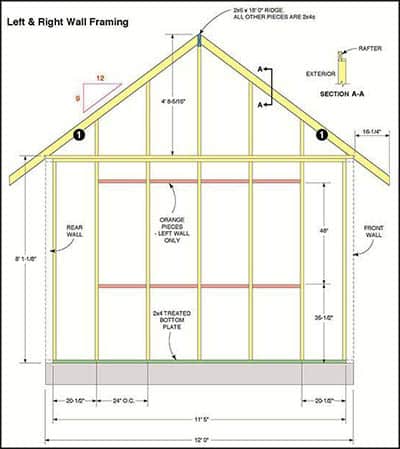
CADPro is made to help users plan home design and improvements, create landscaping plans, and generate mechanical drafting and drawings.
A big benefit of this software is the variety of features available for use. You can start with precise dimensions with the help of their “Smart Dimensioning” and automatic tape measure features. You can also plug in photos, create clipboard files, use paint tools, integrate Microsoft Office, and save your plans as PDF files. If you draw your own plans, you can even scan them in to work on them digitally.
Here is the number the rest of this list is missing. CAD Pro Platinum is a one time purchase under $70, which makes it the only tool here you buy rather than rent. Against SketchUp Pro at $399 a year, that is a different category of decision. It is a 2D drafting program at heart, so there is no 3D walkthrough and no photorealistic render. If what you actually need is a clean dimensioned drawing to hand to a building department, that is not a limitation. That is the whole job.
Pros
● Variety of features
● Import files
● Allows for precise dimensions
● Save plans as PDFs
● Allow others to see your plans even if they haven’t purchased the software
● One time purchase under $70, no subscription
Cons
● Comes at a cost
● No free trial
● Learning curve for more advanced tools
Learn more about Cadpro on this website
How to Design a Shed From Scratch
The software is the easy part. Getting to a shed you can actually build takes five steps, and most people do them in the wrong order.
Do You Need a Permit for Your Shed?
Check the size before you fall in love with a design. Under section R105.2 of the 2021 International Residential Code, the model code most US jurisdictions build their local rules from, a building permit is not required for a one story detached accessory structure as long as the floor area stays at or under 200 square feet. That is why so many standard shed sizes stop at 10×20 or 12×16. It is not a coincidence.
Two catches worth knowing. Being exempt from the permit does not exempt you from the code itself, so the structure still has to be built right. And zoning rules like setbacks from your property line apply at any size, permit or no permit. Your local building department has the final say, and plenty of cities set the bar lower than 200 square feet.
This is exactly where design software earns its keep. Set your dimension ceiling before you start drawing, and you will never have to redesign a shed you already love around a number you found out about too late.
What Your Shed Will Actually Cost
Every configurator on this list will hand you a number. None of them tell you whether that number is reasonable. Here is the benchmark.
Building a shed runs about $3,500 on average, with most projects landing somewhere between $800 and $15,000. Prefab kits work out to $10 to $40 per square foot. A custom build runs $30 to $150. That gap is the single biggest decision you will make, and it happens before you open any software.
| Shed Size | Prefab | Custom Built |
|---|---|---|
| 8×10 (80 sq ft) | $800 to $3,200 | $2,400 to $12,800 |
| 10×10 (100 sq ft) | $1,000 to $4,000 | $3,000 to $16,000 |
| 12×16 (192 sq ft) | $1,900 to $7,700 | $5,800 to $30,700 |
| 12×20 (240 sq ft) | $2,400 to $9,600 | $7,200 to $38,400 |
Then budget separately for the things configurators quietly leave out. A concrete slab foundation runs $600 to $4,800. Insulation is $0.35 to $3 per square foot. A building permit, if you need one, starts around $250 and can climb past $2,000 depending on where you live. Cost figures from Angi.
Shed CAD Software
At this point, we’ve talked a lot about products that offer CAD features in their shed designing software. So, what exactly is CAD software? CAD, which is sometimes lengthened to CADD, is computer-aided design and drafting technology. This is used to automate the manual process of drawing out plans. CAD software can be used to create 2D or 3D designs, depending on the exact software being used.
In shed design, this means that you can generate a model or blueprint of what you want your shed to look like. The more CAD features offered, the more detailed your shed plan can be. 3D CAD software is often much more detailed than its 2D counterpart.
CAD is popular because it vastly simplifies the process of design. It doesn’t require the same level of precision in the measurement of manual drafting. It also helps designers who aren’t as skilled at drawing as they need to be to put their ideas on paper properly.
Free Online Shed Design Software
When you are designing a shed for your house, odds are that you don’t need to buy a subscription to software. After all, you’re only going to use it for this one job. In these cases, it’s a good idea to watch for free software. You can find several options for shed planning software that doesn’t require you to make a purchase or even download an app. These are usually some of the easiest software to use because they guide you through the process. The strongest free picks are the Tuff Shed configurator if you want a real US price, and Sweet Home 3D if you want to model the thing properly offline. StudioShed and Shed Boss are worth a look too. For free tools that go well beyond sheds, see our roundup of free design software.
The tradeoff for this ease is simplicity. The tools and features that you use in this software are rather basic and don’t typically allow for much detail. For example, we noted earlier that Studioshed only allows you to choose from a short list of pre-set features.
Best For 3D Shed Designing
One feature you’ll want to look for in a free planning application is 3D modeling. While 2D modeling helps look at dimensions and shape it’s hard to picture the finished product. When you are creating a 3D model, it’s easy to see what you’re creating. In addition, it also allows you to look at extra features such as flooring, siding, and color choices. Two free programs that offer a 3D view are the Shed Boss and Fair Dinkum Sheds Designer. If you are looking for the best quality designer that you don’t mind paying for, Sketchup has robust functionality and a 3D view.
Tuff Shed and Sweet Home 3D both offer a 3D view for free as well, and between them they cover the two things people usually want: a real price, or real control over the model.
Best with Online Materials List
Shed designing applications should also have a materials list to choose from. It’s important to note that more expansive material lists are better for your planning. The biggest benefit of this is that you can create a more detailed model of your design.
It’s very important economically that different materials have varying costs. If you can create a model that includes factors such as the type of flooring and siding you want, you’ll get a better and more accurate cost estimate than if you only have dimensions, doors, and windows to reference.
Home Designer generates a materials list, and the manufacturer configurators like Tuff Shed produce a full itemized quote for their own buildings. General 3D modelers such as Sweet Home 3D do not, so you will be counting studs yourself. There are also free material lists you can download.
The Short Answer
If you have read this far and still cannot decide, pick by situation instead of by product. Buying prefab and want a real price? Tuff Shed. Building it yourself and need dimensioned drawings? SketchUp Pro. Want detail without paying monthly? Sweet Home 3D. Need a printable plan for the permit office? CAD Pro Platinum. Just sketching on the couch? SketchUp for Web, free.
Shed Design Software FAQs
What is the best free shed design software?
It depends what you want out of it. Tuff Shed’s configurator if you want a real US price attached to your design. Sweet Home 3D if you want to model it properly offline. SketchUp’s web tier if you want the most capable modeler and do not mind that it is browser only. None of the three cost anything.
Can I use SketchUp for free?
Yes, but narrower than most people expect. The free tier is web and iPad only, with no desktop app, no LayOut for 2D drawings, no Extension Warehouse, and no commercial use rights. For a personal backyard shed that is usually fine. For anything you are being paid for, it is not.
Do I need a permit to build a shed?
Usually not, if it stays at or under 200 square feet. That is the threshold in IRC section R105.2 for a one story detached accessory structure, and most US jurisdictions follow it. Setbacks and local zoning rules still apply at any size, and some cities set a lower limit, so check with your building department before you build.
How much does it cost to build a shed?
About $3,500 on average. Prefab kits run $10 to $40 per square foot, custom builds $30 to $150. A 10×10 lands somewhere between $1,000 and $16,000 depending entirely on which of those two roads you go down.
Can shed design software give me a materials list?
Some can. Home Designer generates one, and the manufacturer configurators produce a full itemized quote for their own buildings. General 3D modelers like Sweet Home 3D do not, so you will be counting studs yourself.
Do I need CAD experience to design a shed?
No. The manufacturer configurators need none at all, and you can have a finished design in ten minutes. SketchUp and Home Designer are a different story. Both have real learning curves, and you should budget an afternoon before you are productive in either.
Once the shed is up, the next problem is filling it sensibly. Our shed organization ideas cover how to keep it from becoming a place where tools go to disappear.
Visit our gardens and landscaping gallery for more ideas for the backyard.
To showcase highly specific designs, some images on this website use advanced AI-generation software to illustrate ideas and room inspiration. See our editorial policy to learn more.