Types Of Garage Lighting (Ultimate Design Guide)

Garages are full of possibilities. Indeed, they are primarily for keeping vehicles secure and could be utilized for storage, but they also make wonderful home gyms, stores, workshops, play areas, greenhouses, and so on. Unfortunately, insufficient illumination might prohibit you from getting the most out of the space. It might be difficult to pick the correct types of garage lighting.
This is due to two factors: first, the lighting selections are simply too numerous, and second, the size of the garage can present significant issues. But here is the good news: there are different types of lighting that you can use. What are they? How can you choose the best option for your garage? Let us discuss this matter in this article.

Upload a photo and get instant before-and-after room designs.
No design experience needed — join 2.39 million+ happy users.
👉 Try the AI design tool now
Interior Garage Light Fixtures

Most types of garages are often dreary and dim, particularly if they are indoors. Nevertheless, there are several methods to brighten up the interior of your garage with the aid of some of the most spectacular lighting solutions on the market.
Flush Mount Lighting
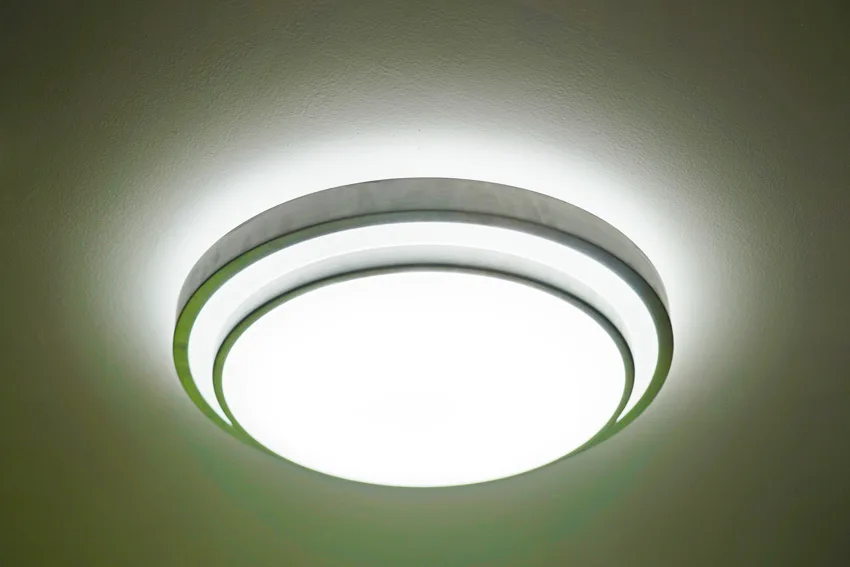
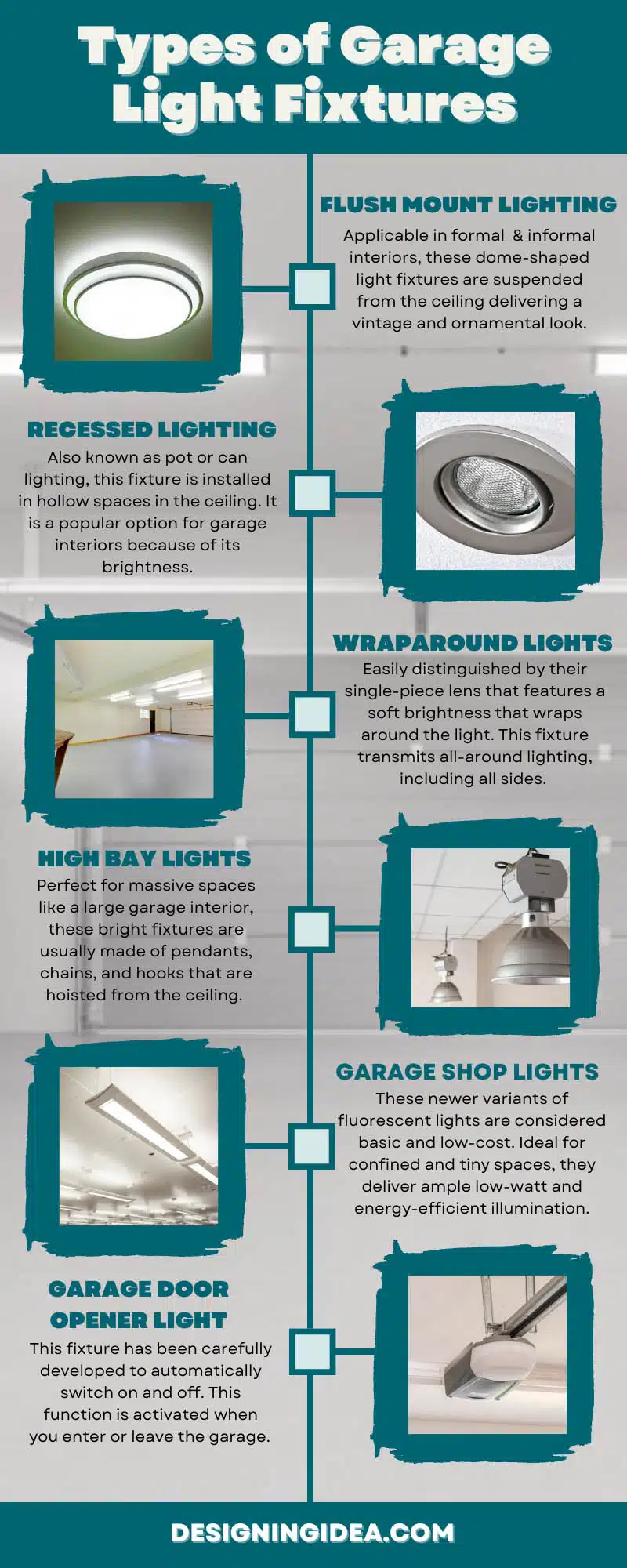
Numerous homeowners like to put flush mount lights in their garages and residences. These types are essentially dome-shaped light fixtures that are suspended from the ceiling. While these are more ornamental and have a distinct vintage style, they are quite flexible. Because of their adaptability, they may be employed in both informal and formal interiors, as well as outdoor locations. They function effectively in a variety of environments and give adequate ambient light to carry out usual duties.
Flush mount lighting comes in a multitude of kinds, patterns, and sizes. Semi-Flush Mounts are one of the most prominent and widely used types. They feature three light sources that emanate from the base of the lamp, as the name implies. The majority of these models include customizable light heads. This feature enables you to focus the bulb on the main subjects of the space by changing its orientation.
Recessed Lighting

This sort of illumination is also known as pot or can lighting, and it is intended to be installed in hollow spaces in the ceiling. Recessed cans are popular in garage interiors because they work effectively and give bright illumination. They focus in a descending form or manner once fitted in the empty spaces in the ceiling, making them ideal for a garage or factory.
The fixtures that these lights employ are made up of three major components. The trim type is defined as the portion that is seen by the eyes. It is essentially the part or parts seen when looking up at the fixture. The fixture itself is the second portion, which is referred to as the housing. It is made up of a lamp holder and is fitted in the ceiling’s hollow apertures.
The last component is, of course, the bulb, which comes in many kinds. Each kind produces a varied quantity of heat and illumination, which is an important factor to examine when selecting the kind of bulb for your recessed fixture.
Wraparound Lights
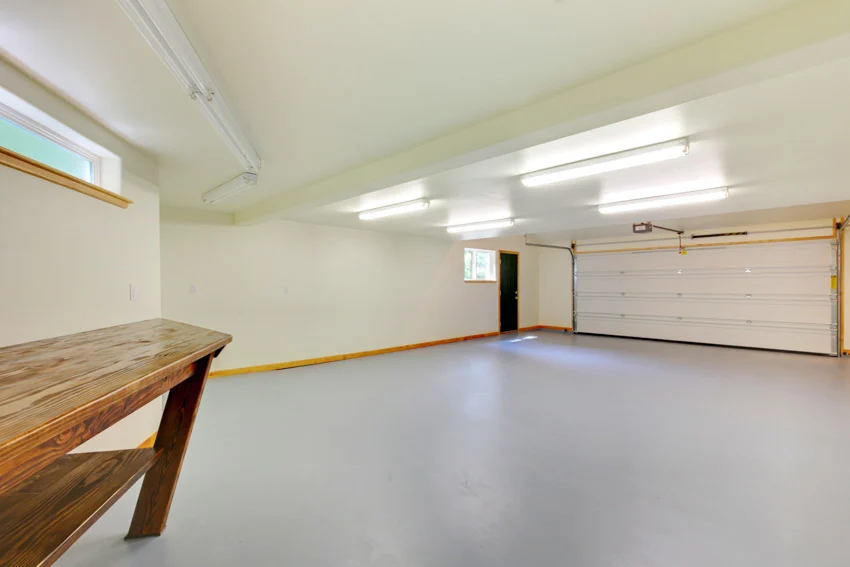
This option is among the types that are distinguished by their single-piece lens. In effect, it wraps around the light, softening the brightness in the process. Wraparound fixtures transmit light from the sides and down, providing all-around or ambient illumination, as opposed to troffers or panels, which are set into the ceiling and could only produce light downward.
Wraparound lighting is obtainable in LED and fluorescent varieties. LED wraparound fixtures reduce the requirement for fluorescent or LED tubing. Such surface mount LED shop lights outperform and surpass fluorescent types, saving money on energy expenditures. Whenever the LED bulbs fail, just change the fixture. Some fixtures are compatible with 0-10V dimmer controllers.
High Bay Lights

High bay lights are perfect for illuminating massive spaces, sections, or rooms, so if you have a spacious garage interior, this could be one of the best alternatives. These give exceptionally bright illumination, making them excellent for garages, which are often quite dreary and drab. Pendants, hooks, and chains are used to hoist high bay fixtures from the ceiling.
Moreover, they can be firmly connected to the ceiling, and as the name implies, are intended for use in areas with high ceilings. This is partly because sites with high ceilings must fill and brighten more space; these provide powerful radiance that rapidly brightens up large spaces. High bay lights are ideal for both industrial and commercial applications.
One significant benefit of employing this illumination system is that it delivers consistent and clean illumination with very minimal glare. These fixtures are often installed using a variety of connectors. Fluorescent lights, LEDs, metal halide lamps, and induction lamps are examples of these fixtures. LED lighting, for instance, offers enhanced energy efficiency as well as an incredibly long bulb lifespan.
Garage Shop Lights

These are thought to be essential for garages, factories, and a variety of other business facilities. Shop lights are a newer variant of fluorescent styles that are ideal for illuminating tiny and confined locations. Shop lights are ideal for garages since they necessitate basic, low-cost illumination fixtures that give ample illumination. Low-watt and energy-efficient options are an excellent approach to improve the brightness in garages, as they are naturally dull and lacking in lighting sources.
Many types now use LED technology (light-emitting diode), allowing them to surpass fluorescent bulbs. These are also more efficient and have a longer lifespan. One of the most essential benefits is their low cost.
Garage Door Opener Light

Garage door openers have light bulbs that have been carefully developed and tested to prevent or minimize remote interference with the vast majority of garage door openers. Some models use a bulb built exclusively for use in a garage door opener device. Most models accept a regular screw-in base light bulb.
This type is intended to switch on automatically, eliminating the need to enter a darkened garage. Whenever you enter or depart the open garage door, you break the transmission between the photo-eye sensors, which activates this function.
Garage Light Bulbs
Here are the different types of garage light bulbs available:
LED Lights

Garage LED light bulbs are made up of light-emitting diodes, which generate electrical illumination in the fixtures. Compared to fluorescent and incandescent bulbs, such bulbs have far greater longevity and perform much better. LED bulbs are often regarded as among the most energy-efficient lighting alternatives available. They are frequently employed as energy savers since the heat generated by such bulbs is captured by an absorber plate. This keeps the bulbs cool to the touch while also saving a significant amount of electricity.
Furthermore, these light bulbs show maximum brightness without any interruption induced by a warm-up period. Even after repeatedly turning on and off, their lifespan remains unaffected. The only disadvantage of LEDs is that they are merely directional. This implies that they only throw or produce light in one direction. Hence, if you wish to use LEDs for your garage interior, you may need to install a huge number of them.
Fluorescent Bulbs

These are regarded as significant advances in small-scale lighting and a major commercial hit. They are very efficient when matched to other models, particularly incandescent bulbs. Fluorescent bulbs are tube-shaped and loaded with mercury-based vapor. When the mercury atoms are ionized, they emit light. These bulbs have a phosphorous coating on the glass tube, as well as a combination of conductors, mercury. and inert gas.
Fluorescents offer the best energy buy around when it comes to lighting your home. You can receive five to six times as much light from a fluorescent bulb as from an incandescent bulb of the same wattage. – Popular Mechanics Complete Home How-to, Albert Jackson, David Day
Fluorescent bulbs have a considerable lifespan and emit at a wavelength that is extremely beneficial to individuals. Such bulbs, meanwhile, necessitate ballasts to work, which are characterized as components that assist in regulating power for circuit safety.
The heat inside the bulb has a significant impact on the functionality and quality of these bulbs. Whenever temperatures fall below a certain level, the mercury within the bulb turns into distributed liquid droplets. Whenever temperatures inside the bulb are higher, however, the production of UV and visible light is drastically decreased due to self-absorption in the vapor.
Compact Fluorescent Bulbs (CFL)

These lights are within the category of fluorescent bulbs, but they offer unique characteristics and advantages that distinguish them from other varieties of bulbs. They’re also known as compact fluorescent tubes, energy-saving lights, and compact fluorescents. The primary reason for the development of compact fluorescent bulbs was to supplant regular incandescent bulbs. These bulbs employ a tube that has been folded or bent in such a manner that it could readily fit into the area occupied by an incandescent bulb.
CFLs are the convoluted spiral bulbs that are commonly used in table lamps, but they are also a wonderful selection for garages and factories. They are believed to be extremely energy-efficient and provide a particularly natural type of illumination. CFLs have a lifetime of roughly 10,000 hours and last nearly ten times longer than normal bulbs according to Green America. Furthermore, there are two types of CFLs – integrated and non-integrated. While compact fluorescent bulbs are more expensive than other types of bulbs, they can save money on power as well as on recurrent purchases due to their long lifespan.
Incandescent Light Bulbs

Incandescent bulbs are some of the most typical seen in places such as bedrooms, baths, and patios. They are also a favorite option for garage interior illumination. Incandescent bulbs generally have wattages ranging from 40 to 110. These bulbs produce electric illumination as a result of the filament’s heat. They adhere to the incandescence mechanism, which relates to light emission. They are available in a range of sizes, outputs, and wattages.
Aside from that, incandescent bulbs are indeed an ideal choice for interior garage illumination since they have a reasonable production cost, don’t require any regulating hardware, and are compatible with control settings such as dimmers and timers. The illumination provided by this bulb has a mellow, yellow-white tone that can persist for a year.
Halogen Bulbs

These are very similar to incandescent bulbs, given that they both include a core that is heated sufficiently to create light. What distinguishes them is that they use less energy owing to the halogen process. In terms of advantages, halogen bulbs are the most efficient and effective of all lighting sources. One of the primary advantages is stated to be the white light it emits, which considerably reduces eye strain and is ideal for completing tasks that require a sufficient level of illumination.
Moreover, they are significantly more energy-efficient than ordinary bulbs, saving almost 10 to 20% of the energy used, and they last longer and shine brighter for an extended duration. Halogen products may be slightly more expensive than standard bulbs, but the cost is still well worth the benefits they provide.
High-Intensity Discharge Lights (HID)
High-intensity discharge (HID) lights are an excellent option for large garages and workspaces, especially in commercial settings. These are highly regarded for their powerful and long-lasting performance, producing bright and white light that can effectively illuminate even the darkest corners of a workspace. One significant benefit of HIDs is their energy efficiency. Compared to other options, HIDs consume less power while still providing ample illumination, resulting in lower energy bills over time.
Additionally, because they have a longer lifespan than many other types of bulbs, HIDs require less frequent replacements, which can further reduce maintenance costs.Despite being slightly more expensive than some other alternatives, it has the potential to cause glare or eye strain if not properly installed or used. Another downside is that they can take a while to warm up to full brightness, which can be an issue for those who need immediate full brightness in the space.
High pressure sodium bulbs, and Metal Halide bulbs are frequently used for HID fixtures. A high-pressure sodium bulb provides a yellow to white hue, requires time to reach full output, and is often used for garages, warehouses, security, and lighting streets. While Metal Halide bulbs are less energy efficient and are slowly being phased out in many settings. A low-pressure sodium bulb is more energy efficient than a high-pressure bulb, according to Bulb America. The downside is their yellow to orange hue.
Outdoor Lights

Outdoor garage lighting is not just a beautiful addition to the exterior of your house, but it is a useful fixture to take into account as well. You can put wall-mounted lamps on the sides of the garage door and add them above the garage door to help illuminate the nearby driveway and surroundings. However, here are some of the outdoor garage lighting options:
• Landscape Lighting: This is a broad category of outdoor lighting that is utilized in both residential and commercial settings. This is normally used for security and community amusement in parks, office building terraces, and public pergolas.
• Motion Sensor Light: Motion sensors are integrated into the fixture and usually located on the outside of a garage. Sensors are made up of microscopic electrical components that recognize infrared energy emitted when things are moving. Whenever a motion system senses a significant quantity of heat radiated, which is found in humans, animals, and automobiles, it immediately switches on.
• Spotlight: This type provides direct and directed illumination on important sections. Spotlights can be used to illuminate garage exteriors, doors, and decorations. Spotlights vary from floodlights in that they focus beams in precise lines focused at a single center point rather than dispersing illumination across a large area.
Lighting Ideas for Garages

• Concentrate on the Overhead Fixture: The overhead fixture is the most significant aspect of your strategy when evaluating interior garage illumination options. This will be the primary light source in the majority of garages.
• Select a High Lumen Intensity: The lumen output mainly determines how bright the light is, so ensure you select high-lumen bulb for the space. Stick with a lumen power range of roughly 1000 to 3000 lumens, varying according to the size of your garage. If the space is broader, higher lumen output is required.
• Select a Light with Cooler Color Temperature: Color temperature refers to the light’s hue, which might be warm (yellow) or cool (white). Because visibility is vital in this location, you must choose a cooler color temperature over a warmer one. For ideal results, strive for a temperature range of 4000K to 5000K.
How To Choose The Best Lighting For Your Garage

The perfect garage lighting is vibrant, economical, inexpensive, and safe. From selecting the proper type to taking into account its brightness, efficiency, and the size of the garage, making a decision could be difficult. But don’t worry, this information will assist in answering all of your concerns.
Use Layered Lighting: Since the garage is often used for multiple purposes, it is indeed ideal to layer lighting so that you have enough illumination for parking, crafting, storage, and displaying. Remember to keep these factors in mind when choosing and arranging the different fixtures for your garage. You should keep in mind that for your garage to be well-lit, you must combine various sorts of lighting to serve different functions.
Artificial lighting is classified into three types: ambient, task, and accent, and your garage must feature all three.
Ambient lighting is a gentle overhead illumination that is intended to brighten the walls and floors so that you can move about it and park properly.
Task lighting is stronger and is designed for usage in working and storage areas to improve vision during detail-oriented activities and organizing duties.
Accent lighting focuses on creations you wish to highlight, such as a foosball table or an antique trophy gallery, and is brighter than ambient.
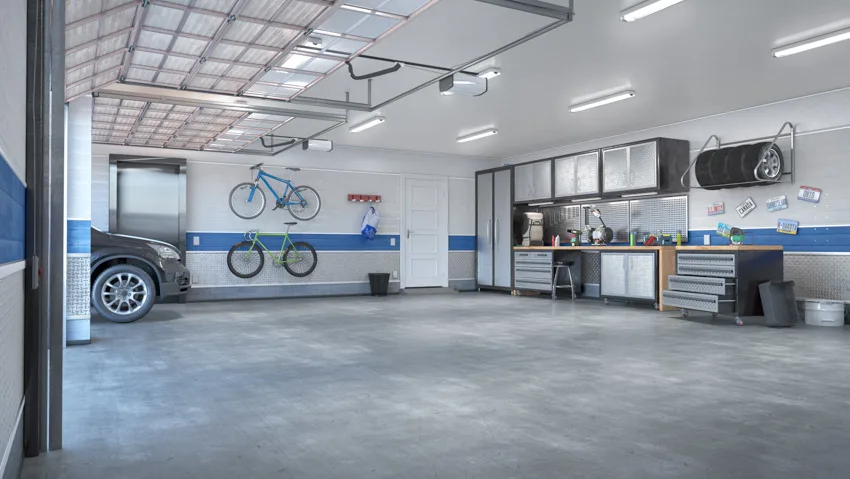
Use the Correct Fixtures: Pick the right fixtures according to their function. Search for fixtures in each category to ensure that you encompass all of your areas. Garage doors with built-in lights are frequently ambient fixtures, and so are circular or rectangular flush-mount types that attach to the ceiling. Task fixtures typically involve trouble lights. These are caged models with a cable connection and a hook that could be moved and hung as necessary. A chain suspends shop lights, which are 4 to 8-foot-long flexible strips, from the garage ceiling.
Pendants that stretch from the garage ceiling and sconces that affix to the wall are examples of accent fixtures that appear stunning on each side of the garage door for a convenient evening entrance.
You can use our garage lighting calculator to easily tell how many fixtures you need based on the dimensions, style, ceiling height, and your usage, such as just for storage or as a workshop.
Use the Right Amount of Wattage/Lumens: A well-designed garage lighting system must enlighten every nook and cranny of the room. The luminosity of a bulb was formerly measured by the number of watts it consumes, but today it is generally determined by lumens. The brightest fixture has the most lumens, and on average, a bulb with 3500 lumens or more (70 watts or more) is regarded as optimum for your garage.
According to the Illuminating Engineering Society, ambient lighting should be 50 lumens (5 watts) per square foot, task must be 300 lumens (30 watts) per square foot, and accent must be 75 lumens (8 watts) per square foot.
Think About Using Bulbs with High CRI: Color Rendering Index (CRI) is a measurement of a light source’s capability to disclose the colors of elements in comparison to a natural source, such as sunlight coming in via your windows.
Clearly explained, it is the measurement of light and how it influences the appearance of the color. To ascertain that the colors of furniture, paint, and other materials you are working on are seen properly and accurately, use a bulb with a CRI of 85 or higher.
How To Make Lights Brighter in the Garage

Although general illumination is essential for bringing your interior garage lighting ideas into reality, task and accent fixtures complement it to create a brighter, layered illumination scheme. Here are three examples of how to use this lighting technique:
• Rope Lighting: This arrangement may be utilized at the bottom of shelving components to assist you in seeing objects while also making them noticeable on the floor where the shelf begins to prevent stubbing toes or mishaps. Rope lighting products can also be installed beneath cabinets to provide additional brightness where it is required.
• Strip Lighting: Strips are a terrific feature when it comes to illumination below cabinets. These items improve general illumination while also providing more targeted task illumination for garage workstations.
• Recessed Can Lights. These are a well-known alternative for adding task illumination or perhaps modest ambient lighting. These styles may be placed at a task location in the garage or used to border the perimeter of the area for increased illumination.
How Many Lumens To Light A Garage?
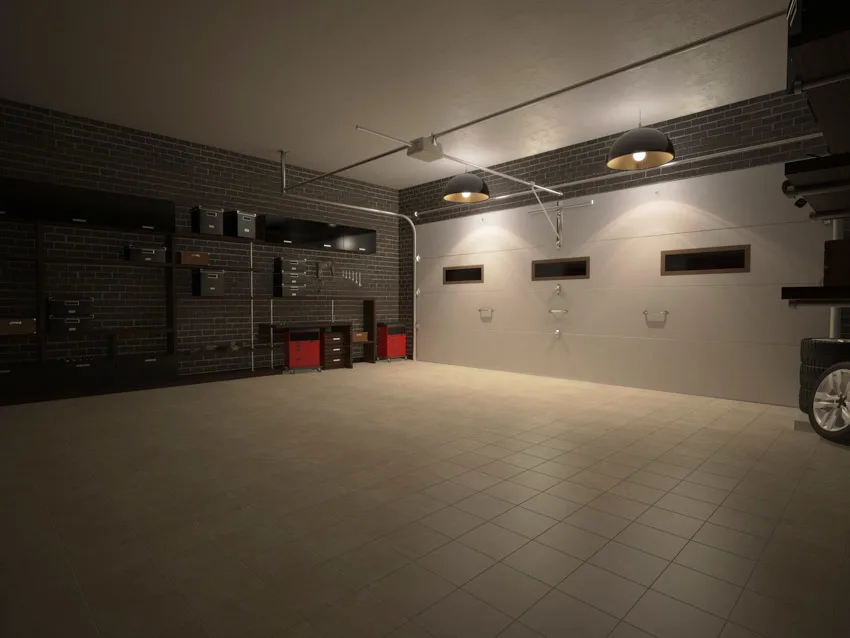
In residential garages, the IES (Illuminating Engineering Society) highly recommends 50 lumens per square foot and 300 lumens per square foot in workshop spaces.
Are LED Lights Brighter Than Fluorescent Lights?

Normally, LEDs are considerably brighter than fluorescents. However, it will still be determined by the number of lumens used. Plus, fluorescents distribute brightness better than LEDs.
What Is The Best Garage Workshop Lighting?
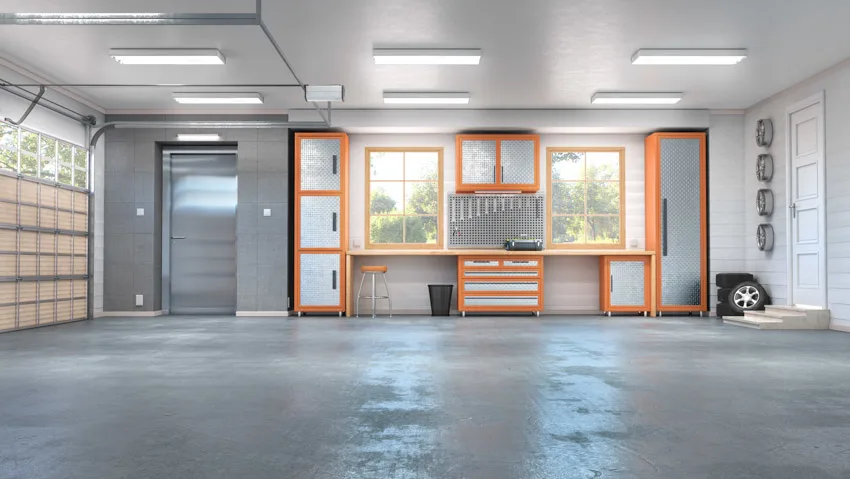
Fluorescent lights and CFLs are an ideal alternative for garage workshop illumination. Although they are not as economical as LEDs, the illumination is more evenly spread. Fluorescent bulbs with a color temperature of more than 5000K are ideal for workshops and other locations requiring precise visibility. To achieve consistency, apply the same color temperatures to all of the lights. If you don’t have a nearby outlet, battery-powered products may be suitable.
What Type Of Lighting Is Best For A Garage?
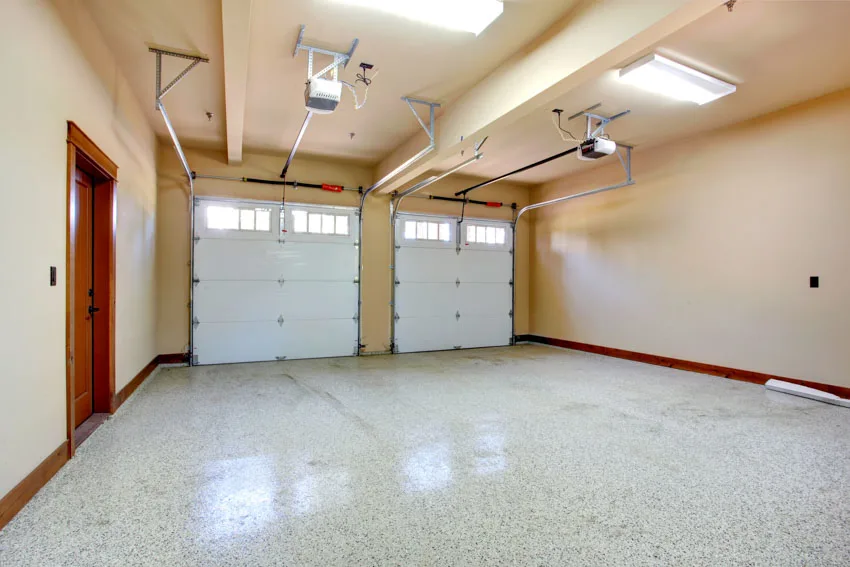
In terms of the perfect brightness and illumination you need, fluorescents are undoubtedly the best options as the light they produce is very cool-toned and well-distributed. And these factors are very important in garages.
The illumination layout is another consideration. Ceiling fixtures should be installed at an equal distance from each other to provide equal light distribution. Don’t forget to account for your garage door opener lights as well.
However, in terms of efficiency, longevity, and energy-saving properties, LEDs are the best option in my experience. One more runner-up, if you have a shop where you need intense brightness for working on projects, are high-intensity discharge lights.
Types of Garage Lights Infographic
To showcase highly specific designs, some images on this website use advanced AI-generation software to illustrate ideas and room inspiration. See our editorial policy to learn more.