Sofa Size Calculator: Get The Right Dimensions For Your Room
Before buying a sofa, you’ve got to make sure it fits your room; if it’s too big, it overwhelms your space, and if it’s too small, it looks awkward and out of place. Our free sofa size calculator takes all of the guesswork out of your furniture shopping. To get the results you need, enter your room’s dimensions, lifestyle choices, and style preferences to get personalized recommendations based on popular interior design principles.
Sofa Size Calculator
Find the perfect sofa size for your room
How to Use the Sofa Size Calculator
Our calculator uses professional interior design recommendations to help you choose the ideal sofa size for your space. Here’s what happens when you enter your info:
- Room Measurements: Enter your room’s length and width in feet, meters, or inches.
- Room Configuration: Select your room’s shape and features like the door, windows, and TV.
- Lifestyle Factors: Tell us about your household size, budget, and how you’ll most often use the space.
- Style Preferences: Choose your sofa style from modern to traditional.
The calculator then analyzes what you added using the industry-standard 2/3 wall rule and other design considerations to provide customized sofa recommendations with exact dimensions so you can have a good idea what to choose. (This calculator is for entertainment purposes only; please use your own due diligence and make sure it can fit through your doorway before buying.)

Upload a photo and get instant before-and-after room designs.
No design experience needed — join 2.39 million+ happy users.
👉 Try the AI design tool now

The 2/3 Wall Rule: A Designer’s Tip
Professional interior designers like to use the 2/3 wall rule to create a balanced and proportional living space. This principle ensures your sofa doesn’t look too large or small, and overwhelm or underwhelm your room.
What Is the 2/3 Rule?
The 2/3 rule states that your sofa should be about two-thirds the length of the wall it’s positioned against. This sizing ratio creates visual harmony and leaves appropriate space for any pathway, side tables, lamps, or décor elements you may use.
Why This Rule Works
- Visual Balance: A sofa that’s 2/3 the wall’s length creates eye-pleasing proportions without dominating the floor plan.
- Functional Flow: This size leaves room for traffic paths and other furniture pieces.
- Design Flexibility: Provides the extra space needed for end tables, floor lamps, etc.
- Prevents Mistakes: Avoids the common mistake of choosing a sofa that’s too big or too small for your layout.
Calculating Your Ideal Sofa Length
Example: If your wall is 12 feet long here’s a way to find your ideal size:
- 12 feet × 0.66 = 7.9 feet
- Ideal sofa length: 7.5 to 8.5 feet (for a standard 3-seater)
Important Note: Always measure the wall where the sofa will sit, and not the entire room’s length.
Professional Designer Tips for Sofa Sizing
Consider Your Room’s Traffic Flow – For a designated pathway, leave at least 30 to 36 inches, or 2.5 to 3 feet of space to walk around your sofa. This allows for comfortable movement and prevents your living room from feeling too tight.
Doorway Clearance – Make sure you measure your sofa so its placement doesn’t interfere with your doorway opening or swing radius, which would create an awkward navigation path. The calculator accounts for door placement to help with this.
Coffee Table Distance – Place your coffee table 14 to 18 inches from the sofa’s leading edge. This distance is close enough to reach something while seated, and still far enough to allow for your legs to stretch out.
Scale for Your Room Size – For smaller rooms that are under 150 sq ft, choose loveseats or smaller-sized sofas measuring 60 to 72 inches. Take a look at armless sofa designs to save visual space for a more open feel. Also, consider buying models with lighter colors to help make the room feel larger.
For medium-sized rooms measuring 150 to 250 sq ft, go with a standard 3-seater sofa ranging from 78 to 90 inches as a general standard. This is the most versatile size for the average U.S.-based living room and still gives you the space for additional accent chairs for guests.
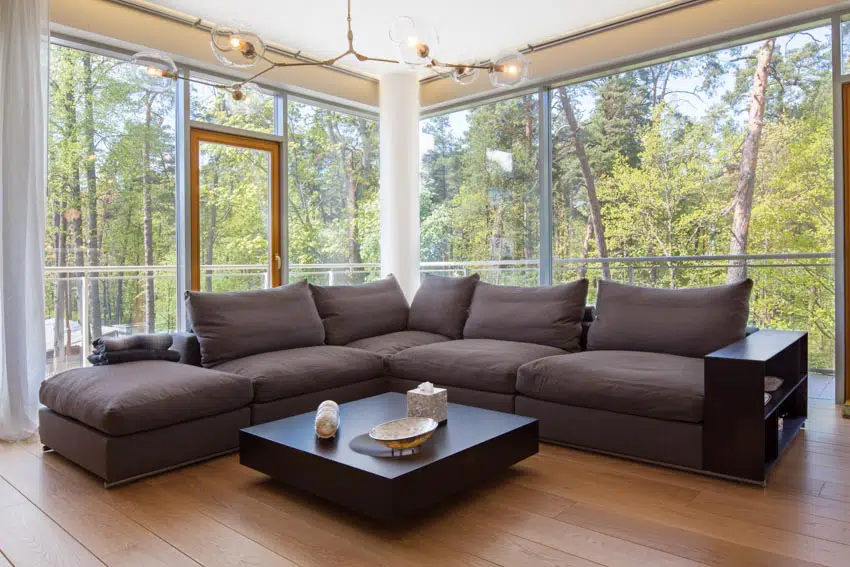
For large rooms that are over 250 sq ft, you can often choose 4-seater sofas or sectionals that measure 90+ inches. For these rooms, you may want to consider L-shaped sectionals to better define the space, especially for open concept layouts that need more definition. With sectionals and rug placement, you can create conversation areas with multiple seating pieces that frame the area.
Your room’s ceiling height can also impact your buying decision. For instance, rooms with a standard 8-foot ceilings may want to move toward choosing low-profile sofas, with a back height ranging from 30 to 36 inches to maintain proportion. Spaces with high ceilings that are 9+ feet may want taller sofa backs that are 36 to 40 inches or high-arm designs that prevent the furniture from looking too diminutive.
Sofa Depth Guidelines – When buying a sofa, you’ll be able to choose between different depths. What is considered the standard depth measures 32 to 40 inches, including cushions. A shallow piece is 32 to 35 inches, and is better for smaller rooms or more formal settings. Medium depth ranges from 35 to 38 inches, and is the most comfortable for the average user. There are also deep depth sofas that go from 38 to 40+ inches that are best for lounging or taller individuals.
Pro Tip: Before buying a sofa, sit on it to make sure it’s comfortable. Your feet should touch the floor when your back is against the cushions.
Multi-Purpose Rooms – When selecting a model for a multi-use room or open plan, you can use the sofa to better define the zones. One of the ways this is done is by floating the sofa away from the walls to separate the living and dining areas. You can use the back of the sofa as a sort of visual divider, or choose sectionals to create natural boundaries between areas.
TV Viewing Distance – The general rule of thumb is to position your sofa 7 to 10 feet from your TV for the best viewing experience. For a 40 to 50 inch TV, try 7 to 8 feet away. For a 55 to 65 inch TV, try placing it 8 to 10 feet away. For a 70+ inch TV, place it 10 to 12 feet away. Our calculator gives you this recommendation when you check the TV/Entertainment Unit option.
Seat Height and Comfort – The ideal seat height is 17 to 19 inches from the floor. When the seat height is 17 to 18 inches it makes it easier to stand up, which is better for the elderly or disabled. The standard comfort height is 18 to 19 inches. Sofas with a seat height at 19+ inches are frequently used in modern, or contemporary style rooms, but can be harder to rise from.
Household Size Considerations – For 1 to 2 people, go with a 2-seater or loveseat measuring 60 to 72 inches. For 3 to 4 people, select a 3-seater sofa ranging from 78 to 90 inches. If your household has 5+ people, a 4-seater or a sectional measuring 90+ inches is recommended. If you often entertain guests, add 20% more seating than your household size.
Budget-Friendly Sizing – If you’re still having trouble determining what size to buy, remember that smaller is safer, as you can always add more chairs or ottomans to the design. Purchasing a couch that is too large is unfixable, and an oversized sofa will overwhelm the space. Rather than a large sectional, consider a sofa and loveseat combination for more flexibility.
Common Sofa Sizing Mistakes to Avoid
Measuring Only The Room Dimensions – The total room size doesn’t account for any doors, windows, or other furniture you have. Instead, measure the specific wall where the sofa will sit, and account for obstructions there.
Forgetting About Doorways – Your dream sofa is useless if it can’t fit through your door. To make sure it fits, measure your doorways, hallways, and stairwells, and note that most sofas need 33 to 36 inches of clearance to get through.
Ignoring Sofa Depth – The sofa’s length isn’t everything; a deep seat can also make a room feel cramped. If you plan on walking behind it, make sure you account for the sofa depth plus walking space.
Choosing Style Over Size – That gorgeous oversized sectional might not work in your space. Instead, take careful measurements, use the calculator first, then shop for styles within your recommended size range.
Not Testing Comfort – Don’t forget that the dimensions don’t tell you if a sofa is comfortable for your body type. Always test sit before buying, and don’t forget to bring your actual measurements when shopping, as it’s really a pain to return them if they let you at all.
Quick Reference: Standard Sofa Sizes
| Sofa Type | Length | Seats | Best For |
| Loveseat | 52 to 64 inches | 2 | Small apartments, bedrooms, compact spaces |
| Apartment Sofa | 68 to 80 inches | 2 to 3 | Studios, small living rooms |
| Standard 3-Seater | 78 to 90 inches | 3 | Average living rooms, the most popular choice |
| 4-Seater | 90 to 108 inches | 4 | Large rooms, families |
| Sectional (one side) | 90 to 140+ inches | 5 to 7+ | Spacious rooms, entertaining, open plans |
Note: These are approximate size ranges. Always verify the exact dimensions with the manufacturer. This calculator is for entertainment purposes only, do your own due diligence before buying.
Final Tips Before Buying
- Always measure twice: Use a tape measure, and don’t just rely on guesswork.
- Use painter’s tape: Mark the sofa’s footprint on your floor with masking tape to visualize the size.
- Consider your lifestyle: A family with kids needs different sizing, so plan according to your household.
- Think long-term: Choose a size that works for your next home, too, if you plan on moving soon.
- Quality over quantity: A perfectly-sized high-quality sofa beats a too-large cheaper one.
Frequently Asked Questions
Q: Can I go bigger than the 2/3 rule suggests? A: You can, but be cautious, as going to 75-80% of wall length is acceptable in large rooms, but anything more risks visual overwhelm.
Q: What if my room is oddly shaped? A: Select “L-shaped” or “Open Plan” in the calculator. These options will adjust the sizing for non-traditional layouts.
Q: Should I include the sofa’s arms in my measurements? A: Yes, always use the total width, including arms. This is the space the sofa actually takes up.
Q: What about sleeper sofas? A: Add 6 to 12 inches to the depth recommendations to account for the sleeper pull-out mechanism and the mattress thickness.
Q: How do I know if a sectional will fit? A: Measure both walls where the sectional will sit. Each section should follow the 2/3 rule for its own wall.
To showcase highly specific designs, some images on this website use advanced AI-generation software to illustrate ideas and room inspiration. See our editorial policy to learn more.