How To Design An Open Concept Living Room So It Looks Amazing

Open concept homes are becoming increasingly popular, with homeowners hoping to maximize their living space. For those looking to adopt this design in their home, it may seem like an overwhelming project to take on. Open concept isn’t just about asking, “how do I decorate?”, it’s about how I create zones so each space stands on its own. When planning, it’s important to know that every open concept layout should solve 1. flow, 2. focal point, and 3. functional zones. Designers plan open concepts like a single composition that repeats shapes, finishes, and colors throughout, so it feels cohesive and everything works together. We’re going to break this down and give you some ideas on how to organize your open concept living room to create the space you’ve been dreaming of.
What Are Open Concept Room Layouts?
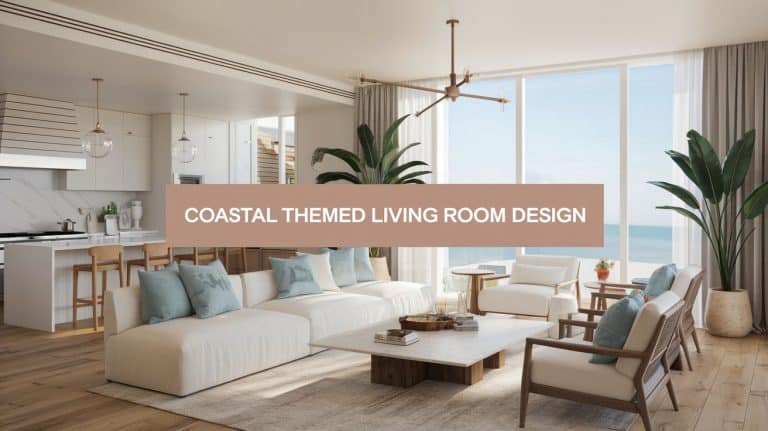
“Open concept” refers to a residential layout in which space that would otherwise be broken up into two rooms is joined in one room. This is done by removing the partition walls that would divide the spaces and opening up the area into one large space. In the case of an open concept living room, some combination of the kitchen, living room, and dining room is joined. This may involve joining the kitchen and living room or the dining room with one of the others. It is also possible to join all three, resulting in an entirely open floor plan.
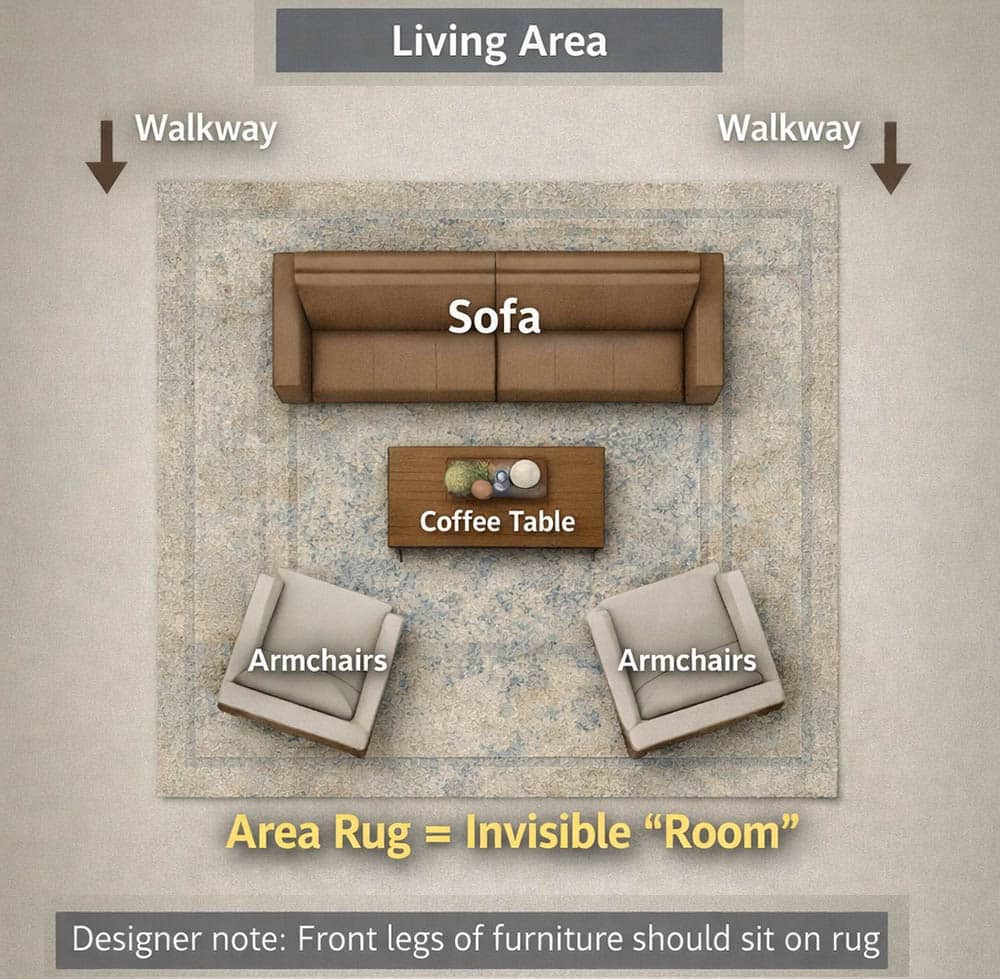
Define “zones” as invisible rooms: Designers create these rooms with rugs, lighting, furniture backs, and ceiling treatments, instead of walls. This way, they define zones as invisible rooms within the space. These rooms look best when tall or bulky pieces are placed along the perimeter, such as tall cabinets or bookcases, and the center stays visually lighter. It works best when you can pick one main focal point, like the fireplace, TV wall, or a big window view. Then make the other areas stay quieter so the eye can rest. In open plans, mismatched furniture scale is often the #1 reason it feels so chaotic. Keep your sofa, dining table, and island “weight” balanced so they work together.
An open concept design can be incorporated into almost any home layout. Home size does not dictate whether an open concept can be utilized, as it works well in large and small homes. Small homes may benefit from an open concept as it will increase the amount of space in the home, making it feel larger. Larger homes can also benefit from an open concept, as it allows homeowners to play with the wealth of space available.
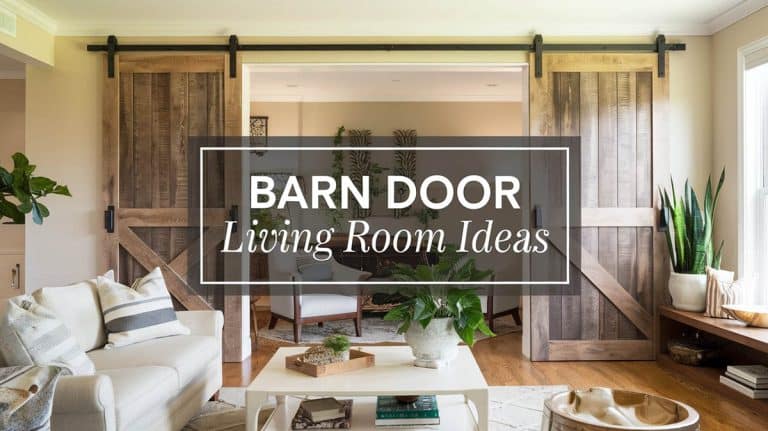
A living room layout achieves a more open concept by using sliding barn doors to provide separation between the living room and dining room, if needed. Large French doors can also help the space feel more open and provide plenty of natural light. A closed space can feel more open by opening just the doorway, rather than going for more expansive remodeling. Do consider that barn doors look great, but aren’t soundproof. If your point is “separation,” using pocket doors or glass French doors may also work as functionable upgrade. For a more open look without remodeling, designers often use wider casement openings or glass doors/transoms to bring in daylight.
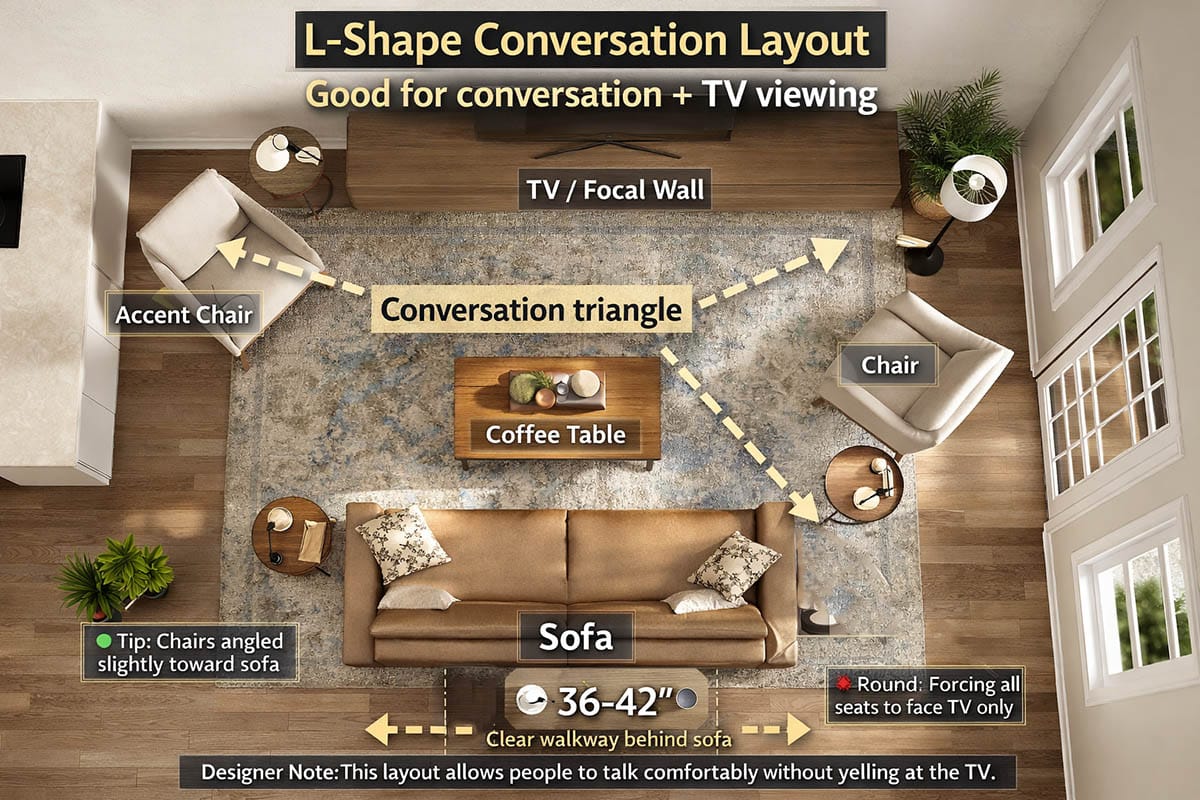
Open designs are also best for families who want to keep an eye on small children while cooking or preparing food in the kitchen. In addition, they’re great for entertaining friends and family in order to promote socializing and togetherness. Plan for a conversation triangle by adding a kitchen perch with island stools, dining seats, and living seats, so hosts aren’t isolated from friends and family.
Popular Types of Open Concept Living Room Layouts
An open concept living room will involve a joining of the living room with the dining room, kitchen, or both. The way these rooms are joined depends on which of the three rooms is being combined. When designing, you’ll want to repeat one material across all of the zones. This is often done by repeating one metal finish, like brass/black/nickel, and one wood tone in each zone.
You can also use lighting to label spaces, for instance, pendants for the kitchen, a chandelier for the dining table, and floor and table lamps for the living area, all in the same style family. It is effective to identify the main walkway from the entry to the kitchen, to the living room, etc. Keep this pathway clear with a space measuring 36″ to 48″ wide.
Open Plan Living and Dining Room Design
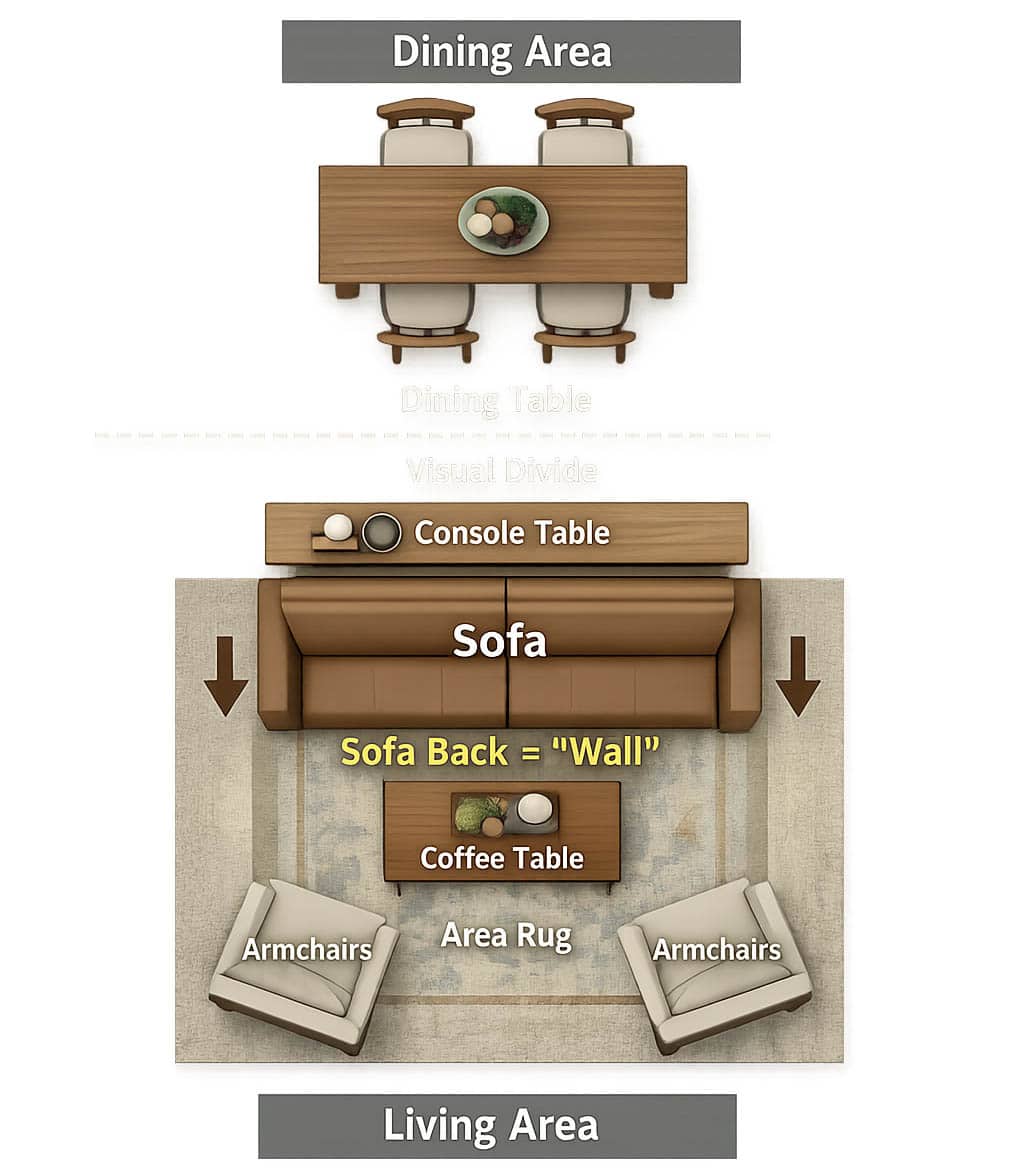
In the case of an open concept dining room and living room, a visual dividing line will be used in place of a traditional doorway. This may come by painting each space a different color, giving the feeling that the shared space is actually two separate areas. Don’t rely only on paint, though; color can help, but the designer divider is usually a rug, lighting, and furniture orientation.
Use the sofa as the wall, by floating it with its back toward the dining area to create a clean separation. Add a console table behind it for extra delineation between zones. The living rug should be large enough for the front legs of all the seating to sit on top of it. On the other hand, the dining rug should allow chairs to stay on the rug when pulled out. Hanging a chandelier or pendant over the dining space instantly says this is a room.
This division can also come with a small set of stairs or a step, wherein one space is lower than the other. This layout is useful for those who frequently host gatherings where the dining room is used. An open concept allows guests to socialize from the living room while other guests finish their meals.
Open Plan Living Area and Kitchen Design
An open concept that combines the living room and kitchen may use some of the same elements as the previous type. Another way to separate kitchens and living rooms is through the strategic placement of the kitchen counter. If the open concept kitchen design has an island or peninsula, this may be positioned so it creates a visual divider between the living room and kitchen. This type of open concept is perfect for those who spend a lot of time in the kitchen. For hardcore chefs who prefer socializing rather than using the dining room, this layout allows for open kitchen access while mingling with those in the living room.
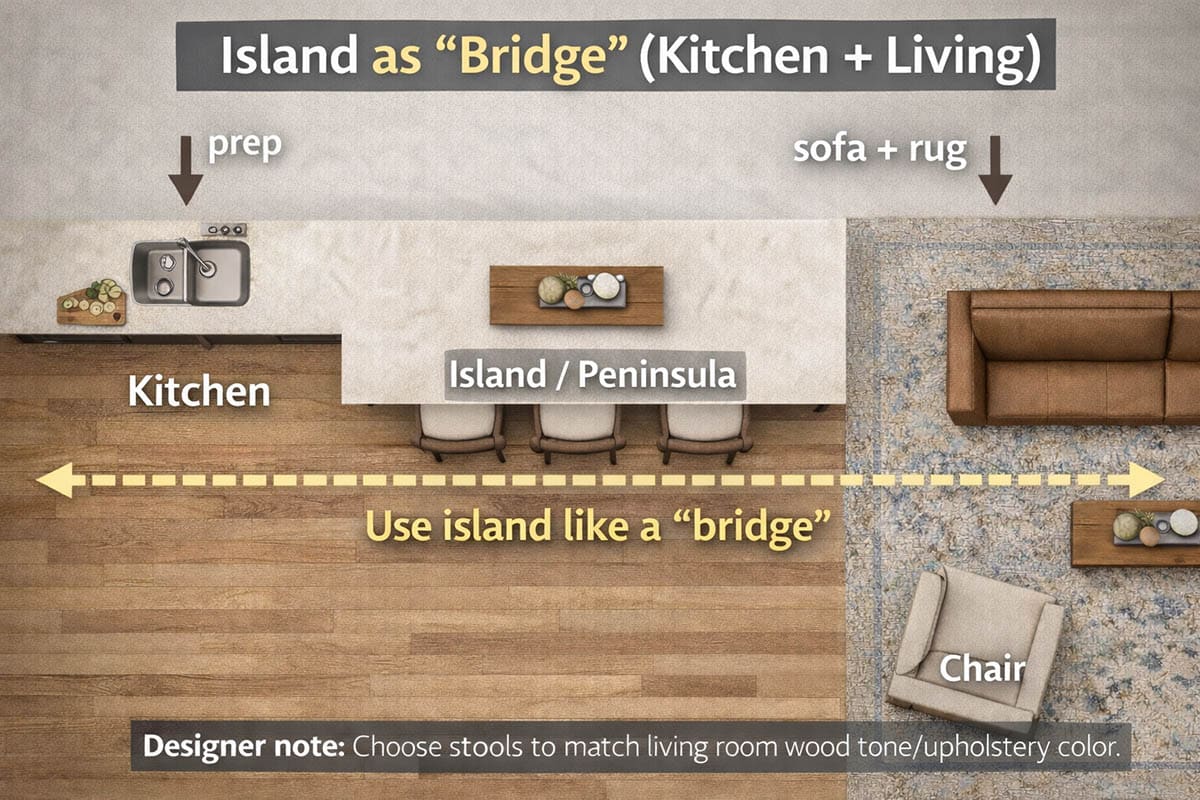
In an open kitchen, the living room sees everything, so designers often hide clutter with paneled appliances, a taller backsplash, or an island that catches all of the attention. For a family-friendly design, put the work zone, like the sink & stove, so it faces the living area, and keep traffic lanes behind the cook, and not through the cooking zone. Use stools or chairs in the kitchen that have the same matching wood tone or upholstery as those in the living area for a cohesive look.
Plan seating so the conversation distance from the island stools to the sofa chairs is reasonable, allowing people to talk. Don’t force the TV above a fireplace if the kitchen is the main hangout; you can plan a low media console wall, so sightlines work from both zones. Angle the furniture toward the main sofa to create a conversation layout. Then have the main sofa pointing toward the TV if you want a space that is great for watching shows and entertaining with friends and family.
Open Living, Kitchen & Dining Room Floor Plan
The final layout combines the kitchen, dining room, and living room into one large space. An open floor plan kitchen is good for homeowners who need to maximize their space for large gatherings. In a situation where the kitchen, dining room, and living room are connected, there are ways to keep these spaces separate.
Using one continuous color palette, with layered accents, is often recommended. To do this, keep the big surfaces consistent, such as the walls and flooring material, then assign each zone a subtle accent in the form of its textile color, art theme, or centerpiece. A vaulted ceiling may be designed in the central space to create the illusion that each space is a separate room. However, simpler moves often do more, such as adding a faux beam detail, a change in the ceiling paint, or distinct light fixture placement.
Remember to put visually heavier elements on opposite sides of the room. For instance, kitchen cabinetry at one end and a fireplace or media wall on the side, so the large space feels grounded. So furniture doesn’t feel off and incorrectly placed in the center, make sure each zone has an anchored element like a rug, lighting, or a defined wall feature.
How Do You Organize an Open Room So It Makes Sense?
If you are looking to incorporate an open concept design into your home, it’s important to properly organize the space. An expansive room can feel a bit too open and sparsely decorated if the furniture is not organized correctly. Consider organizing your large furniture symmetrically to give the room a sense of balance.
You will also want to arrange your furniture away from the walls, as this will prevent the space from feeling too big. If the furniture is arranged against the walls, it will feel as though the items are far away from each other, creating a sense of distance that is not pleasing.
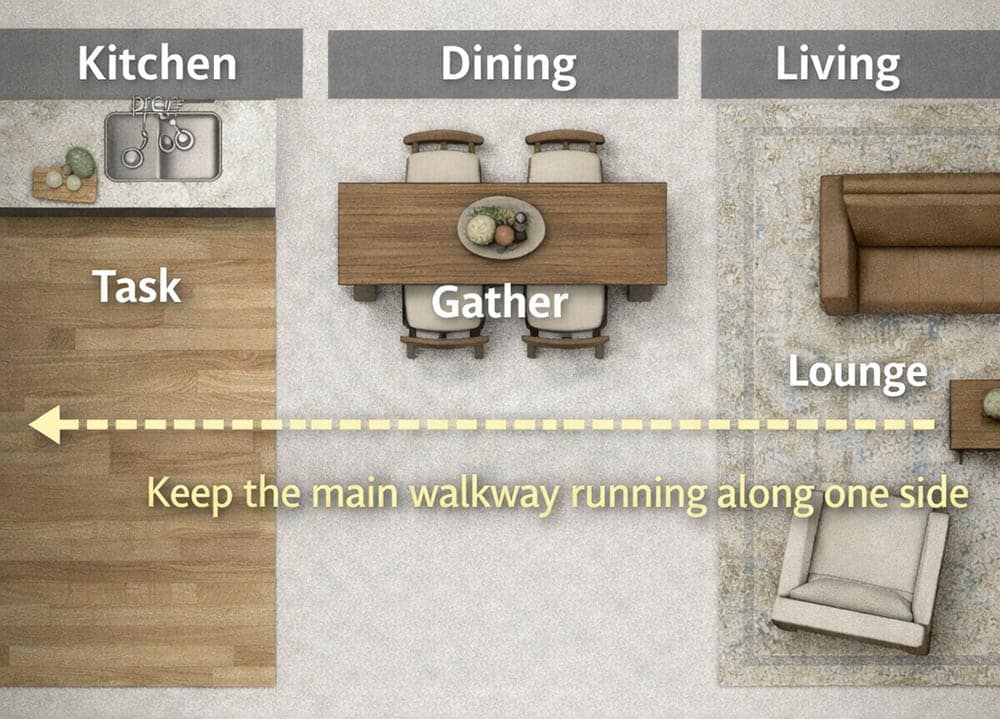
When choosing furniture, go for pieces that have multiple functions. This can cut down on the number of pieces that need to be used in one room. In addition, it’s also a good idea to choose pieces that can be accessed from most or all sides, such as a well-placed kitchen island. Arranging the furniture in the middle of the room leaves empty areas along the walls that function as walkways across the room. Easily accessible furniture prevents people from having to walk around to get to where they want to sit or eat.
When it comes to furniture selection, there are a few avenues that you can take. Pieces with strong angles can look sharp in the right room, giving the space a modern feeling. If you choose some angled pieces, try to offset those by choosing some softer pieces as well. One way to do this is by choosing tables or counters that have sharp angles, and pairing them with stools or other seats that are soft and rounded. This combination can help keep an open concept looking smart and modern, while also ensuring that the space is comfortable and warm.
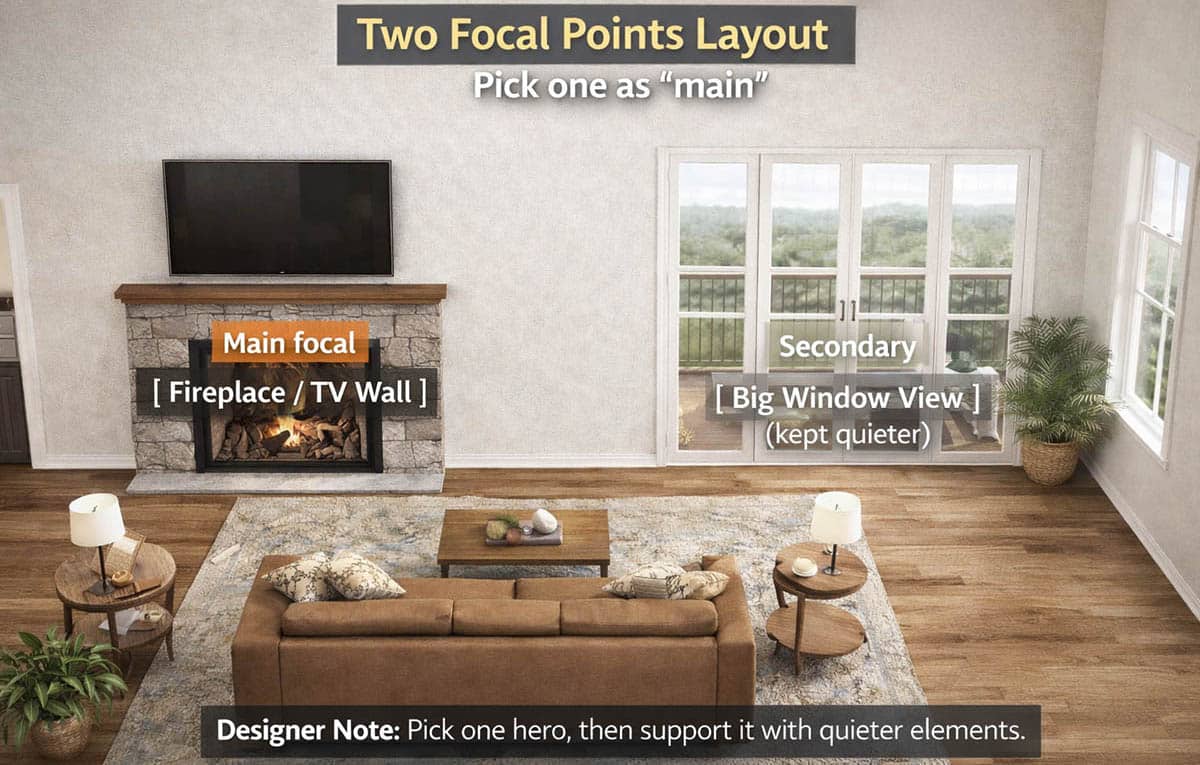
When planning, remember that symmetry works best around a focal point like a fireplace or TV. In the rest of the plan, designers use balanced asymmetry so it doesn’t feel stiff. If you have an area with two focal points, pick one as the main and tone down the other so it feels quieter.
You’ll also want to arrange your furniture so that natural light is preserved as much as possible. Open concepts allow high amounts of natural light into the home as there are fewer walls. Natural light helps give rooms a sense of openness, which helps make the space feel comfortable. This natural light can also play well against an accent wall painted a different color.
With so many design schemes to choose from, homeowners are always on the lookout for ways to maximize the space and utility of their homes. If space and natural light are qualities that are important, an open concept design may be the right choice. This type of design is a great way to give your home an all-new feel without taking on whole-home renovations and it’s a good way to bring everyone together.
To showcase highly specific designs, some images on this website use advanced AI-generation software to illustrate ideas and room inspiration. See our editorial policy to learn more.