Where to Put a Sofa: Designer Tips That Make a Living Room Feel Bigger
Most sofa-placement problems come up because people try to place their furniture without really considering their needs and how best to meet them. Many just decide to push the couch up against a wall instead of using it to shape the room’s contours. The sofa is usually the biggest piece in the living room, so wherever it goes, the whole layout follows. Let’s take a look at where to put a sofa and explore the best ways you can avoid the biggest mistakes when planning your furniture floor plan. [toc]
Start with the room’s “job”: conversation, TV, or both

Before you move any furniture around, decide what the sofa’s primary function is:
- Conversation-first: The sofa faces nearby chairs (or another sofa) with clear sightlines and has a coffee table within reach.
- TV-first: The sofa faces the TV screen for comfortable viewing without blocking any foot traffic.
- Hybrid: The sofa is angled or positioned to see both the TV and the people that are seated (often with chairs that swivel or float).
A simple designer tip: if the sofa placement makes people talk across a large expanse, the layout will feel awkward, even if it looks put-together.
Don’t default to the wall: “float” it (even a few inches)
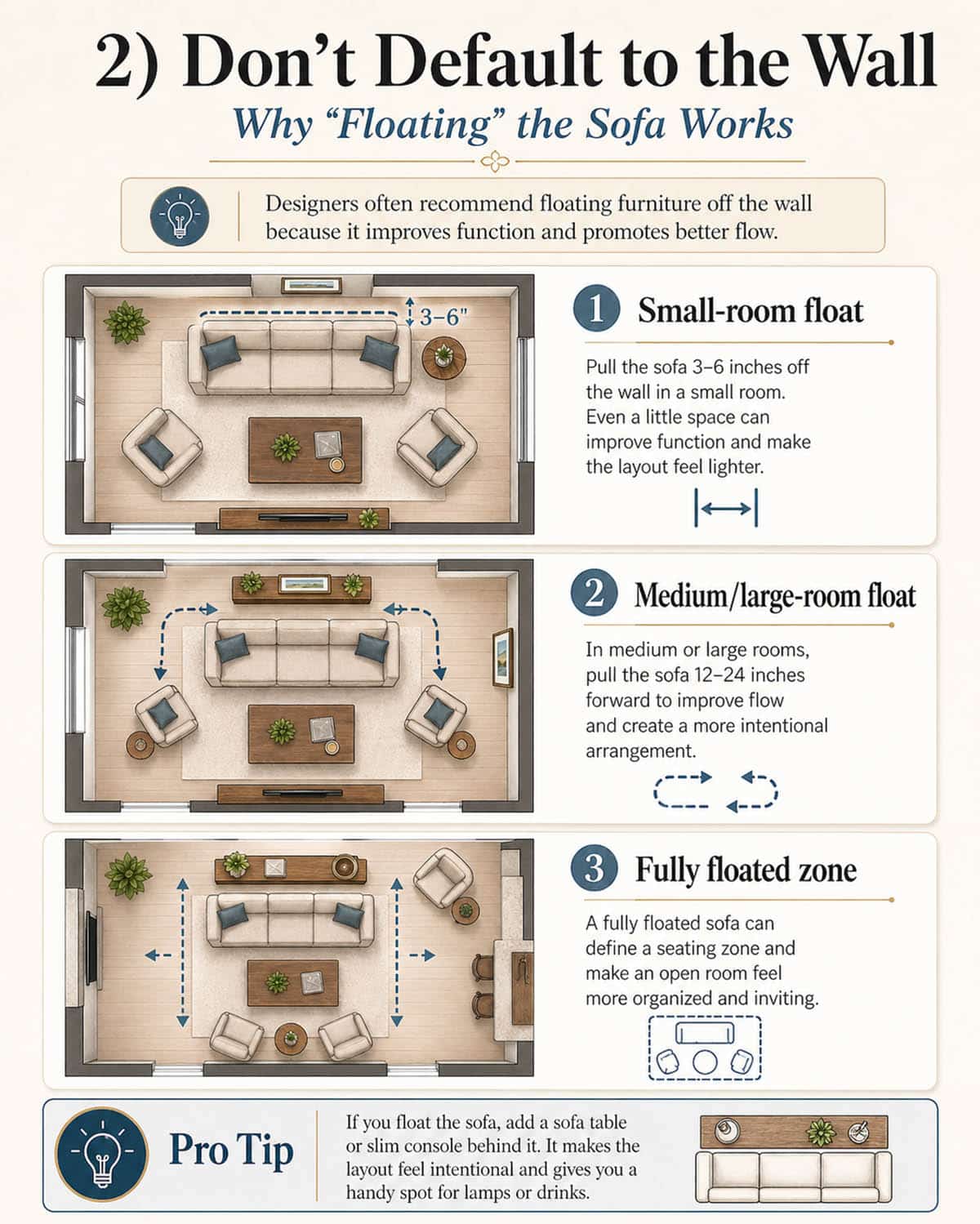
This is the #1 upgrade in most living rooms. Havenly designer Brady Burke puts it plainly: “Floating your furniture off the walls, even just a few inches, will make a space feel more functional…” – Source. And Good Housekeeping quotes Studio Seva’s Steph Schlegelmilch with the why: “Creating space between the furniture and the walls promotes better flow…” – Source
What “floating” can mean for day-to-day life:
- Pull the sofa 3 to 6 inches off the wall in small rooms.
- Pull it 12 to 24 inches off the wall in medium to large rooms.
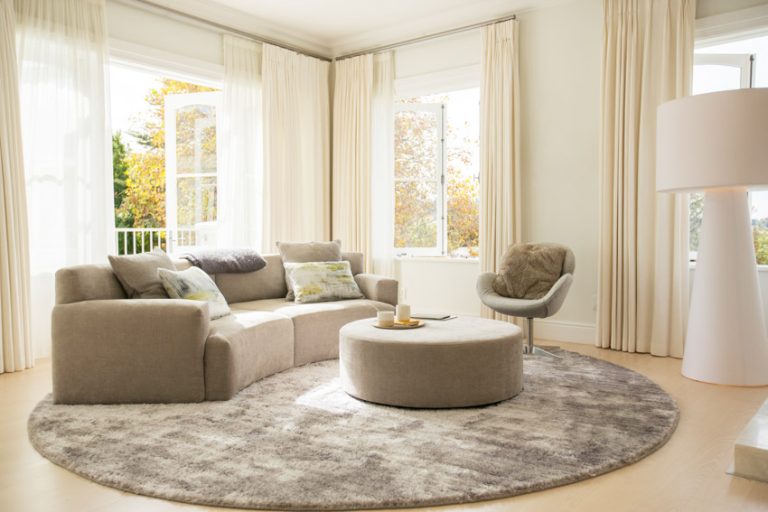
- Or place it fully in the room to create a defined seating “zone.”
Pro tip: If you float the sofa, add a sofa table or a console behind it so it feels in the space, looks more stylish, and it gives you a spot for lamps/drinks.
Build a conversation zone
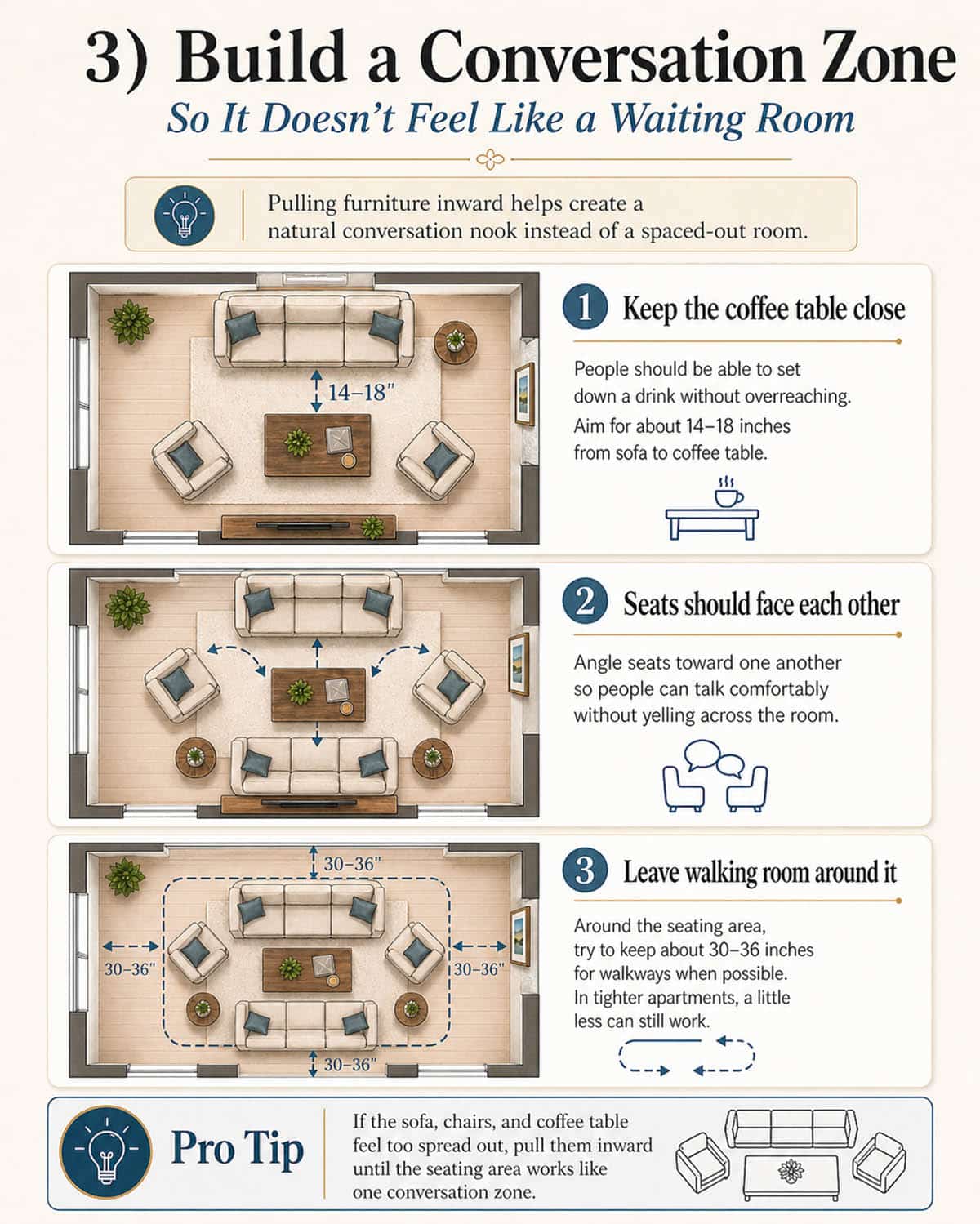
If the room is for gathering and hanging out, your sofa shouldn’t be a long way from the coffee table or chairs. As a good general rule:
- People should be able to set down a drink without leaning to reach too far.
- Seats should face each other enough that you can talk without yelling across the room at each other.
Brady Burke explains the point of pulling pieces inward: “It creates a natural conversation nook…”
Quick spacing guidelines that are easy to eyeball:
- Sofa-to-coffee-table: 14 to 18 inches for a comfortable reach.
- Walkways around the seating area: Try to keep it at about 30 to 36 inches if you can, but you may have to go with less in tight apartments.
Anchor the sofa to a focal point (but don’t force it)
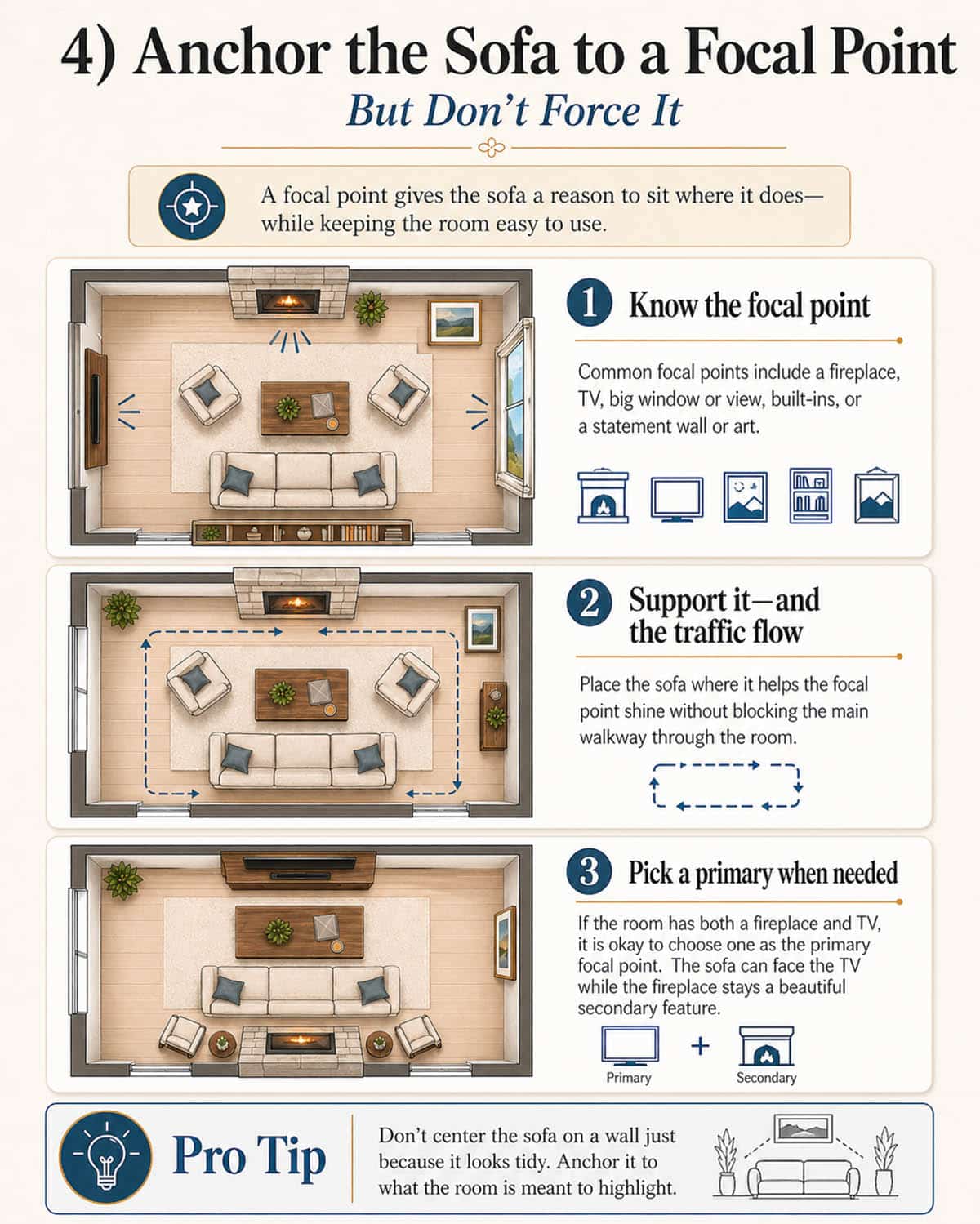
If you want to find your room’s focal point, it can be one of these:
- Fireplace
- TV
- Big window/view
- Built-ins
- A statement wall/art
Put the sofa where it supports the focal point you choose and make sure it keeps the room’s traffic flow moving without any interruption. If you’re stuck choosing between the fireplace and TV, it’s okay to pick one as the “primary.” The sofa can face the TV, while the fireplace serves as a visual feature. Sometimes it works out to combine them, for instance, mounting the TV on the fireplace can work well in many living room designs. You can further enhance a focal point by using elements like a styled mantel, downlighting, flanking chairs, etc.
Use the sofa to define space in open floor plans
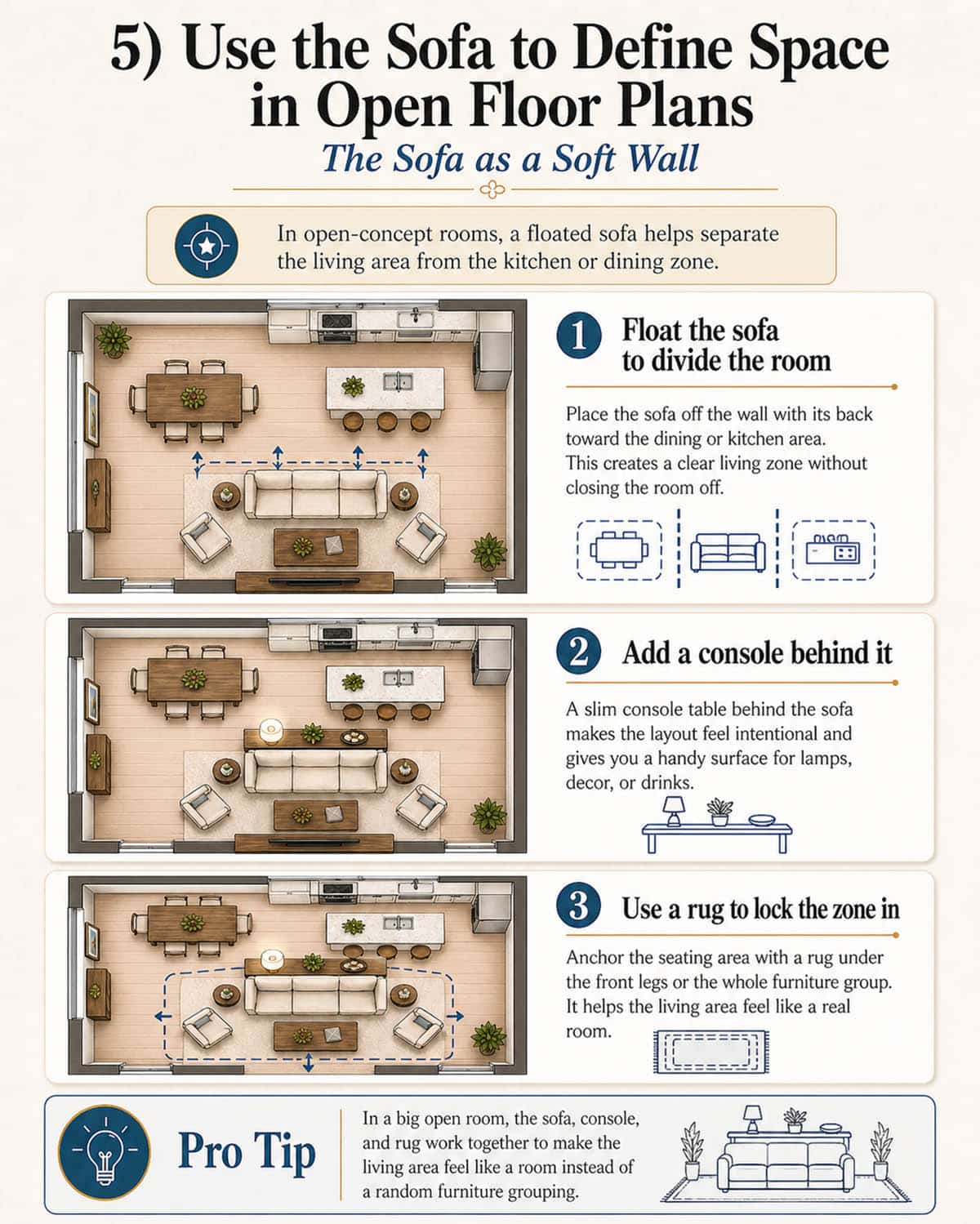
In open concept rooms, the sofa is basically a “soft wall” that acts as a divider. Interior designer Lauren White describes the concept clearly: “Floating the furniture means that you place pieces off the wall, or sometimes in the middle of the room…” – Source
The furniture arrangement moves that work most often:
- Float the sofa with its back toward the dining or kitchen zone.
- Add a console table behind it.
- Put a rug under the front legs, or underneath the whole seating group, to lock the zone in.
This makes the living area feel like a room, and not some random pile of furniture haphazardly placed in a big space.
Fix the “void in the middle” problem (large rooms, especially)
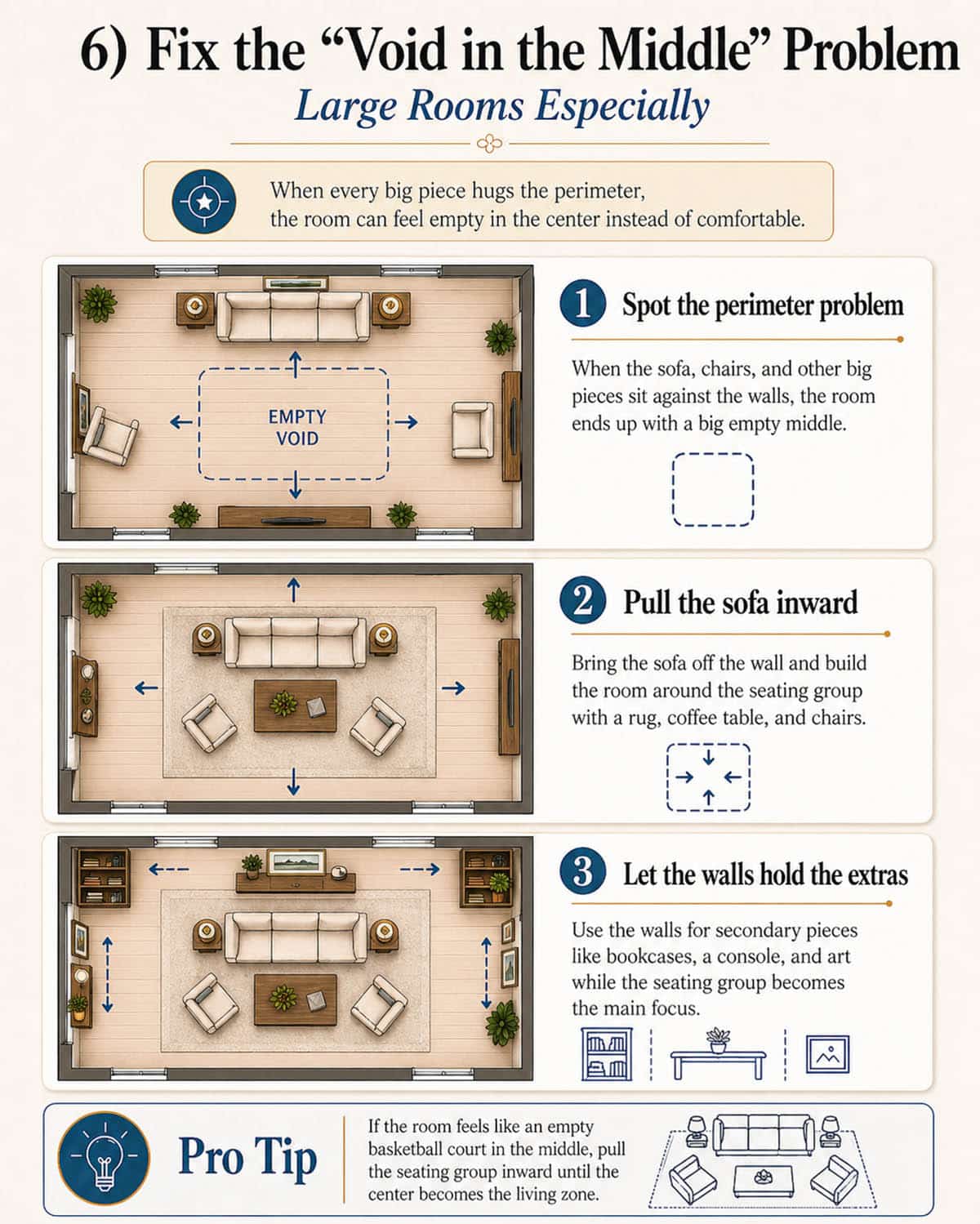
When every big furniture piece hugs the perimeter, you can get that dreaded empty-room feeling. Kroesser + Strat Design calls out the issue: with everything pushed to the wall, “the room ends up feeling like it has a void in the center…” – Source
Solution: Pull the sofa in toward the center and build the room around the seating group (rug, coffee table, chairs). Let the walls carry secondary pieces which can be your bookcases, console, and wall art.
Small living room? You can still place the sofa on a wall, just balance it
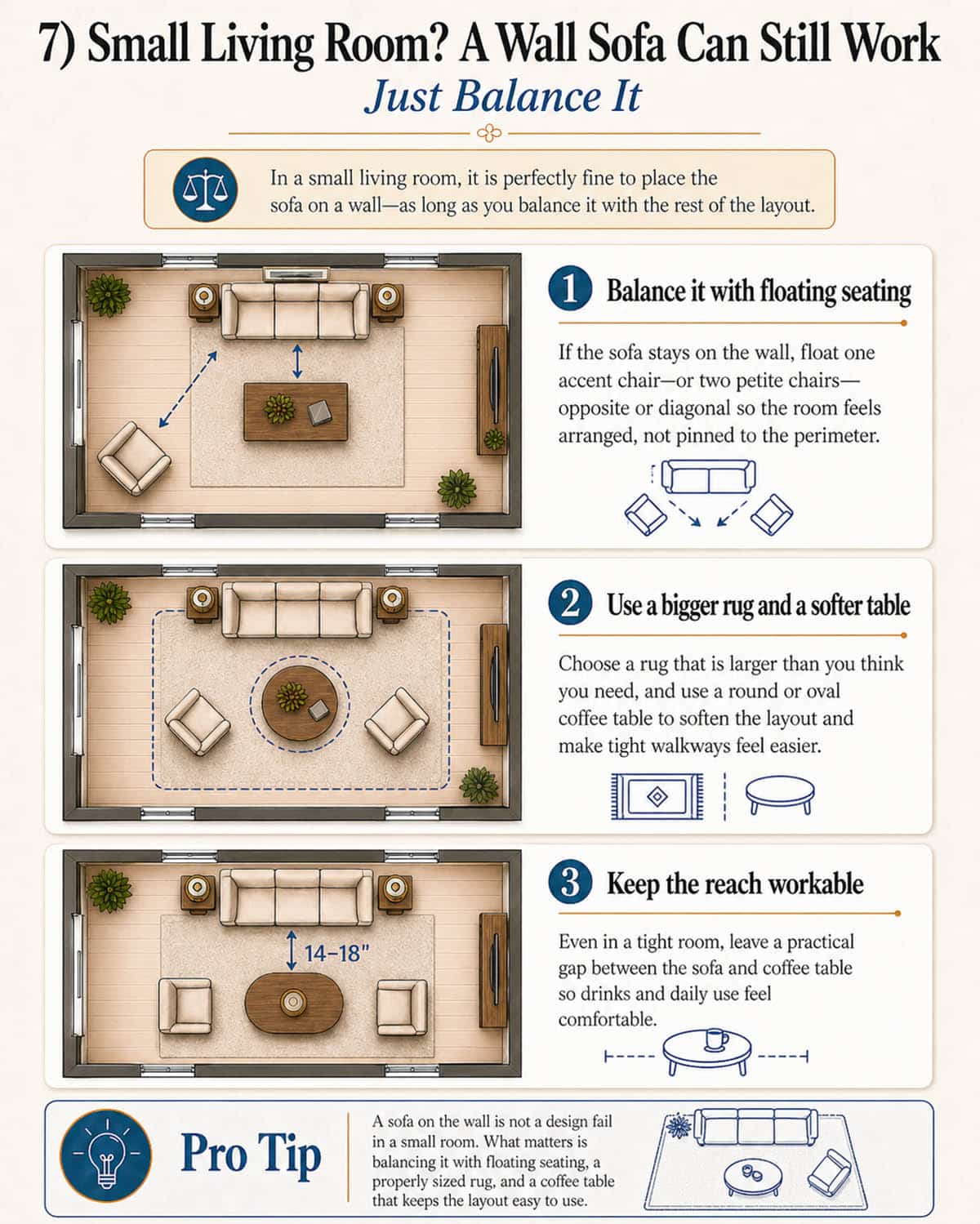
Sometimes you just don’t have the depth to float a sofa very far. That’s fine, and Good Housekeeping notes: “In a smaller living space, it’s perfectly fine to place a couch against the wall… Just try to balance it with other elements…” – Source
How to “balance” it (so it doesn’t look anchored down):
- Float one accent chair or use two petite chairs that are placed opposite or diagonal.
- Use a bigger rug than you think you need, as tiny rugs make your layout feel more cramped.
- Add a round or oval coffee table to soften any tight walkways.
- Keep the space between the sofa and the table workable, even if it means using a smaller table.
The sofa should improve flow, not block it
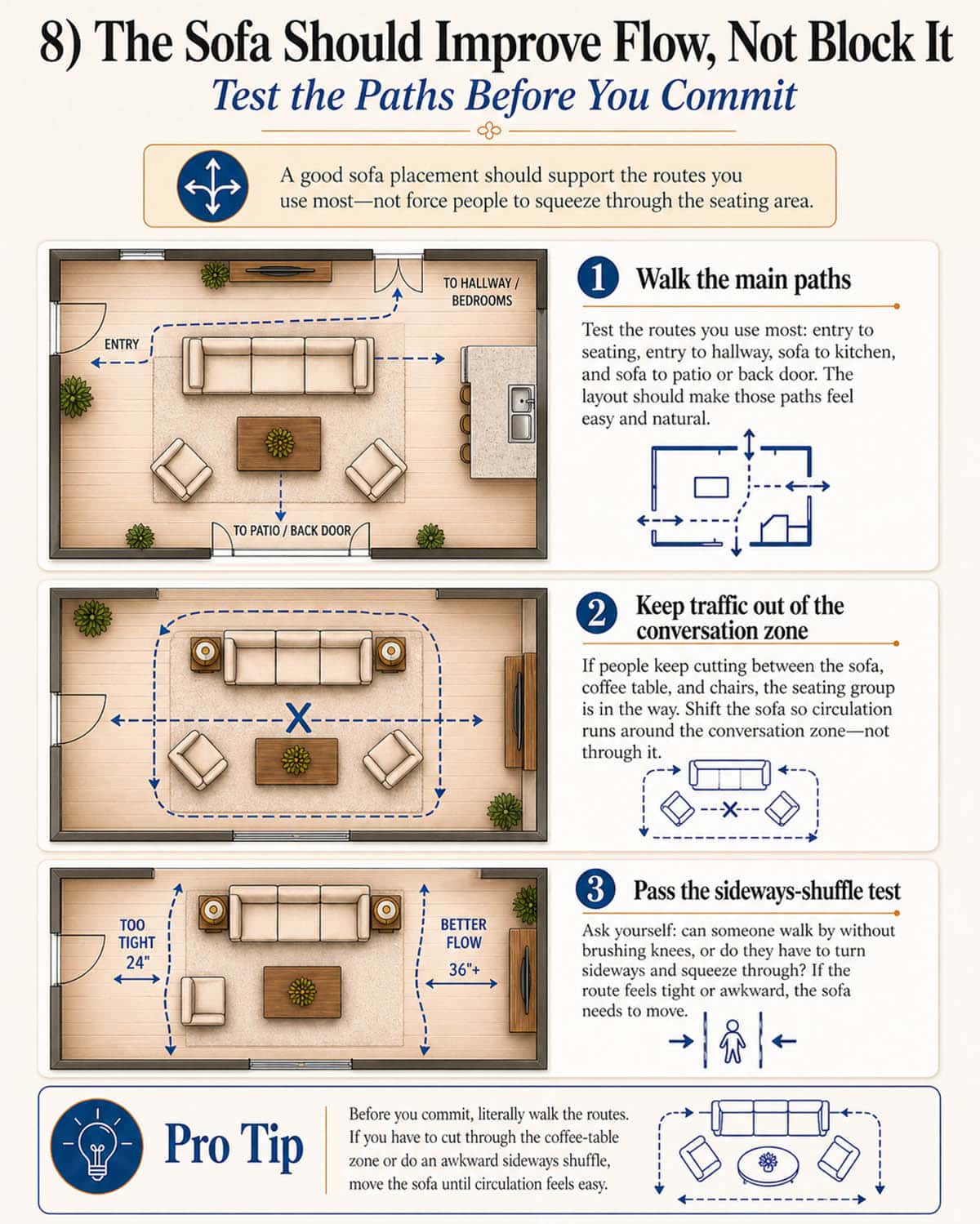
Before you commit to a sofa placement and furniture floorplan, do one test:
Walk the paths you use most:
- Entry → sofa → seating
- Entry → hallway/bedrooms
- Sofa → kitchen
- Sofa → patio/back door
If you’re constantly cutting through any conversation areas, you’ll need to move the sofa so there’s no awkward maneuvering required to get through.
Make the sofa feel “designed,” not just “placed”
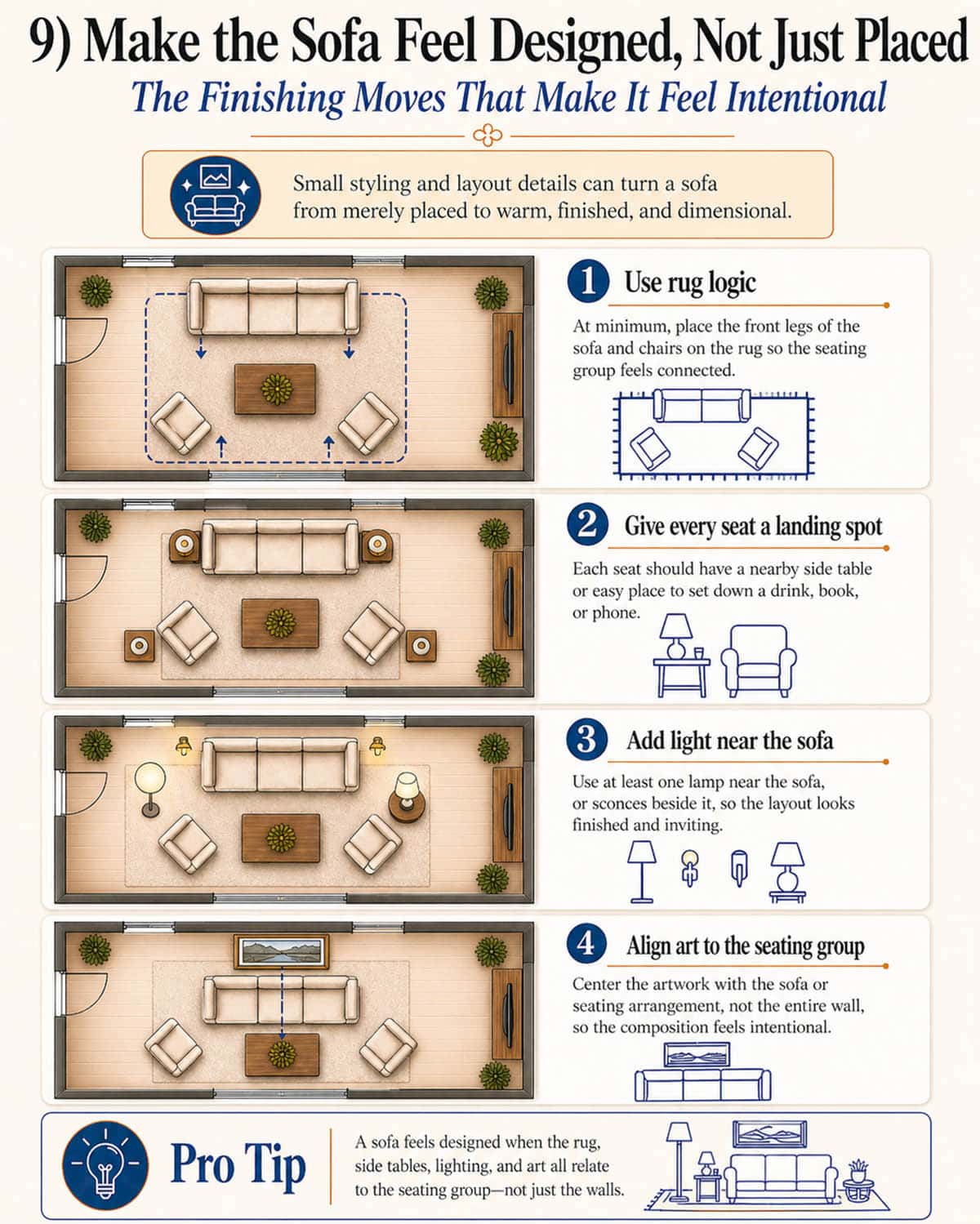
Here are some of the subtle techniques designers use to make sofa placement look more intentional:
- Rug logic: At a minimum, the front legs of the sofa and chairs should be on the rug.
- Side-table rule: Every seat should have a landing spot nearby.
- Lamp placement: Place at least one lamp near the sofa or install sconces behind or next to it so the layout feels finished.
- Art alignment: Hang art relative to the seating group, not the wall.
Sarah West sums up the vibe shift: “Resisting the urge to push furniture against the walls can transform a room… to warm and dimensional…” – Source
The “Sofa Placement” Cheat Sheet (print this in your brain)
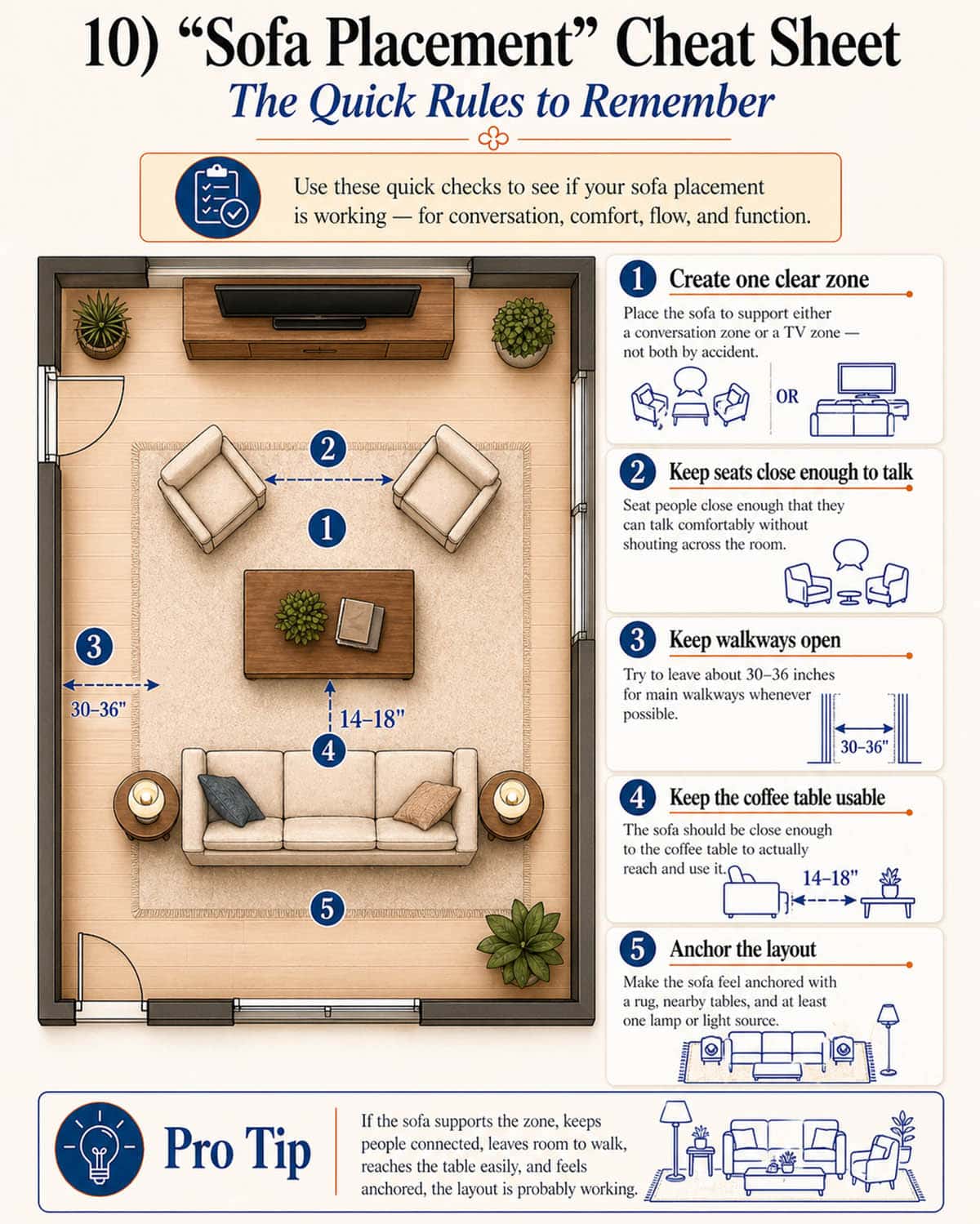
Put your sofa where it sits best for conversation, watching TV, or both:
- Use placement that creates a conversation or TV zone, but not both by accident. (have a plan)
- Have the right-sized sofa for your room dimensions.
- Doesn’t force people to shout at each other from across the room.
- Keeps main walkways open by aiming for 30 to 36″ whenever possible.
- It is close enough to the coffee table so you can comfortably reach it without effort.
- Feels anchored with a rug + tables + lighting for a cohesive living room seating layout.
To showcase highly specific designs, some images on this website use advanced AI-generation software to illustrate ideas and room inspiration. See our editorial policy to learn more.