How to Pick Rug Sizes (Interior Designer Tips For Each Room)

One might think that when picking a rug, the most important selection is the color and pattern, but on the contrary, size makes a huge difference. The size of a rug can mean the difference between echoes in the room and overpowering a space. Each layout and setting brings a different setup, requiring smaller or larger rugs to define spaces and bring comfort to a space. Rugs can help with acoustic issues as well as avoid putting bare feet on hard flooring. Some of the proper sizes are discussed below.
Choosing Rug Sizes For Your Home
Looking straight down makes the rule obvious: the rug should run past the front legs of every seat, not float in the middle like a placemat. Some of the common choices and ways to decide what size the rug should be can be done by keeping in mind that bigger is better. Choosing a bigger option avoids echoing in a room with tile or hardwood flooring and helps avoid making a room feel disjointed.
It is also important to check the room size and shape. If the room is long, then the rug should be long. If it is large, the rug should follow suit. Another consideration should be the furniture layout, which is going to be talked about in more detail later. Standard sizes only get you so far, what matters most is the furniture you’re putting on the rug and how much of it needs to land on there.
| Room & Setup | Go-To Size | The Rule | Where People Go Wrong |
|---|---|---|---|
| Living room, furniture floating | 9′ x 12′ | All legs on the rug | Buying an 8′ x 10′ and hoping nobody notices the back legs hanging off |
| Living room, sofa against a wall | 8′ x 10′ | Front legs on, coffee table centered | Letting the rug stop short of the accent chairs across the room |
| Small living room | 5′ x 8′ | No legs on, about 6″ of float in front of each seat | Going even smaller, which makes the room read as cluttered instead of open |
| Sectional, all legs on | Sectional footprint plus 18″ to 24″ | Measure the full L or U, then add the border | Measuring the seat cushions instead of the outside edge of the arms |
| Sectional, all legs off | Inside of the L, minus 6″ to 12″ | Rug lives inside the seating, not under it | Skipping this option entirely. It’s the one designers actually reach for |
| Dining, 48″ round table | 8′ round (72″ minimum) | Add 24″ to 36″ past the table edge | Sizing to the table instead of to the pushed-back chairs |
| Dining, rectangular six-seater | 8′ x 10′ | Every chair leg stays on, even pulled out | Using a 6′ x 9′, which catches chair legs on the edge all night |
| King bed, two-thirds on | 9′ x 12′ | Rug starts below the nightstands | Centering the rug on the room rather than on the bed |
| King bed, full coverage | 10′ x 14′ | Nightstands and bench all land on it | Running it so wide it creeps into the doorway swing |
| Queen or full bed | 8′ x 10′ | 18″ to 24″ of rug past the sides and foot | Grabbing a 5′ x 7′, which only reads as decor under the bed |
| Bedroom runners, either side | 3′ x 8′ (or 3′ x 9′ for a king) | Match the length of the bed | Buying two different widths and hoping the room balances out |
| Bathroom | 2′ x 3′ to 2.5′ x 5′ | Mirror the length of the tub or the width of the vanity | Anything that blocks the door from swinging clear |
| Entryway | 3′ x 5′ or 4′ round | Use the door width as your starting point | Picking by looks alone. This one takes the most abuse in the house |
Standard Rug Dimensions
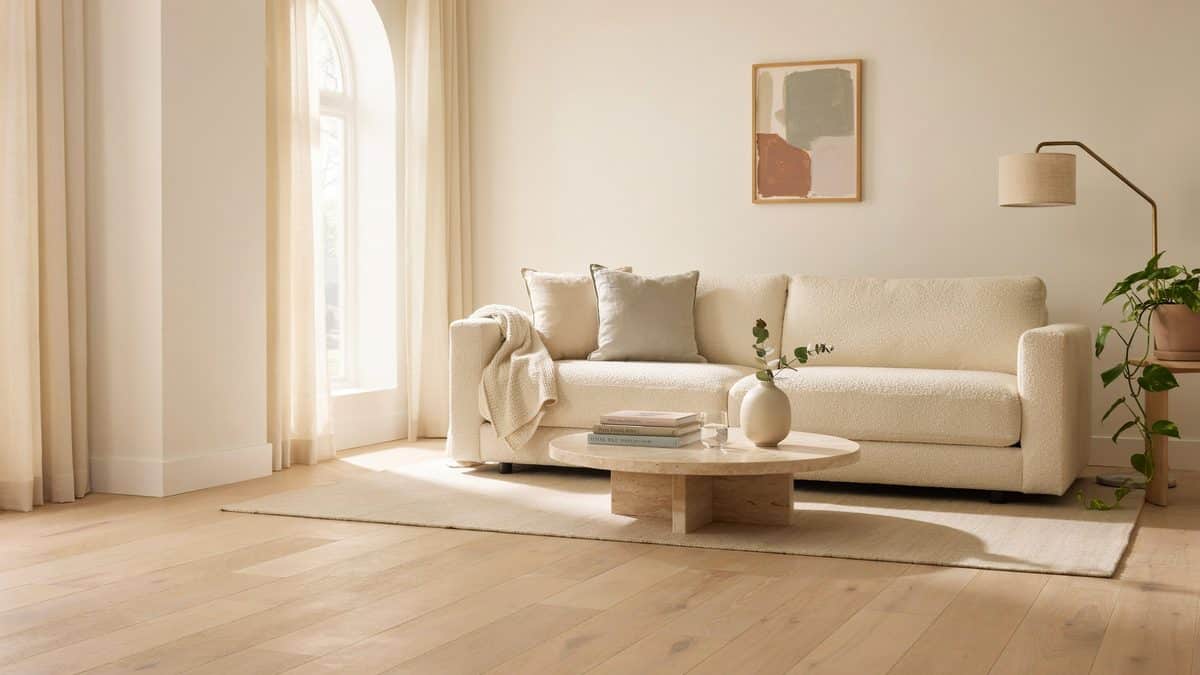
Here the sofa keeps only its front legs on the rug, which is the workaround when a room is too tight for the full nine by twelve.
Some rugs are readily available that can be picked up from a store and brought to your home. Based on the settings discussed below, you can pick from the standard sizes listed below or come up with a custom size that best fits your room and space.
The standard rug sizes that are available in most stores are:
Rectangular
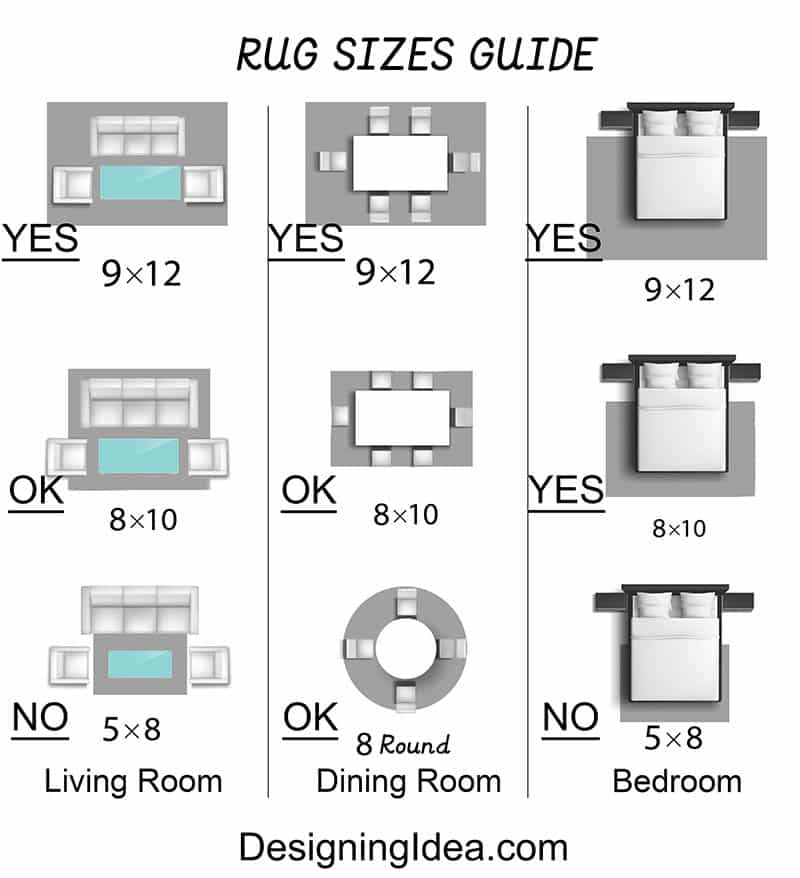
- 9 foot by 12 foot – This is a common living room rug size that is often used with a floating furniture layout. This means the furniture is pulled out from the walls and sits completely on the rug.
- 8 foot by 10 foot – This size works better for living rooms with furniture that sits against the walls. The front legs of the furniture should sit on the rug with a coffee table as the center point.
- 6 foot by 9 foot – For living rooms with furniture against the walls and front legs on the rug.
- 5 foot by 8 foot
- 4 foot by 6 foot
- 3 foot by 5 foot
Round
- 5-foot diameter
- 6-foot diameter
- 7-foot diameter
- 8-foot diameter
- 9-foot diameter
- 10-foot diameter
Runners
- 4 foot long
- 6 foot long
- 8 foot long
- 10 foot long
Square
- 5 foot long
- 6 foot long
- 7 foot long
- 8 foot long
- 9 foot long
- 10 foot long
While these may be the standard size that these certain types of rugs come in, there are also so many custom choices and other options available. These are just the most commonly used and made sizes.
Later in this article, rugs are referred to as small, medium, and large. Larger rugs are typically 8 feet or bigger. Medium between 5 and 7 feet. Small rugs are generally under the 5 foot range. While these vary in size and shape, it is a general way to understand what sort of rug you need.
Rug Size Chart
What Rug Measurements for the Living Room
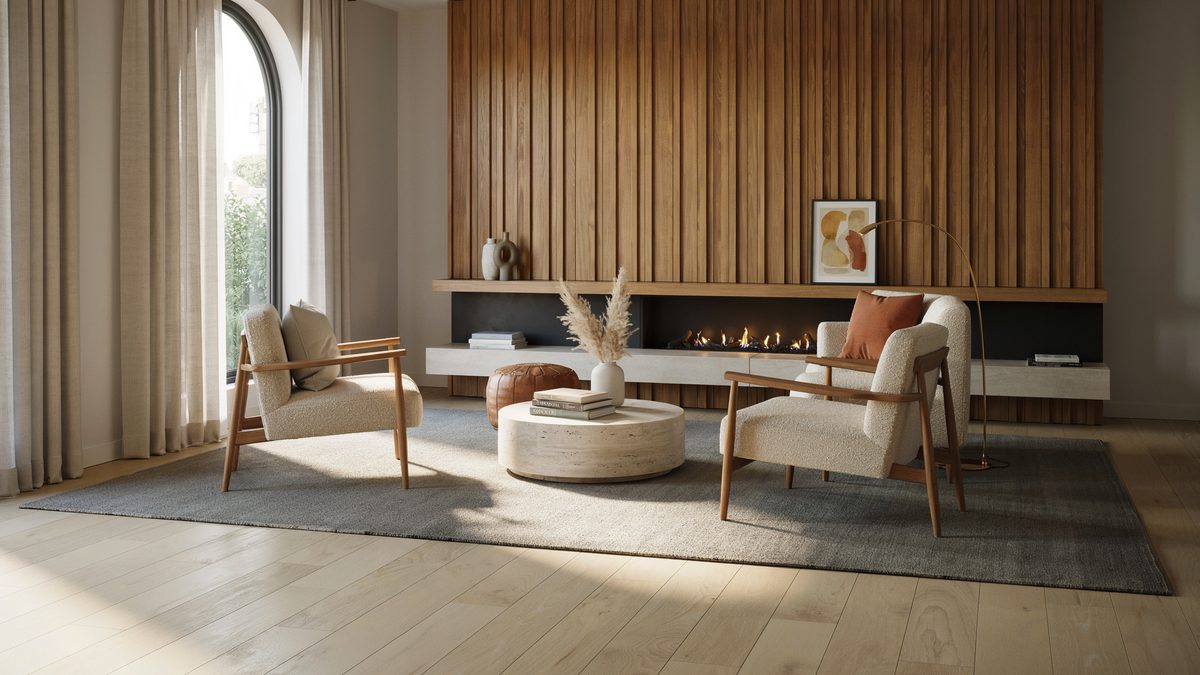
All four legs landing on the rug is the most generous of the three layouts, and it quiets the echo you get off hard flooring.
Living room rugs have a few different recommended sizes and shapes, and overall theories as to how they should be set up, based on use and taste. The most common three are legs all on the rug, front legs on the rug, and no legs on the rugs.
Starting with the legs on the rug, using the largest rug, this should pretty much take up much of the entire room. This tactic makes the room feel uniform and put together and is a great floor saver for the hard surface underneath. If using an open concept space, the rug gives a great form of space definition.
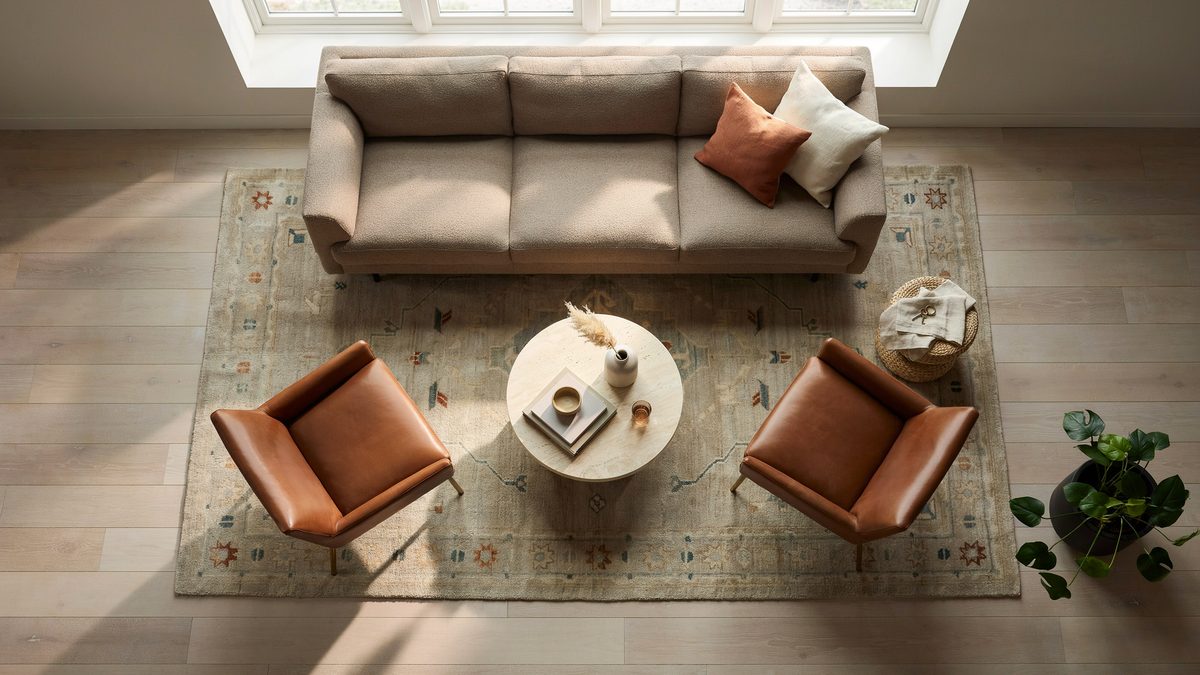
Two legs on the front of the chairs as well as the entire coffee table (if there is one present) on the rug. This requires pretty decent-sized rugs as well, depending upon the spacing of the seating in the area. This is often used in longer rooms and smaller, more closed-in rooms.
For very small rooms that you would like to be larger, do best when the rugs do not touch any of the legs on the seating, only one on the coffee table (if present). This calls for smaller rugs that are about six inches in front of each of the pieces of seating.
Correct Rug Measurements for a Sectional Couch
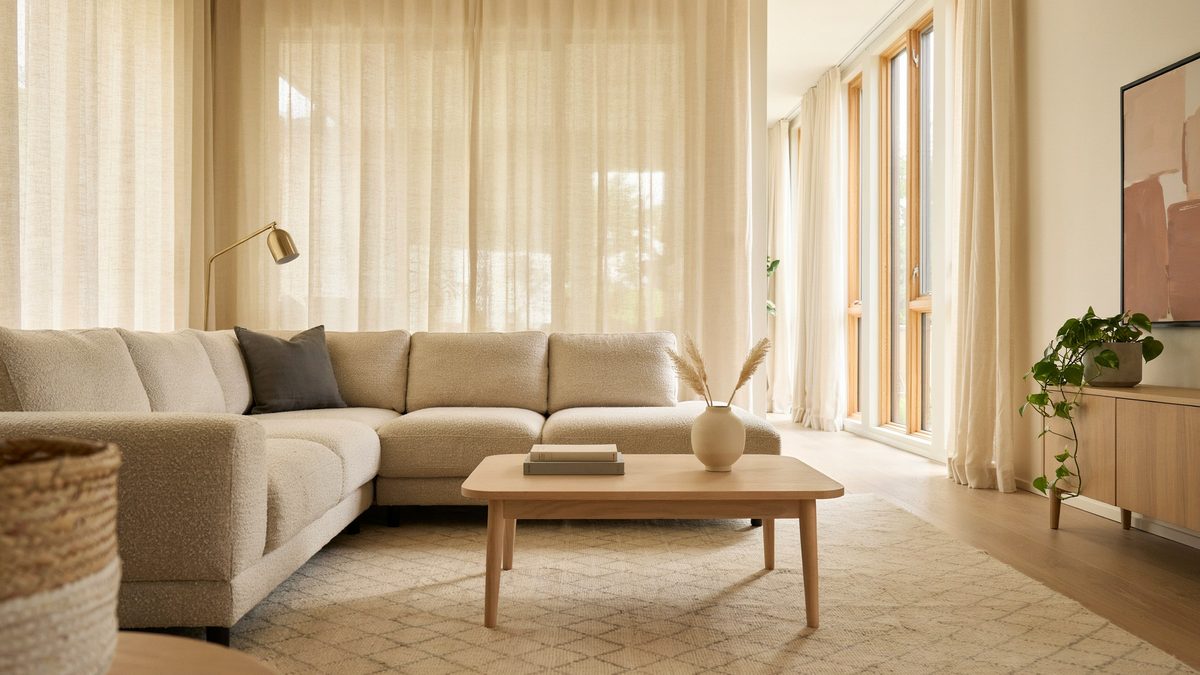
With a sectional, add roughly 18 to 24 inches past the arms if you want every leg on. Anything less and the rug reads as a bath mat.
One creative way to rugs to the living room is to combine it with a sectional. This also can be done in one of two ways: all legs on or all legs off. All legs on means that the rug needs to be large enough to cover the entirety of the sectional. Taking the length and width of the sofa and adding about 18 to 24 inches gives you the size of the rugs you need in that case.
With all legs off, you can measure the inside l or U or the sectional, shrinking it about 6 to 12 inches to fit along the inside of the sectional. This second way is actually the recommended way as it brings the energy to the middle of the area, where the users typically will be sitting and using the space.
It is acceptable not to extend it completely under the sectional sofa. However, if this is the case, you should position the front legs on it and the back legs off. In addition, it’s a good rule to keep all the legs of smaller furniture pieces on the floor covering.
There are other ways to include a rug with a sectional. You could add a round one to the inside of the sectional area, where a round coffee table is the best match. This also goes along best with rounded sections, which is a bit more uncommon. Another option is a sofa design layout with a half-on-half-off option, calling for a larger size, mocking the size of the sectional, and offsetting it a little for aesthetics.
Dining Room Rug Proportions
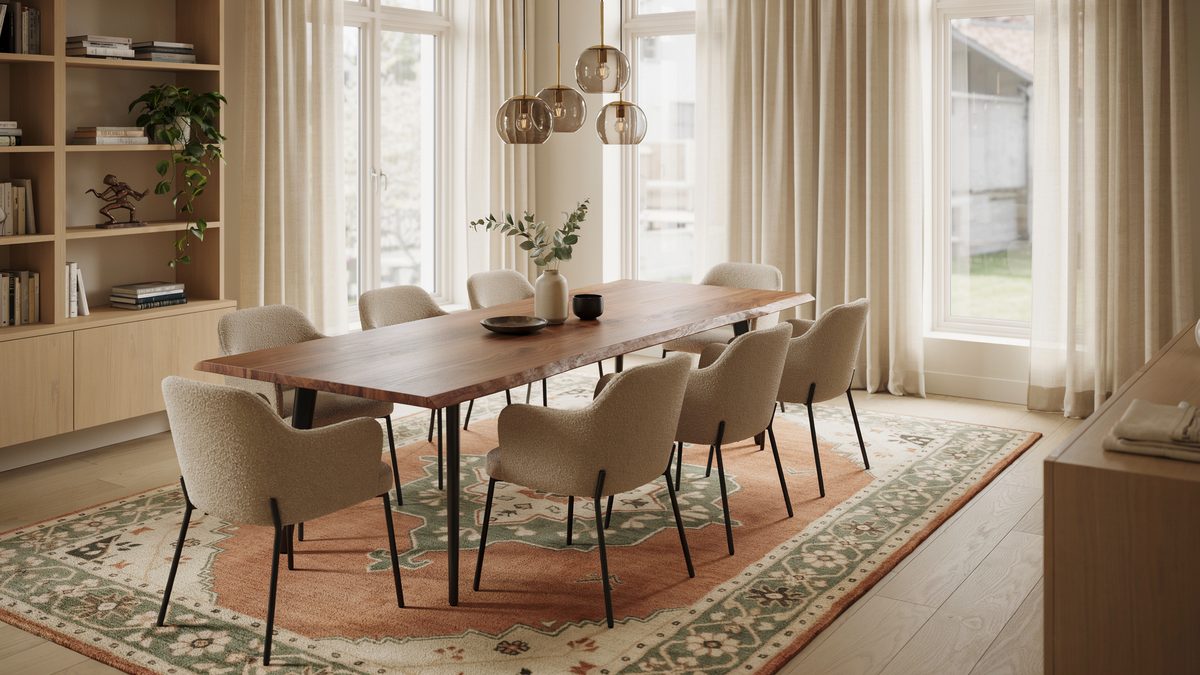
Notice how much rug shows past the chairs. That border is what lets someone push back from the table without catching a chair leg on the edge.
Dining room rugs are really best to stay with all the legs of the seating and the table on the rug. This is due to the chairs being a little less cushioned and heavy-duty, making them off-kilter when having them half on and half off. Just having the rug under the table is not as visually pleasing, as it would have to be a very small one for when the chairs are all pushed in. At that point the rug does not help much.
What Size Rug Under a 48 Round Table
The size of the dining room table is a major consideration. Typically, you want about 24 to 36 inches of extra space than table space – this gives room for the chairs to sit. Therefore, for a 48-inch round table, you need at least a 72-inch round rug. This gives space for the chairs and the individuals moving around; you do not want it too large, or it gets in the walkway and can be a tripping hazard.
Rug Dimensions for the Bedroom
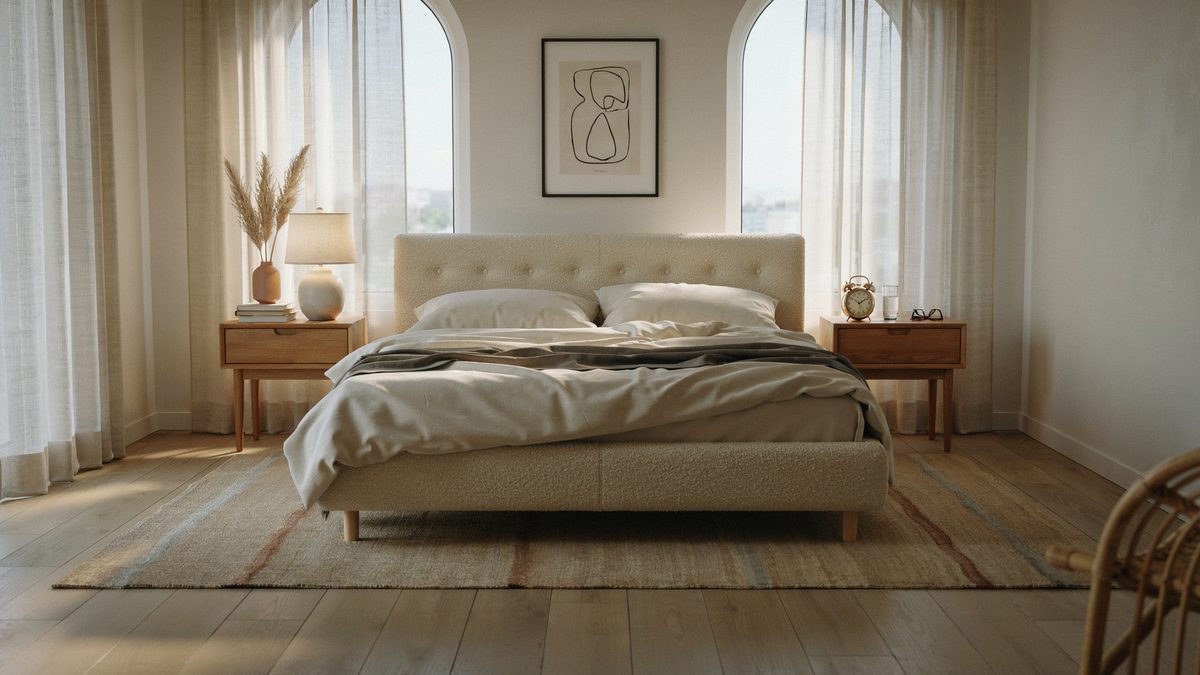
Running the rug wide enough to catch both nightstands is what keeps a bedroom from looking like the bed is parked on an island.
Moving onto bedroom-sized rugs, there once again are all legs on, all legs off, and a new 2/3 legs on the rug. When it comes to bedroom layouts with all legs on the rug, they need extremely large floor coverings based on the size of the room and the bed sizes used. This should also be large enough to go underneath the nightstand and end of bed bench (if they are present in the room). If possible, it should be 18 to 24 inches longer than the furniture pieces, but it should not get in the way of the walkways as they could become tripping hazards.
For the no-legs-on-the-rug version, this is mixed up a little, but by having two small rugs on either side of the bed, maybe even a third one along the end of the bed. Typically, these will be the length of the bed and either the same width as the nightstand or a little larger. In theory, these would be the walkways or where the user’s feet would land when getting on and off the bed.
Two-thirds on and one-third off gives a good framing to the bed while using only medium-sized rugs (less expensive than the larger ones) and still gives a good warmth to the room. Read more about bedroom rug placement here.
Rugs Suited for a King Bed
For a king, it should be 9 feet by 12 feet when it comes to being two-thirds on the bed. Larger at 10 feet by 14 feet for covering the whole bed, including end tables. A runner can be about 9 feet by 3 feet.
Rugs for a Queen Bed
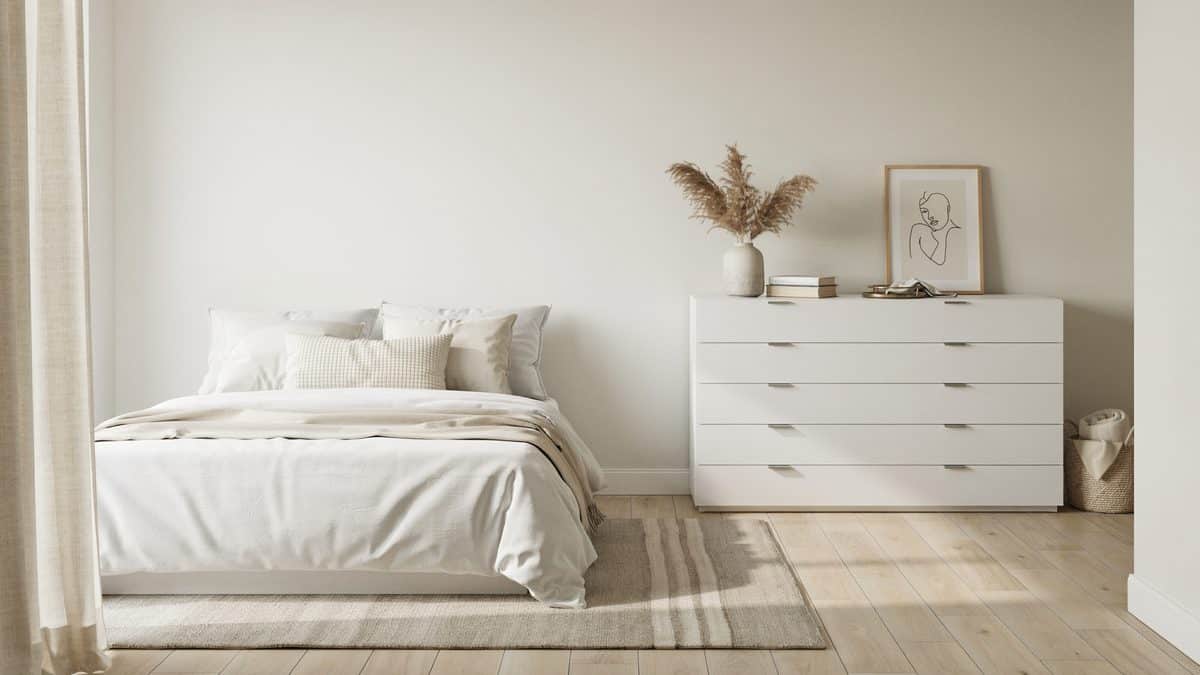
For a queen, a runner along the side covers the walkway where your feet actually land, and it costs a fraction of a full room-size rug.
Looking at a standard 60″ wide by 80″ long queen-sized bed, the rugs should be at least 8 feet long. For a queen bed with small end tables, you’ll want it to be about 8 feet by 10 feet. A larger rug covers the whole bed with larger furniture pieces. For just laying under a bed for decor purposes, 5-foot by 7-foot rugs are often used. Runners can be about 8 feet by 3 feet.
Rug Appropriate for the Full Bed
Full-sized beds are about the same size as queen-sized beds, meaning under-bed rugs should be about 8 feet by 10 feet. They are larger for covering the whole bed, and for runners, they can be about 8 feet by 3 feet.
Bathroom Rug Measurements
Since bathrooms are usually pretty small rooms, the rugs are also pretty small. There are options to put something the same length as the tub or mirror the width of the sink or toilet. Those are all common places to put the bathroom rugs.
Entryway Rug Sizing
The size of entryway rugs is very dependent on the size and shape of the entryway itself. They can be anything from round or half-circle to rectangular or square. Using the door as a general size guideline can be a great place to start. This usually puts the sizes around 3 to 4 feet, either in width or diameter.
To showcase highly specific designs, some images on this website use advanced AI-generation software to illustrate ideas and room inspiration. See our editorial policy to learn more.