Replacement vs New Construction Windows: When to Use Each Type

This comparison of replacement vs. new construction windows will help you see the differences between the two and find the best choice for your home. Both styles are available in a wide variety of styles, suitable for whatever your decor and design ambitions may be. Whether you need new construction or replacement windows comes down to several factors.
What’s the Difference between Replacement Windows and New Windows?
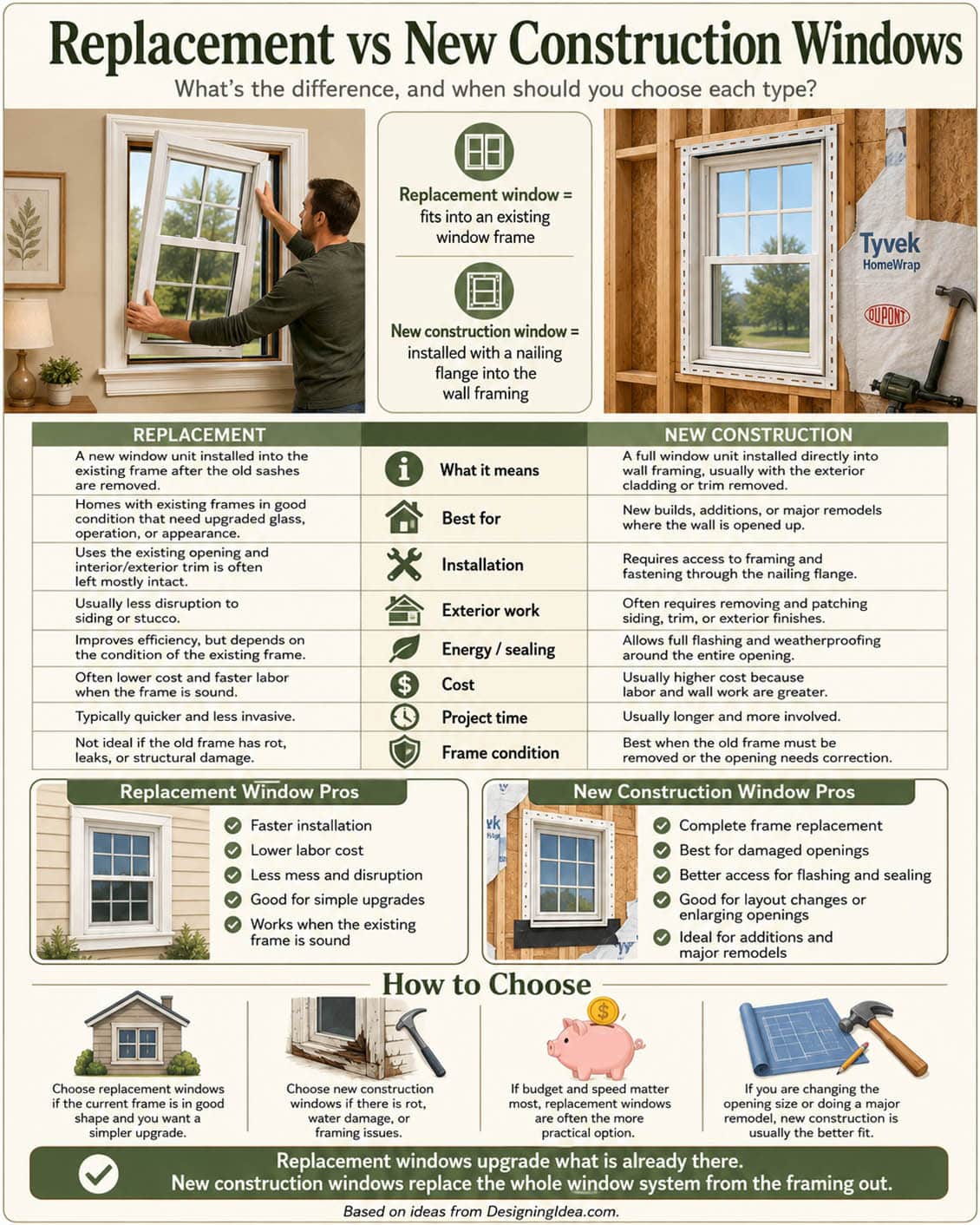
Replacement windows are only considered for installation on existing buildings. All new builds must have new construction windows installed. New construction windows come with a nailing fin, also known as an attachment fin or a flange. The flange is meant to secure the window to the home’s exterior wall. This attachment method allows for a larger percentage of the window to be glass.
These are called ‘new construction’ because they are standard when erecting a new building. The windows are attached while the studs of the building are still exposed; before they have been wired, insulated, and sealed. No exterior siding has yet been applied to the stud frame, leaving it free and clear for the attachment of a new construction window.
Replacement and New Construction Windows Comparison Chart
Here’s the short version before you scroll the chart. Replacement windows slide into the frame you already have, so they’re faster and cheaper. New construction windows need the studs exposed, which means opening up walls if the house is already finished. Everything else follows from that one difference.
| What You’re Comparing | Replacement Windows | New Construction Windows |
|---|---|---|
| How it attaches | Fits inside the existing window frame. No nailing fin. | Nailing fin (flange) fastens straight to the exterior wall studs. |
| Best for | Existing homes where the frame and studs are still solid. | New builds, additions, outbuildings, or a rotted frame that has to go. |
| Average cost per window | About $650 installed. Range runs $200 to $1,600. | About $700 installed, plus wall repair on an existing home. |
| Wall damage | Interior trim comes off. That’s usually it. | Interior drywall and exterior siding both get opened up. |
| Install time | One to three days for a whole house, depending on count and size. | Longer. Siding, drywall, and trim all have to be put back. |
| Glass area | Slightly smaller, since the unit sits inside the old frame. | Full size. More glass, a bit more daylight. |
| Energy efficiency | Comparable. Around 15% off the utility bill versus old windows. | Comparable, assuming a similar product and a professional install. |
| Disruption to the house | Low. Most people stay home through it. | High. Open walls, dust, and weather exposure while it’s underway. |
| Skip it when | The frame is rotted, termite eaten, or water damaged. | The existing frame is fine and you just want better glass. |
The choice that decides it for most people is the amount of wall damage you have. If your frames are healthy, replacement windows get you nearly the same performance without tearing into siding. If a plumber already found a burst pipe behind that wall, the wall’s coming open anyway, so you may as well get the bigger glass while you’re in there.
What Are the Replacement Window Options?
When the quality of the windows has degraded over many years, a homeowner has two options. The first is to remove just the windowpane. A replacement window can then be fitted inside the frame of the old window, increasing energy efficiency while requiring a minimum of construction effort.
Replacement windows are exactly what they sound like—a scaled-down version of your current window that can be horizontally installed into the existing frame. The interior trim will need to be removed, but if care is taken not to damage it, it can usually be replaced. This is also a perfect opportunity to retrim your windows for an updated look!
Easy, efficient, and quick, replacement windows are a low-stress home upgrade and by far the most common choice for window replacement. In fact, replacement windows are almost always the right choice, provided that your existing frames are still in good shape.
Most homeowners will need professional help to determine the relative health of their window frames. A professional will be able to take the history of your home, including previous and current damage, original installation method, and any renovations or replacements that may affect the window replacement process. Then, they will provide you with a price for the materials and installation for both options — replacement vs new construction windows.
Finally, considering your needs and desires, they will recommend a plan of action. Measuring, sourcing, and delivering the windows can usually be done in about four weeks. The installation of the new/replacement windows will take between one and three days, depending on the size and number of windows. Clean-up and finishing touches should usually be completed within six weeks of signing the contract unless unforeseen circumstances interfere.
It is important to note that any non-standard sized windows will increase the cost of both material and installation. See our guide to standard windows sizes here. However, some homeowners find themselves needing to replace both window and frame, in a home that has already been finished. There could be many reasons for this — water or insect damage are two of the most common.
If you’re in this situation, both the interior and exterior walls around your window will need to be disturbed in order to remove the old frame and insert the new one. It’s a bigger project than simply replacing the windows, but the results should last longer.
Because a replacement window is made to fit inside an existing frame, it will always be slightly smaller than a new construction window. One silver lining of needing to replace the entire window and frame is that the surface area devoted to glass will stay exactly the same. Replacement windows have less glass, and so they catch slightly less light than their new construction counterparts. See our gallery of the different types of windows here.
Replacement vs New Construction Window Prices
Calculating the cost of a construction project requires you to think about both present and future concerns. First, the cost of the materials — replacement windows are slightly smaller and use less material than new construction windows, so they tend to cost less.
Next, the cost of labor—installing new construction windows in an existing home will take longer than installing replacements. If you choose new construction windows, you also need to add the cost of repairing the interior and exterior walls.
Replacement or new construction windows should be equally energy-efficient, assuming a similar product is chosen and professionally installed.
The typical cost to replace a window is about $650 for each window. However, this price can vary depending on the type, size and material. The typical range for replacement windows is between $200 to $1600 each. This price includes labor costs.
New replacement windows can help recover lost energy costs, saving you an average of 15% off your utility bill which can immediately help offset the costs. New construction windows will cost, on average, about $700 per window.
When to Install Replacement Windows
Whether or not to install replacement windows vs. new construction windows depends first on one question: What is the condition of your existing studs and window frames? If there has been no extreme damage to the frame and surrounding area, it is usually easier to use replacement windows. This allows you to avoid damaging and repairing interior and exterior walls to access the studs underneath.
If the frames of your existing windows have been damaged, it’s highly likely that there is significant damage to other components lurking behind the surface. Termites and burst pipes rarely constrain themselves to one material in your home. The interior drywall or exterior siding may have been affected by insect damage.
If the property has been flooded, even your flooring and subflooring may need to be inspected. If you are already going to expose the inner workings of your home, it is probably worth having new construction windows installed. Otherwise, replacement windows are the cheapest and easiest option.
When to Install New Construction Windows
Always install new construction windows in new homes, add-ons, new outbuildings, or additions. Consider installing new construction windows in your existing home if there is significant damage to the window frame and/or other housing elements.
If the existing frame is in reasonable condition, there is only one reason to choose a new construction window over a replacement window: light. The smaller surface area of the glass in a replacement window is due to the installation method.
To showcase highly specific designs, some images on this website use advanced AI-generation software to illustrate ideas and room inspiration. See our editorial policy to learn more.