Narrow Kitchen Layouts That Prove You Don’t Need a Big Space to Cook Well
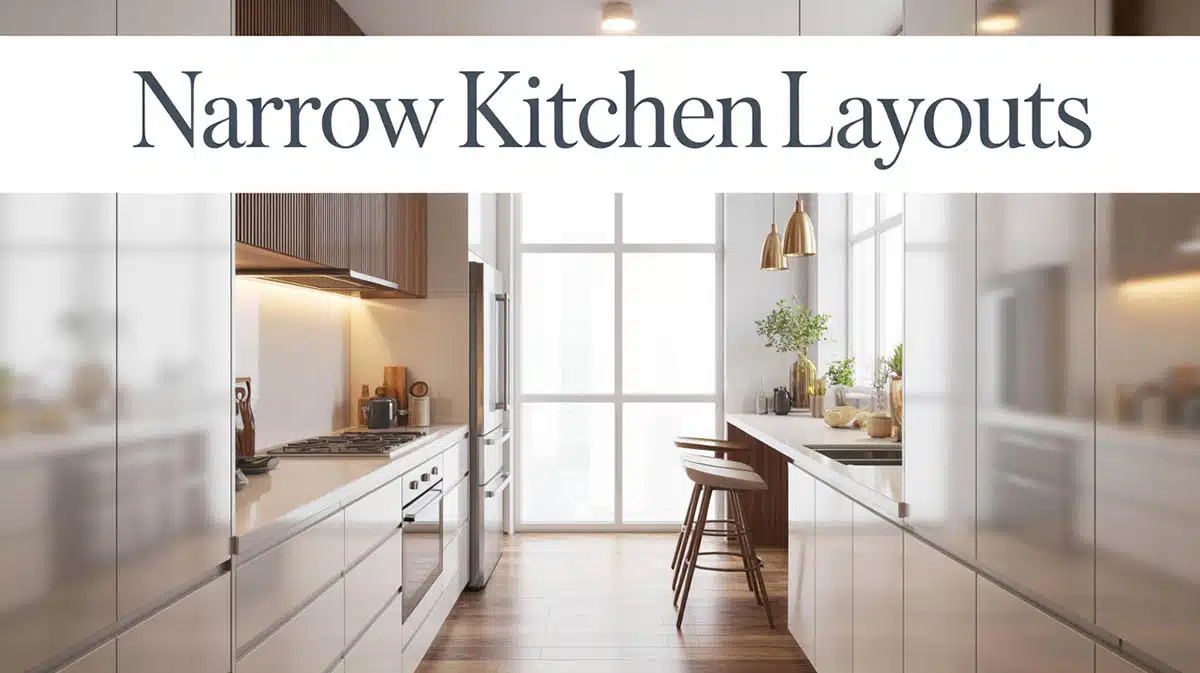
If you’ve got a house with a really narrow kitchen, it poses some interesting problems that can seem difficult to fix. Having a narrow space like this isn’t necessarily a bad thing. Some of the most efficient cooking spaces ever designed are those with long, tight cabinets that run along a single wall or two parallel ones. Many professional kitchens are basically narrow by design and have an efficient floor plan with less wasted motion, and everything within reach. The narrow kitchen layouts shared in this guide range from a compact 7 by 16 one-wall setup all the way up to a 9 by 14 galley with a full pantry wall and dual cooking zones. I’ve carefully planned each one so you can see what works in the dimensions provided, using real appliance sizing and storage solutions so you know exactly what you’re working with. So if you’re thinking about planning a similar design, you can use these options as inspiration for your remodel project. [toc]
7×16 One-Wall Streamlined Kitchen Layout
This layout offers a tight, well-sequenced single wall kitchen that’s designed to give every inch a purpose to maximize efficiency.
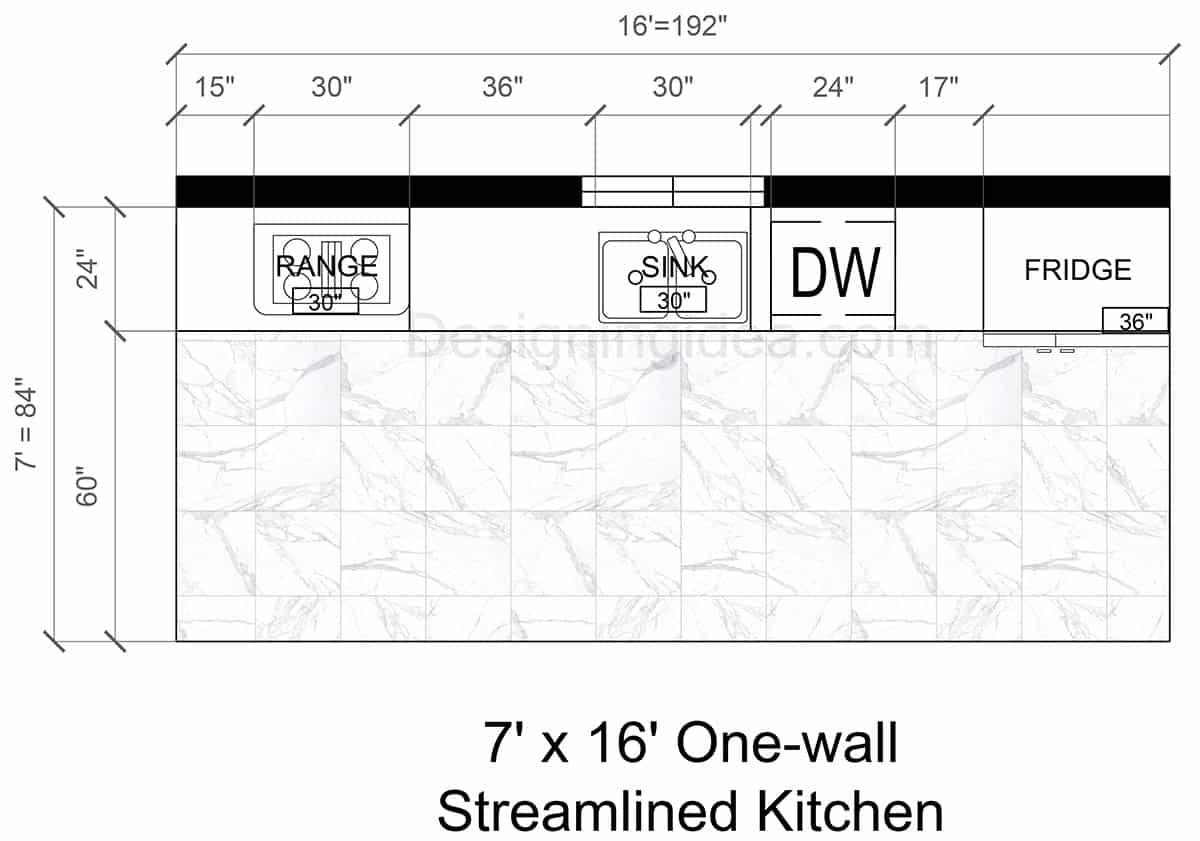
Floor plan details: This 7′ x 16′ one-wall kitchen layout is streamlined so that everything is placed along the single 16-foot wall. There’s no island or peninsula, just one long run of cabinets and appliances in a space that’s 7 feet deep. It’s an efficient setup that starts from the left with a 30″ range flanked by 15″ of cabinet space on one side and 36″ of counter space on the other side for your prep zone. Moving to the right the next thing is the 30″ sink in the center under a 36″ window that’s followed by a 24″ dishwasher and finally a 36″ fridge on the far right end. The countertop depth runs 24″ throughout, and the floor space opens up to a full 60″, or 5 feet of clearance in front. This gives you enough room for two people to move around without any trouble.
Dimensions:
- Total length: 16′ (192″)
- Room depth: 7′ (84″)
- Open floor clearance: 60″
- Countertop depth: 24″
- Range: 30″ wide
- Sink: 30″ wide
- Dishwasher: 24″ wide
- Refrigerator: 36″ wide
- Left end cabinet: 15″
- Center prep counter: 36″
- Right gap cabinet: 17″
Design tips:
- Install pull-out pantry cabinets and go vertical with your cabinetry from the floor to the ceiling if you can.
- Keep the fridge at the end so it doesn’t interrupt the workflow between the range and sink.
- Ensure that your fridge opens properly in the space it’s installed in.
- Prioritize the 36″ window above the sink as it provides natural light, which is beneficial in a narrow kitchen.
- Choose light countertops, as darker colors can make a 7-foot-wide kitchen feel a bit cave-like.
- Consider a single-basin sink over a double since you’ve only got 30″ to work with and every inch counts.
8×12 Galley Kitchen with Efficient Two-Wall Floor Plan
The galley turns a narrow room into a perfectly choreographed workflow, with everything within easy reach for an easier cooking process.
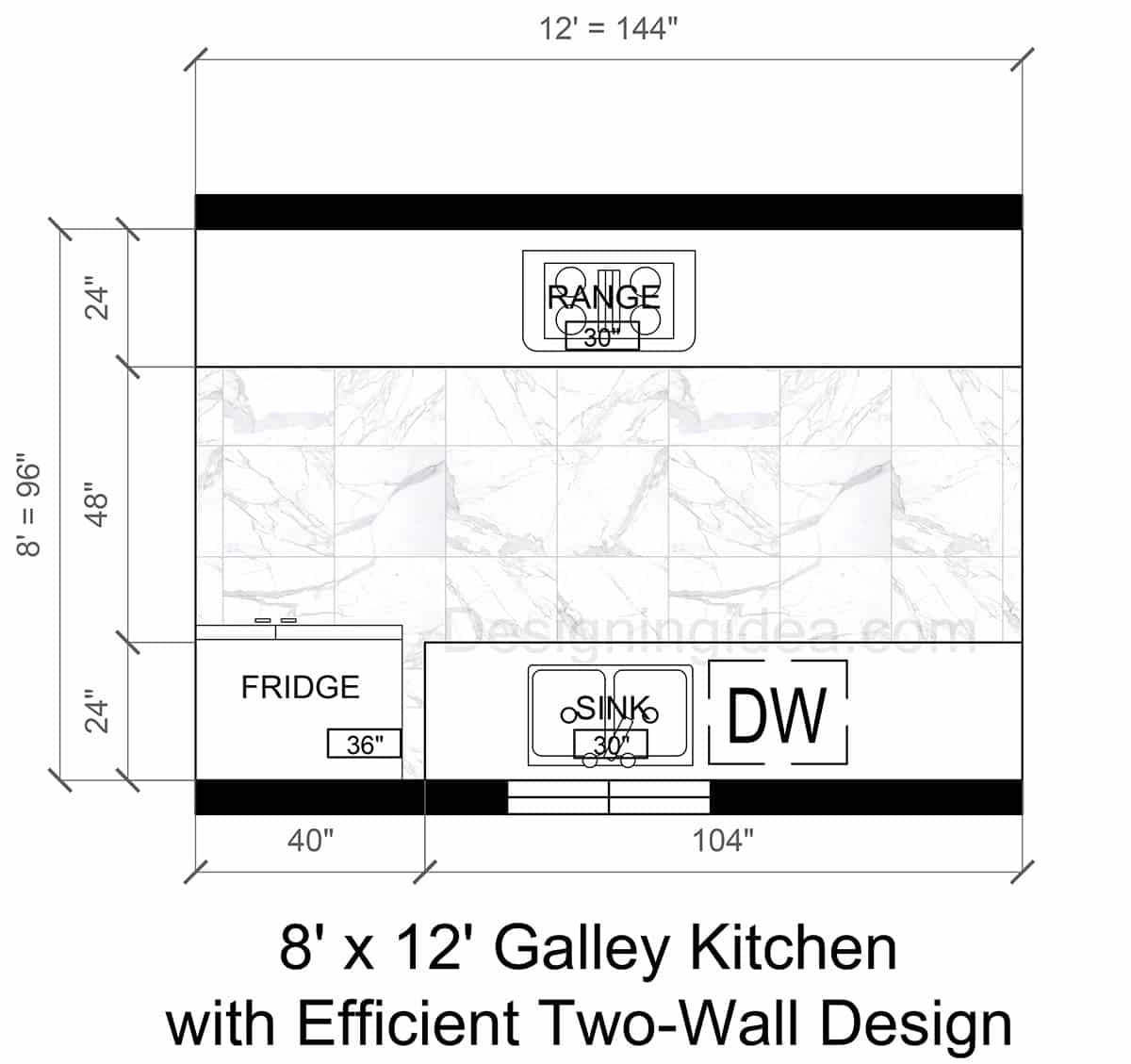
Floor plan details: This 8′ x 12′ galley kitchen features an efficient setup with two walls facing each other. The top wall handles the cooking with a 30″ range that sits in the center of the 12-foot run, with 24″ deep counters on either side, giving you plenty of prep space. The bottom wall is where the cleanup and storage are located, with a 36″ fridge in the left corner, and then a 30″ sink plus dishwasher fills out the remaining 104″ to the right. The aisle between the two walls is 48″, which is just enough for two people to not feel too cramped while working together. See another compact galley kitchen design here.
Dimensions:
- Total room: 8′ x 12′ (96″ x 144″)
- Aisle clearance: 48″
- Counter depth (both walls): 24″
- Range: 30″ wide, top wall center
- Refrigerator: 36″ wide, bottom-left (40″ wall section)
- Sink: 30″ wide, bottom wall
- Dishwasher: 24″ wide, beside sink
- Bottom wall split: 40″ (fridge zone) + 104″ (sink/DW zone)
Design tips:
- Keep the aisle clear of any obstructions since the 48″ pathway is workable for one person, and tight for two.
- Keep the fridge placement near the entry side, so family or any guests can grab a drink without walking through your whole space.
- Since no window is shown here, lighting matters a lot; try installing under-cabinet lights on both walls to make a big difference.
- Use the top wall for all of your tall upper cabinets.
- Going with pocket doors or no door at all works best with galley layouts, as a swinging door into a 48″ aisle cuts into valuable floor space.
9×14 Galley Kitchen With Tall Pantry Wall Layout
This kitchen splits cooking duties across two walls and gives the cook a 60″ aisle to move around in.
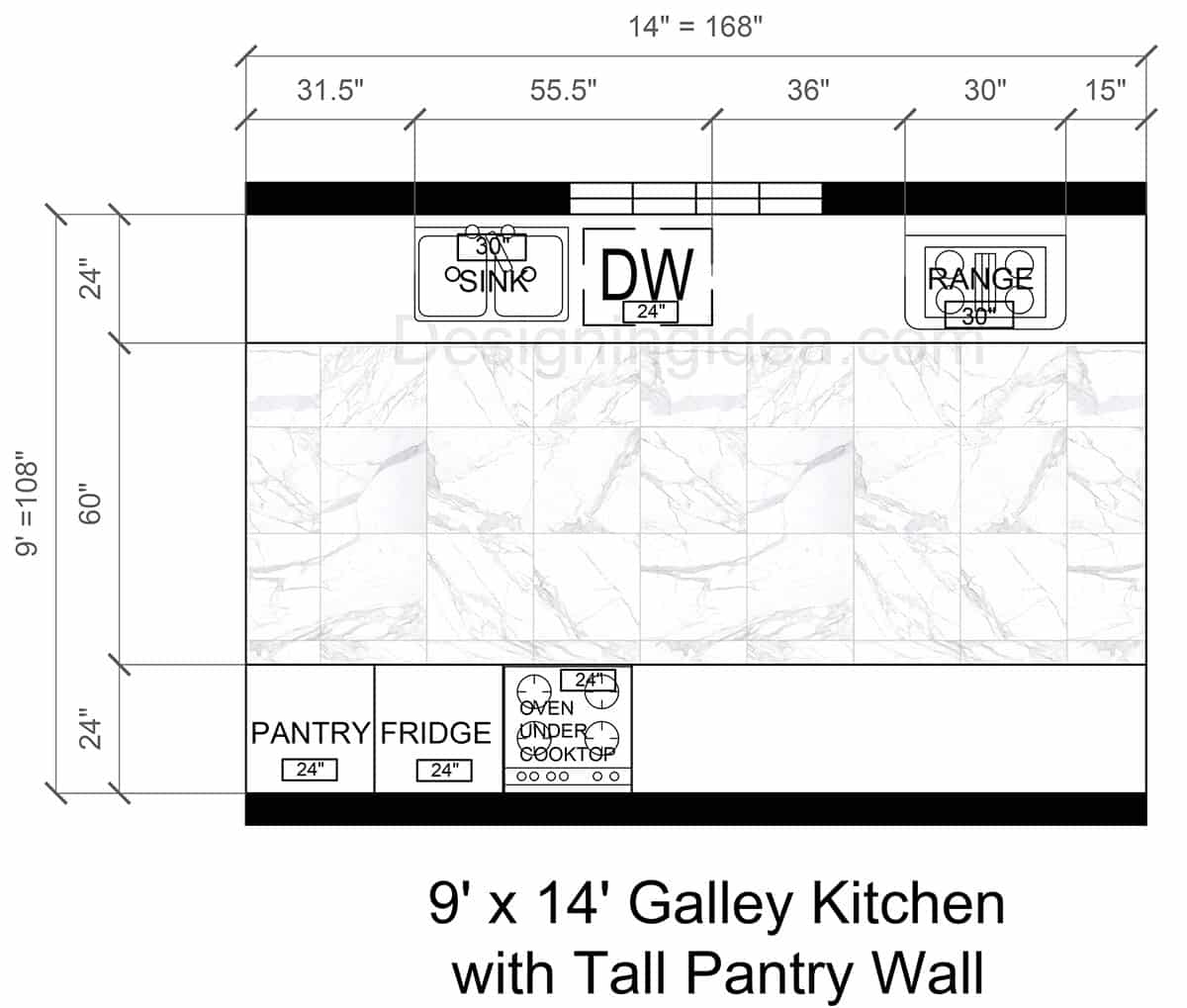
Floor plan details: This 9′ x 14′ kitchen features a classic galley style configuration with a tall pantry wall. Instead of two identical walls facing each other, you’ve got a working wall up top and a storage-focused wall below for a smart split design. The top wall runs the full 14 feet and handles all the wet and hot work. Spanning from left to right on top, you have 31.5″ of cabinet space, a 30″ sink with a window above it, a 24″ dishwasher, 36″ of countertop, a 30″ range, and a final 15″ cabinet at the end. For this arrangement, the prep happens between the sink and range, which are close but not located right on top of each other. The bottom wall is storage-focused with a 24″ pantry cabinet, a 24″ fridge, and then a 24″ under-counter oven with a cooktop on top. This lower section gives you a second cooking zone, which is great if two people cook at the same time, or if you just want to keep baking separate from everything else. There is also a large 60″ aisle that makes it work well for two people simultaneously.
Dimensions:
- Total room: 9′ x 14′ (108″ x 168″)
- Aisle clearance: 60″
- Counter depth (both walls): 24″
- Sink: 30″ wide, top wall
- Dishwasher: 24″ wide, top wall
- Range: 30″ wide, top-right
- Pantry cabinet: 24″ wide, bottom-left
- Refrigerator: 24″ wide, bottom wall
- Under-counter oven with cooktop: 24″ wide, bottom wall
- Top wall segments: 31.5″ / 55.5″ / 36″ / 30″ / 15″
Design tips:
- Make the pantry cabinet a proper floor-to-ceiling pull-out model, so you’ve basically got a walk-in pantry’s worth of storage in 24 inches.
- The second cooking zone on the bottom needs ventilation for the cooktop with a downdraft system or some creative hood placement.
- The sixty inches of aisle means you could fit a small island on wheels in here and roll it out when you need it, and park it against the bottom wall when you don’t.
- Keep the upper cabinets consistent on the top wall and resist the temptation to add open shelving since closed storage keeps things looking calmer.
9×13 L-Shape Kitchen With Short Peninsula Floor Plan
The L-shape kitchen with a peninsula gives you a proper work triangle, seating inside looking out, and a natural room divider all at once, without needing much more space than a basic galley.
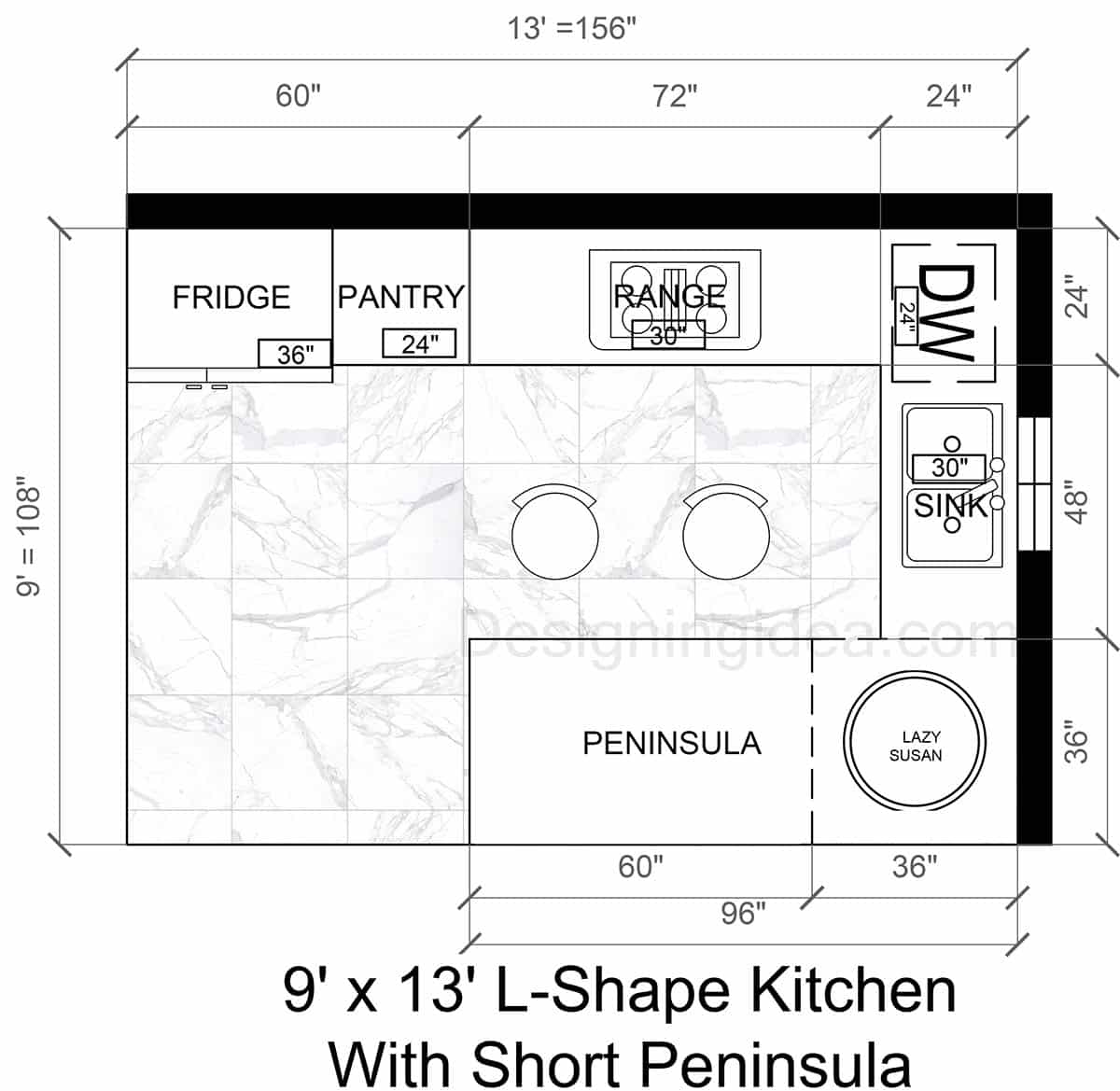
Floor plan details: This 9′ x 13′ L-shape kitchen has a short peninsula that increases the amount of available countertop space and gives a place for sitting and casual eat-in dining. The L-shape is the first layout in this series that actually zones the kitchen into different utility areas. Cooking happens in one direction, cleanup in another, and the little peninsula works to separate the kitchen from whatever room is next door. The top wall runs 13 feet and starts with a 36″ fridge and a 24″ pantry that sit together on the left. Then a 30″ range centers the middle stretch, and over on the right, there’s a 24″ dishwasher that sits up top, and a 30″ sink runs down the short right side. The peninsula extends 96″ total from the bottom right wall, with a lazy Susan tucked into the corner and room for two stools to tuck underneath when not needed.
Dimensions:
- Total room: 9′ x 13′ (108″ x 156″)
- Top wall: 156″ total (60″ fridge/pantry zone + 72″ range zone + 24″ DW)
- Right wall: 48″ with 30″ sink
- Peninsula: 96″ total (60″ + 36″ corner section)
- Fridge: 36″ wide
- Pantry: 24″ wide
- Range: 30″ wide
- Dishwasher: 24″ wide
- Sink: 30″ wide
- Peninsula seating clearance: 36″
Design tips:
- The fridge-pantry pairing works well as a dedicated grocery zone so you can easily collect your ingredients while cooking.
- Install the lazy Susan corner cabinet to avoid any dead space under the peninsula.
- Add two barstools at the peninsula to turn the space into one where people actually hang out.
- The sink being on the short wall under the window provides a nice view while doing dishes and gives needed natural light in the room.
- Watch the traffic flow near the peninsula and use low profile stools that can tuck underneath so they don’t crowd the aisle.
9×11 Compact U-Shape Kitchen With Max Storage & Tight Work Triangle Design
- When square footage is tight, a U-shaped kitchen pulls everything closer together, making cooking feel almost effortless.
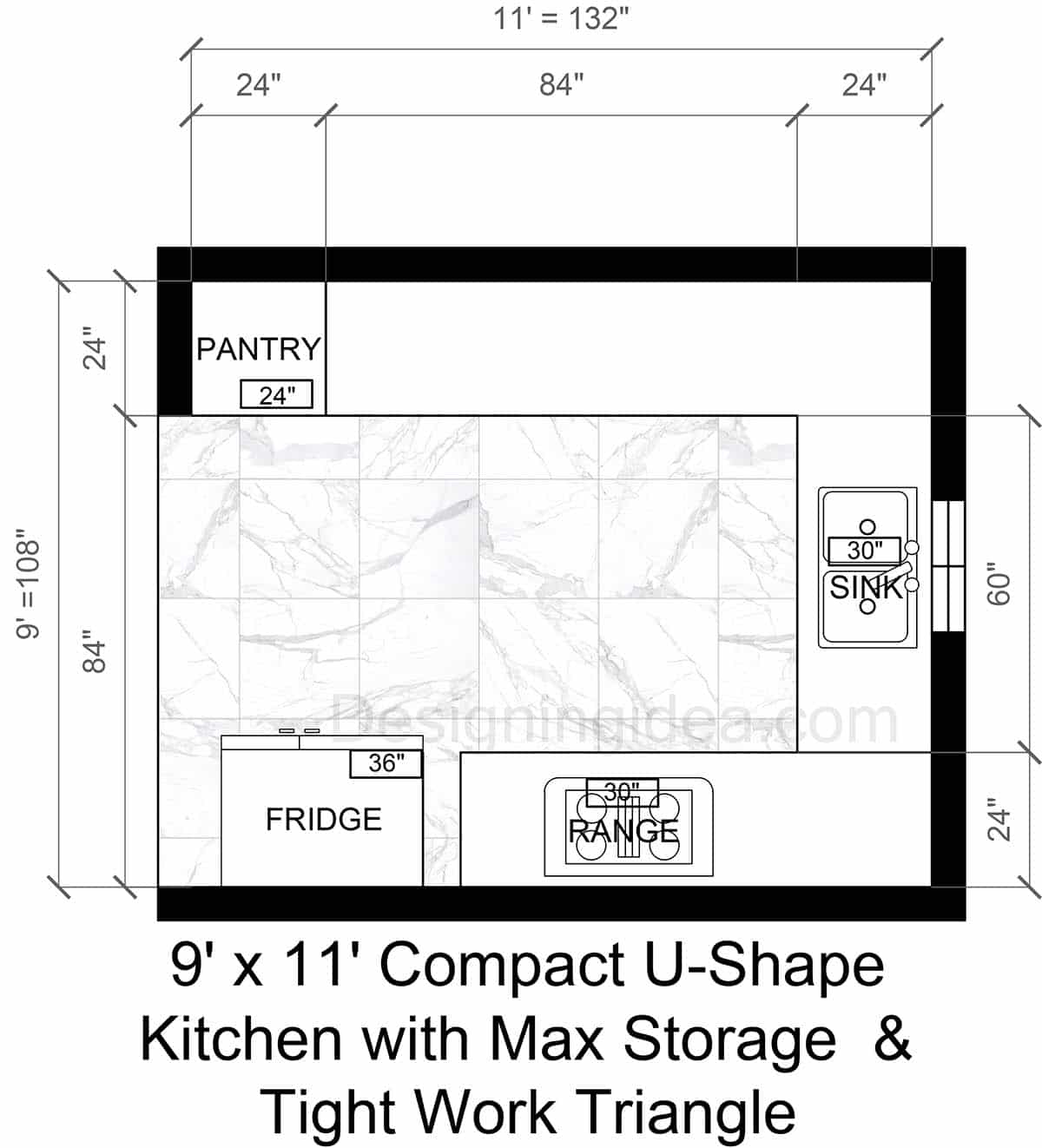
Floor plan details: A 9′ x 11′ compact U-shape kitchen gives you the max amount of storage while still offering a tight work triangle. It’s got three walls for a full wraparound design with the left wall starting things off with a 24″ pantry up top. The right wall holds a 30″ sink in the middle of a 60″ run. The bottom wall handles the big stuff like the 36″ fridge on the left and a 30″ range sitting right next to it. The open center wall at the top is just counter space and storage with no appliances. The result is an effective work triangle that’s tight and ideal for one or two people to use at maximum efficiency.
Dimensions:
- Total room: 9′ x 11′ (108″ x 132″)
- Top wall: 132″ total (24″ + 84″ counter + 24″)
- Right wall: 60″ with 30″ sink
- Bottom wall: 24″ depth with 36″ fridge + 30″ range
- Left wall pantry: 24″ wide
- Interior open space: 84″ across
Design tips:
- For the most cabinet storage, go vertical everywhere with floor-to-ceiling uppers on all three walls.
- Since the fridge and range are side by side on the bottom wall, which is a little unconventional, you’ll need to put a proper heat buffer between them, even if it’s just a small cabinet.
- Since there is no dishwasher shown here, you may want to consider placing it next to the sink on the right wall.
- That big open top wall is prime real estate for a window or a run of glass-front cabinets, so it opens things up and can add some drama with LED backlighting.
- U-shapes can feel closed off if you’re not careful, so use light colors, open shelving on one wall, and good lighting to make a real difference.
Narrow Kitchen Plan Comparison Chart
| Layout | Room size | Aisle | Best for | Main advantages | Watch out for | Cooks at once | Storage |
|---|---|---|---|---|---|---|---|
|
One-wall
7 x 16 ft
|
112 sq ft | 60″ | Open plans & Studio/loft | Max open floor space, simple plumbing run, easy to supervise kids, budget-friendly install |
No work triangle, limited upper storage | ★ | ★★ |
|
Galley (2-wall)
8 x 12 ft
|
96 sq ft | 48″ | Solo cooks & pass-through rooms | Tight, efficient workflow, pro kitchen feel, double counter runs fridge at the entry |
Tight for 2 cooks. No seating | ★★ | ★★★ |
|
Galley + pantry
9 x 14 ft
|
126 sq ft | 60″ | Serious cooks & two-person cooking |
Dual cooking zones, generous 60″ aisle, tall pantry storage, range + oven split |
Needs a ventilation plan & It is a more complex build |
★★★ | ★★★ |
|
L-shape + peninsula
9 x 13 ft
|
117 sq ft | 36 to 48″ | Families & open-plan homes |
Real work triangle, peninsula seating, natural room divider, Lazy Susan corner fix |
Peninsula traffic flow & corner cabinet waste |
★★ | ★★ |
|
U-shape compact
9 x 11 ft
|
99 sq ft | 48″ | Solo cooks & max storage needs |
3-wall storage, shortest work path, most counter space, enclosed, focused feel |
Can feel closed in & one-cook kitchen |
★ | ★★★ |
Designing Tips For A Kitchen With a Narrow Layout
Light is doing more work than you think – In a narrow kitchen, natural light isn’t decorative, it’s structural. Having a window above the sink or a glass-panel door at the end of the cabinetry run can make the room feel twice as wide. I’ve seen clients spend thousands on cabinetry and then wonder why the kitchen still feels tight. It’s almost always the amount of light in the room that makes the most impact.
Your upper cabinets might not be doing everything they can – Standard uppers stop at 30 inches, which leaves a foot or more of dead space between the cabinet top and your ceiling. Instead of this, take them from the floor to the ceiling. This way, you’ll use those top shelves for seasonal stuff, big decorative platters, and things you only need every once in a while, but you’ll have them accessible when you need them.
The aisle number matters more than the room size – Clients sometimes fixate on square footage. I get it, but honestly, having a 48-inch aisle in a tight galley cooks better than a 60-inch one with a poorly placed island. That clearance between the counters is where everything actually happens in day-to-day use.
Pulls over knobs – In a narrow kitchen, you’re brushing past cabinet fronts all the time. A knob can catch your hip, while a pull doesn’t. It may seem like a small thing, but switching to pulls is an easy fix to avoid the discomfort and help elevate your style at the same time.
Don’t put the fridge in the middle – This one surprises a lot of people. But having your fridge located mid-run breaks your counter space into two short sections. Push it to one end, and you’ve got one long, uninterrupted prep surface. It’s also more convenient when your fridge is located closer to the living space, so there’s less movement required to get a quick drink when you’re on the go, and it helps keep visitors out of the main cooking space.
Vertical storage is basically free counter space – There are a few ways you can easily clear up your counter. Having a magnetic knife strip, a rail system on the backsplash, and hooks for pots are some that come to mind. In a narrow kitchen, your walls are storage, and many people don’t think to use them enough.
Color has a job to do here – Light countertops and cabinet faces reflect light back into the room, while dark ones absorb it. I’m not saying you can’t have dark lower cabinets, as this can it can actually look great, but be deliberate. Know that there’s a trade-off in having darker surfaces that may impact the space and its overall feel.
The addon splurge worth making – If there’s one place to spend a little extra money in a narrow kitchen, it’s in the cabinetry hardware and the faucet. Since you’re close to everything in here, you touch it all the time. Avoid cheap hardware in a small kitchen and splurge on an upgrade that will make it feel satisfying to use every day.
To showcase highly specific designs, some images on this website use advanced AI-generation software to illustrate ideas and room inspiration. See our editorial policy to learn more.