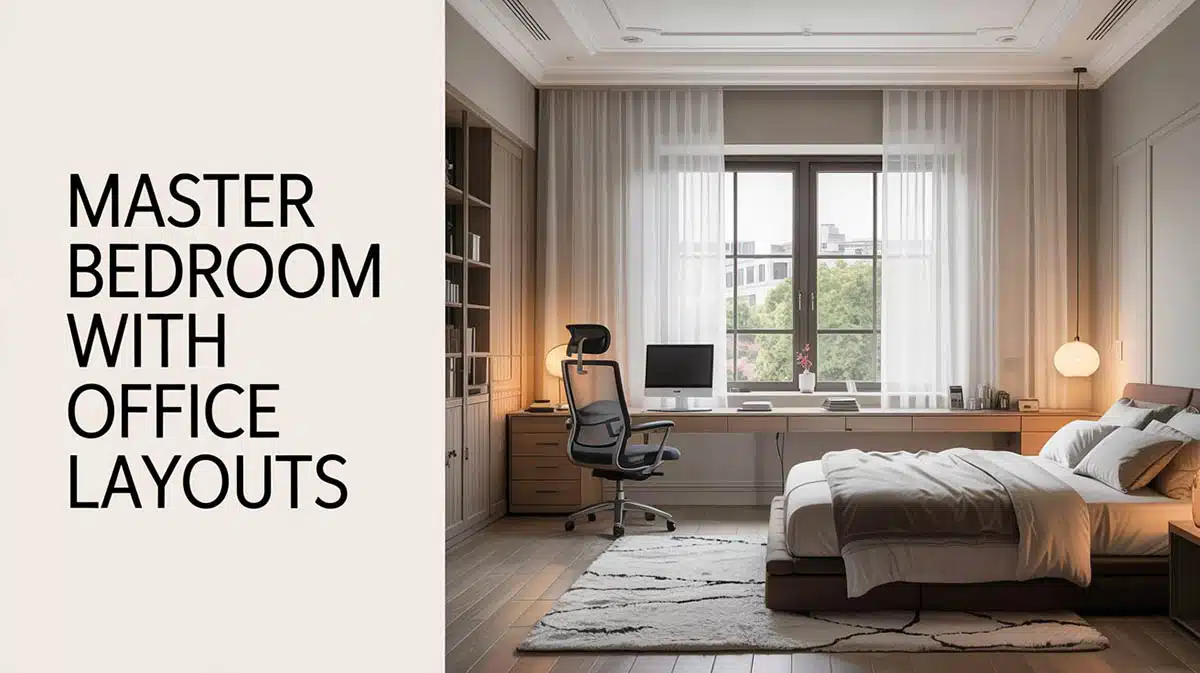
Working from your kitchen table isn’t always the best place for your home office, especially if you have a busy household. A master bedroom with an office can be an excellent alternative for a quiet place where you can work productively without any interruption. When carefully planned, master bedroom with office layouts can effectively separate the areas where you sleep, relax, and work so you can get the most out of the space you have. Below, I’ll walk you through five different designs with recommended desk placements, including dealing with awkward corners, glare from windows, and the little design moves that make the space feel like a bedroom.
13×16 Master Bedroom Layout With Window-Side Office Wall
This primary bedroom positions the bed in a strong rest zone according to Feng Shui principles, with the desk on the opposite side under a window and a different wall, so that its work energy stays contained away from where you sleep.
Easily Create Your Own Room Makeover
Upload a photo and get instant before-and-after room designs. No design experience needed — join 2.39 million+ happy users. 👉 Try the AI design tool now
Floor Plan Details: This 13′ x 16′ master bedroom splits the room into two separate zones with the sleeping area on the left and an open office wall under a window in the top right. The bed has its headboard against the left wall, with two nightstands on either side. In Feng Shui principles, the headboard against the wall helps keep the bed visually quiet for a calmer yin energy to enhance sleep. The right office side positions the desk under the window and out of the way, creating a dedicated work spot that doesn’t crowd the bed area. A long dresser anchors the lower-right side, allowing plenty of clothing storage. There is an open space at the foot of the bed so the room feels easier to move through.
Dimensions:
Room size: 13′ x 16′
Bed size shown: 76″ x 80″ (king)
Desk size: 60″ x 24″
Dresser size: 72″ x 24″
Nightstands (2): 24″ x 12″ each
Entry door width: 32″
Clearance between the bed and desk zone: 54″
Clearance at the entry path (bed corner to dresser/door swing zone): 39.5″
Promote “two-zone” feel by placing a rug under the bed to designate the sleep zone, and a smaller desk mat in the office area so it feels more like a separate workspace.
Keep the desk visually light with a slimmer chair and wall-mounted shelves near the desk to avoid office furniture from taking floor space.
Go with a low-profile mirror or artwork above the 72″ dresser to keep that side from feeling tall and heavy.
Light the room with a desk lamp (task), ceiling or flush mount (ambient), and bedside lamps (soft), making the room work no matter the time of day.
Best for: Those wanting a king bed and a single-person office.
14×18 Master Bedroom With Office Alcove Floor Plan
By placing the office in its own fully contained alcove, the bed benefits from a wide, uninterrupted 58″ lane at its foot with an area for a large reach-in closet or wardrobe, making the bedroom feel large and spacious.
Floor Plan Details: This 14′ x 18′ master bedroom uses an “L-shaped” plan that separates work and sleep with the use of an alcove, so there’s no need for a full extra room. The office alcove sits in the upper-left corner and is sized for a standard 60″ x 24″ desk. Because the desk is tucked into a 5′ deep recess, you get some extra privacy from the rest of the room. The sleeping zone becomes the center with its king bed (76″ x 80″) placed along the lower wall with matching nightstands on both sides. This setup leaves a big open lane between the bed and the top storage wall, which can be adapted to have a built-in reach-in closet or wardrobe, or a combination of shelving and a dresser, depending on your needs.
Dimensions:
Room size: 14′ x 18′
Desk size (office alcove): 60″ x 24″
Office alcove depth: 5′ with 36″ depth in front of the desk to accommodate your chair
Bed offset along lower wall (as drawn): 70″ total reference shown (38″ + 32″)
Nightstands (2): 24″ x 12″ each
Design Tips:
Make the alcove feel well-designed by installing a plug-in sconce or wall-mounted task light, and one floating shelf above the desk.
Use a low-visual-weight chair to keep the alcove from feeling too tight.
Treat the 58″ lane as your walkway with no benches at the foot of the bed to maintain an easy pass-throug.
For additional seating, use a small slipper chair near the left wall corner instead.
Go built-in styling on the storage wall if you need a dedicated closet space.
Place a wide rug under the bed to help visually “square up” the sleeping zone and create seapation from the alcove.
Best for: Those wanting a dedicated office nook with more visual separation from the sleeping area.
12×18 Primary Bedroom With Desk as Room Divider Floor Plan
Using the desk as a divider creates a soft boundary that allows for a peaceful reading area in one corner and a storage wall for your essentials.
Floor Plan Details: This 12′ x 18′ primary bedroom uses the desk as the dividing point that separates the sleep zone from everything else. The queen bed measuring 60″ x 80″ is placed along the left side, leaving a lane at the foot of the bed so there’s room for an office chair facing the floating desk. Instead of pushing a desk into a corner, the 60″ x 24″ desk floats toward the center, acting as a soft divider between the bed and the living/storage area on the far right. The storage wall starts with a dresser near the entry, leads to a wardrobe, and finishes at the top-right corner to become a dedicated reading area. That combination creates an office room within a room with sleeping on the left, working in the middle, and lounging/storage on the right.
Floor Plan Details: This 15′ x 18′ bedroom features an L-shaped desk to keep the work zone concentrated in the upper-left and the sleep zone far away on the right. Two desks form a compact office corner with a main 60″ x 24″ desk along the top, and a 48″ x 24″ desk on the left for an efficient L-shaped workstation with extra surface space for a printer, second monitor, or writing. The sleeping area is on the right side of the center with a king bed measuring 76″ x 80″ and nightstands on either side. Storage is focused on the left with a long dresser. There’s also a loveseat and a small ottoman table that creates a relaxing corner spot for quiet contemplation or study.
Put the computer on the 60″ desk and use the 48″ side for your printer, paperwork, writing, or charging surface.
Separate the office from the bed by using a large area rug underneath and a smaller rug under the desk.
Choose a dresser depth that’s 22″ deep so you have extra storage that doesn’t detract from the other furniture profile.
Make the loveseat corner a real destination by adding a floor lamp and a small side table so it sits out of the way and leaves the middle aisle open for walking.
Keep the bed area symmetrical by installing wall-mounted sconces with matching nightstands so the area is stylish and sleep-focused.
Best for: Those with a larger master that want an office corner and seating area.
14×20 Master Suite Layout With Bay-Window Office
This bedroom uses a custom bay-window nook for its desk to create a natural separation for a real office area, while the bed sits on the opposite side with a loveseat as a divider for an open, comfortable suite-style floor plan.
Floor Plan Details: This 14′ x 20′ master suite is designed like a mini sleep lounge and home office with the desk pushed into a bay-window nook on the far right. The king bed at 76″ x 80″ sits on the left side with a nightstand on each side. In between, there’s a loveseat measuring 55″ x 41″ that creates separation between the sleep and work areas. From the entry midway in the lower wall, you step into an open area that feels like a bedroom suite. The layout places its storage on the right side with two 48″ x 24″ closets stacked along the lower and top corners. Natural light comes in from a large window on the upper side and the wraparound bay window on the right. The bay-window office area. In the bay-window nook, there’s a 72″ x 24″ desk that acts as a dedicated work spot with outdoor views and separation from the bed. A loveseat in the center is a separator between the zones and a nice escape for reading or relaxing, but has plenty of walking space to either side so there’s no feeling of constraint.
Dimensions:
Room size: 14′ x 20′ (main suite zone)
Bay-window projection (shown): 5′ for the office bump-out
Bed size shown: 76″ x 80″ (king size bed)
Desk size: 72″ x 24″
Loveseat size: 55″ x 41″
Closets (2): 48″ x 24″ each
Entry door width: 32″
Clearance: bed to loveseat zone: 43″
Clearance: loveseat to desk zone: 87.8″
Clearance near closet/office passage: 36″
Bottom left run to entry reference (shown): 10.4′
Design Tips:
Use a built-in 72″ desk in the bay window nook that’s large enough to fit a monitor, laptop, and printer.
Control bay-window glare by using solar shades or light-filtering drapes so you’re not fighting with screen glare while working at the computer.
Consider installed mirrored doors to make the room feel brighter and bounce light back into the room.
Use the loveseat as a room divider and add a small side table or floor lamp next to it so it becomes a lounge spot
Choose matching nightstands and minimal décor, with warm bedside lighting to keep the sleep area restful.
Best for: For those wanting a premium master suite with a sitting/office area that feels like a mini studio design.
Plan
Best benefit
Essentials (what makes it work)
Feng shui fit
Simple upgrade
Plan 1: 13×16 Window-Side Office Wall
Full desk & dresser with a center walkway.
King bed on one side, desk on
the opposite wall
Good sleep/work separation, with an in-swing door, protects the bed from direct “door rush” energy.
Seat the desk so you can see the door (or use a small mirror to reflect the entry.
Plan 2: 14×18 Office Alcove
Most “separate office” feeling without a separate room.
Desk tucked into a 5′ deep alcove, bed stays in the main rectangle.
Excellent containment of work energy; the alcove acts like a mini-room, so the sleep zone stays calmer.
Add strong task lighting and keep the alcove surface clear to avoid “stagnant corner” energy.
Plan 3: 12×18 Desk as Room Divider
Turns a narrow room into clear zones (sleep/work/
storage).
Queen bed along one wall, desk floats as a divider, right wall for storage, and the corner as a reading nook.
Divider reduces “work in view of bed”; flow paths stay open so energy circulates smoothly.
Give the desk “backing” (high-back chair or low bookcase) so it feels more supported.
Plan 4: 15×18 L-Shaped Sleep & Office
Best for heavy WFH use (two-desk L workstation).
L-shaped desk corner, king bed on opposite side, dresser & loveseat.
Strong zoning concentrates active (yang) office energy away from the bed (yin rest).
Add a tall plant/screen at the office edge so the bed doesn’t face the workspace directly.
Plan 5: 14×20 Bay-Window Office Suite
Most “suite-like” feel with the strongest work/sleep separation.
Closets buffer the office zone, the desk sits in a bay window nook, and the bed and loveseat stay in the main suite.
Closets act as an energy buffer; bay window brings strong light for focus (just manage exposure/glare).
Use light-filtering shades & supportive seating (or desk placement with a “solid back” feeling).
To showcase highly specific designs, some images on this website use advanced AI-generation software to illustrate ideas and room inspiration. See our editorial policy to learn more.
Millions worldwide work from home right now; many people work from the dining room table, doing work and studying at this moment. The typical home office…