Double Island vs. Single Large Island: What’s Best for Your Kitchen?
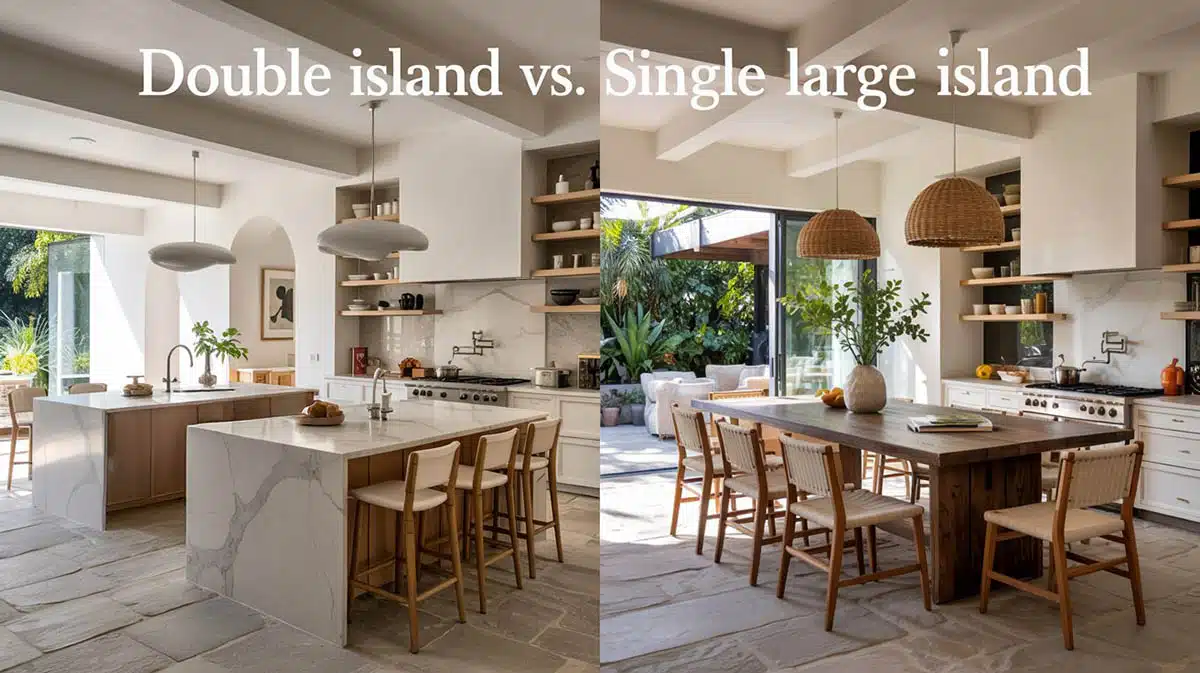
As someone who has spent countless hours perfecting kitchen layouts, a question I’m often asked is: should you install a double island floor plan, or opt for one expansive single island? Both approaches can transform your kitchens into a stunning space that’s functional for you and your family, but the right choice depends on your needs, space, and day-to-day lifestyle. Let’s look deeper into a double island vs. a single large island kitchen design to find which one is best for you.
Differences Between Two Regular-Sized and a Single Large Island in the Kitchen
A single large island has one freestanding countertop and cabinet that serves as the kitchen’s main anchor. These typically range from 8 to 12 feet long and can be used for multiple functions within one unit.

Upload a photo and get instant before-and-after room designs.
No design experience needed — join 2.39 million+ happy users.
👉 Try the AI design tool now
A double island layout features two separate islands, and many times, they each serve a different purpose. One might serve as your primary prep and cooking counter, while the second functions as a casual dining area with stools for eat-in dining.
Why You Would Choose Double Islands
Now let’s break down why you would want two islands in your kitchen.
Better Traffic Flow – In my experience, double islands are ideal for kitchens where multiple people cook together. The separation creates natural pathways that prevent the foot traffic often seen around a single layout. A double setup can dedicate one surface to food prep, while the other is used for seating for friends and family.
Functional Zoning – Double islands offer the opportunity for the separation of tasks. I often see one as the “working” island, with a built-in cooktop, sink, and food prep work surface. The second one becomes the “social” island offering seating, serving space, and perhaps a wine fridge or beverage center. This arrangement helps especially when entertaining guests.
Design Flexibility – With two islands, you can play with contrast. For instance, the outer one can have a stunning waterfall-edge marble counter and be paired with a warm butcher block prep counter that the chef will appreciate. While not as popular these days, you can also vary heights, with a standard counter height for one and bar height for the other for sitting and eating.
Defined Kitchen Boundaries – In open-concept homes, having double islands helps separate the kitchen without needing walls or other furniture. The two islands create a sense of enclosure and purpose, making the kitchen feel like its own room while still maintaining the open sightlines and flow.

Why You Would Choose A Single Large Island
Now, let’s explore why you may want to go with a single island design.
Uninterrupted Sightlines – One large island often offers better views across the kitchen and into nearby living spaces. There’s a simple elegance to this approach, as it feels less cluttered and more serene, especially for smaller floor plans. For clients who value minimalism, a single unit often fits better into their design vision.
Maximized Counter Space – A large single island provides one continuous work surface. Having 10 feet of uninterrupted surface is harder to achieve when you’re using divided units.
Cost Efficiency – One island costs less than two to design and build. Since you’re looking at just one set of cabinetry, one countertop fabrication and installation, fewer electrical runs, and simpler plumbing, the price is much less.
Easier to Navigate – There are some people who find two islands visually busy or even physically constraining. A single one offers straightforward circulation walkways, and its simplicity appeals to many clients. This could mean that the extra money you spend on going with two may not translate into a higher home resale value later on.

Comparison Of Size Considerations For Double vs. Single Islands
This is where many homeowners can get into trouble. For example, double islands aren’t just about having enough square footage; they’re about having the right dimensions.
Minimum Requirements for Double Islands:
- You need 13 to 14 feet of width for two small to normal-sized islands in your kitchen. However, you’ll need at least 15 feet of width for large ones.
- A minimum of 4 feet of clearance between them is required. (I prefer having 5 feet)
- There needs to be at least 3.5 to 4 feet of clearance around the perimeter.
- Total kitchen square footage of at least 400 square feet.
If your kitchen doesn’t meet these minimums, a double design will feel too cramped and may actually negatively impact its functionality.
For Single Large Islands:
- Minimum kitchen width of 12 to 13 feet for a larger island.
- Maintain at least 3.5 feet of clearance on all sides (4 feet is ideal)
- Have about 300 to 350 square feet of total kitchen space
You can check out our island size calculator to see what will fit in your kitchen space.
Lifestyle Assessment: Which Is Right for You?
Choose Double Islands If You:
- Like to cook with a partner or entertain while cooking
- Have a kitchen of 400+ square feet
- Want separate zones for different activities (Eat-in dining/food prep)
- Want a kitchen with extra contrast between cabinets and countertops.
- Like to host large gatherings.
- Want different counter heights to accommodate everyone. (High breakfast bar for dining and a lower one for food prep)
Choose a Single Large Island If You:
- Want to have more streamlined and minimalist aesthetics
- Have a kitchen under 400 square feet.
- Need the most amount of uninterrupted counter space.
- Are working with a tighter budget.
- Cook primarily solo or with one other person.
- Value simplicity and the easiest circulation for pathways.
Best Kitchen Layouts For Each Design
| Kitchen Layout | Single Large Island | Double Islands | Why It Works / Doesn’t Work |
|---|---|---|---|
| L-Shaped Kitchen | Best Fit | Works in Large Kitchens | Natural traffic flow makes an L-shape ideal. Singles suit most homes; doubles are great in large, open plans. |
| U-Shaped Kitchen | Excellent | Only Works in Huge Footprints | Plenty of perimeter storage. Single fits easily; doubles require deep rooms to not crowd. |
| Galley (Open-Concept) | Good Fit | Not Recommended | A single unit replaces one galley wall. Doubles rarely work because the aisles become too narrow. |
| Open-Concept / Great Room | Excellent | Ideal in Large Homes | A single unit anchors the space. Doubles add structure & zoning in very wide open layouts. |
| Peninsula Kitchen | Sometimes Works | Usually Too Much | Single + peninsula can work in wide rooms. Doubles interfere with the peninsula. |
| Narrow Layouts (under 12 to 13 ft wide) | Works with Small Island | Does Not Work | Singles must be scaled down for 36 to 42 inch aisles. Doubles are not possible in narrow rooms. |
| Large, Wide Layouts (18 to 20+ ft wide) | Great | Ideal | Enough space for proper walkways. Best environment for doubles with separate work & social areas. |
Design Tips I Always Share
If Going with Double Islands:
- Vary the functions and contrast meaningfully. Don’t create two identical islands.
- Consider using different materials or finishes to distinguish each purpose and add style.
- Install the sink and cooktop on separate islands to prevent cleanup debris from getting close to the food.
- Place the seating on the island furthest from the main cooking zone
- Think about lighting and make sure each one has its own pendant fixture group.
If Going with a Single Large Island:
- Break up the visual with varied cabinet finishes from the main kitchen design.
- Consider installing 15″ to 24″ wide, deep drawer stacks that are ideal for storing pots, pans, lids, and mixing bowls.
- Install adequate seating (plan for 24 inches between each person for comfort)
- Don’t overcrowd with appliances, and leave breathing room.
- Watch out that the seating does not come in contact with a built-in range.
- Use the island to anchor your kitchen’s work triangle for better functionality.
Neither option is necessarily better than the other; it really depends on your needs. We’ve created breathtaking kitchen floor plan designs with both configurations. In my view, some of the most successful double-island kitchens belong to families who often cook together and entertain often. I’ve found that the most stunning single island designs serve clients who value clean aesthetics and have more modest spatial constraints.
To showcase highly specific designs, some images on this website use advanced AI-generation software to illustrate ideas and room inspiration. See our editorial policy to learn more.