Desert Landscape Ideas To Transform Your Yard

Welcome to our gallery of desert landscape ideas including front yard and backyard designs. Landscape design is just as important to the appearance of your home as the furniture you keep in it and the design of the house itself. However, if you live in the desert, you might be worried that your options are limited due to the harsh climate. Desert landscape design holds a lot of potential! These ideas will help you set your own desert exterior up in a way that will make you happy to enjoy the sun. [toc]
Hardscape
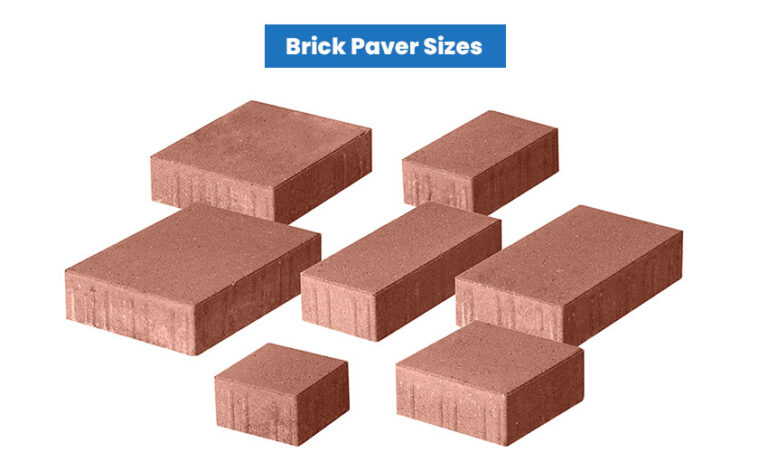
Hardscaping is the part of your landscape that uses man-made materials rather than plant life. This can include pathways, driveways, and any clearings made of fabricated materials. This can serve as a great way to contrast any vegetation you might use. Traditional building materials are the best choice for a Southwestern-style hardscape. This includes gravel, stacked stone, and adobe mud, just to name a few. You can also incorporate more contemporary materials such as concrete & brick pavers or steel accents to add a modernized touch to your hardscaping designs.
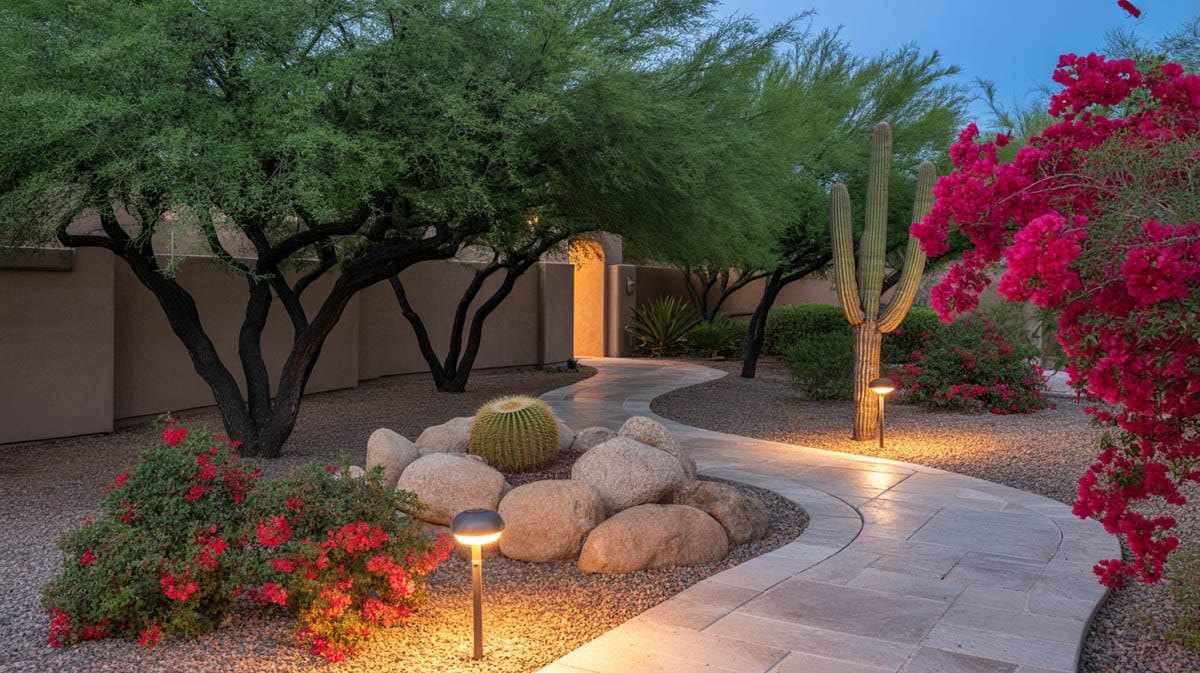
If you’re choosing between materials, using something like decomposed granite is the most budget-friendly option. It generally costs $1-$3 per square foot installed, which is a low-maintenance, budget-friendly option. Concrete pavers cost more upfront but hold up better under heavy foot traffic and are easy to repair. Flagstone sits in the middle in terms of cost and tends to look the most natural alongside desert plantings.
Path width matters, and you should aim for about thirty-six inches, which is a comfortable minimum for a single person. Bump it up to 48 inches for a main entry route. Stepping stone gaps should be no more than 18 inches, or it starts to feel like a stretch. Also, don’t overlook the edging. Without a solid border, gravel migrates all over the place. Metal or concrete edging keeps things tidy and saves a lot of raking down the line.
Softscape
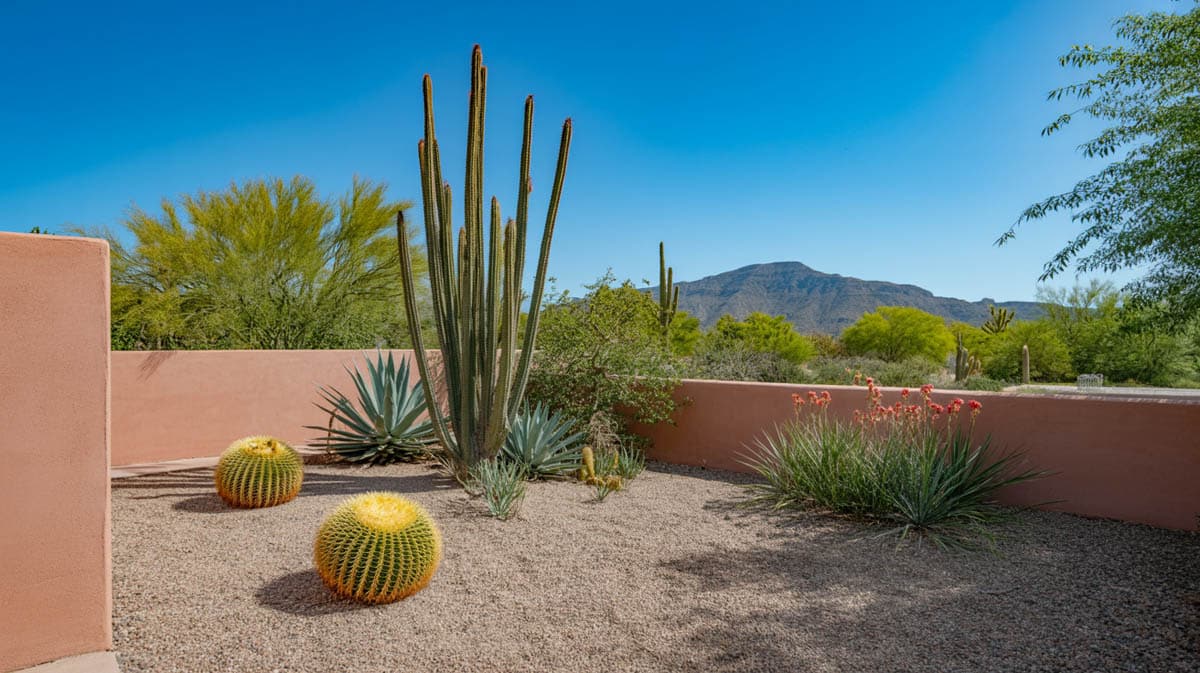
Softscaping, as the name suggests, is the opposite of hardscaping. The practice uses natural materials to decorate your landscape. For instance, the use of trees, bushes, flowers, and natural stone to design your yard would fall under the category of softscape. Sandstone and sun-bleached wood are both great additions to desert landscape ideas. Wildflower blooms and plants such as the hairy desert sunflower are also good choices to add to your yard.
Beyond those basics, river cobbles, weathered terracotta, and ornamental boulders add some texture without competing with your plants. Agave, prickly pear, and native ornamental grasses are all reliable low-maintenance choices that tend to look great year-round. Layering makes a real difference as well, so use tall plants like ocotillo or saguaro at the back, mid-height shrubs like brittlebush in the middle, and low ground covers or gravel mulch at the front. That extra depth makes everything look more styled and nuanced. On the maintenance spectrum, succulents are the easiest option to handle without constant care.
Walkways & Paths
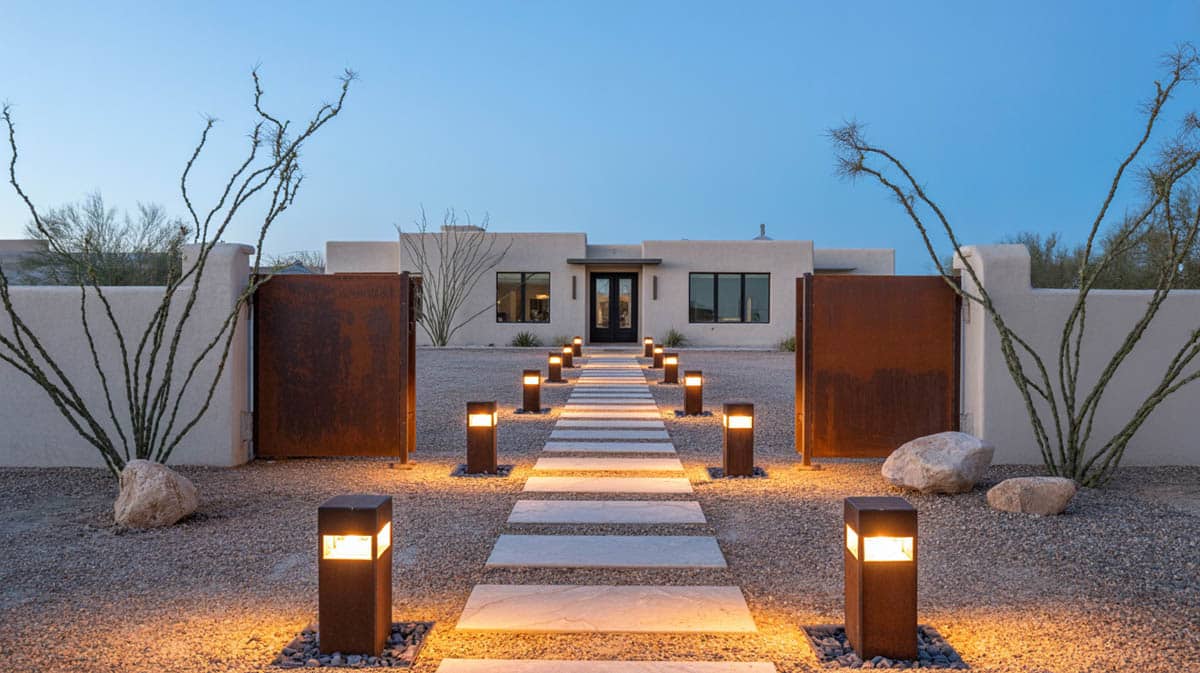
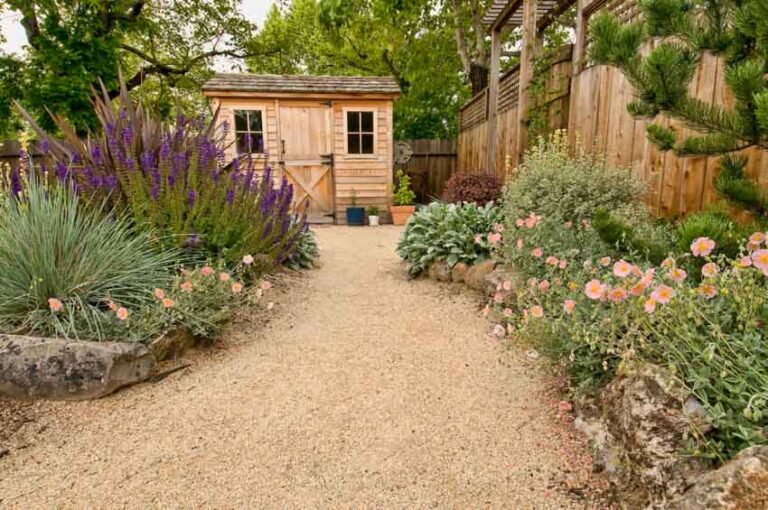
Walkways and paths are an essential part of any design. They guide you and anyone else from place to place. Walkways also serve as a way to keep guests from treading on parts of the landscape where they should not, such as into gardens. In desert landscapes, it’s best to keep these walkways paved and clear. To keep the natural look consistent, many homeowners choose to use stone walkways. Beds of gravel or pebbles are also a common choice.
The most common paving options are flagstone, travertine, concrete pavers, and decomposed granite. Flagstone is irregular and natural-looking, which works well in a more organic desert design. Travertine stays cooler underfoot in direct sun, a real consideration in hot climates. Concrete pavers are the most uniform and easiest to install. Decomposed granite is the most affordable and works well as infill between stepping stones.
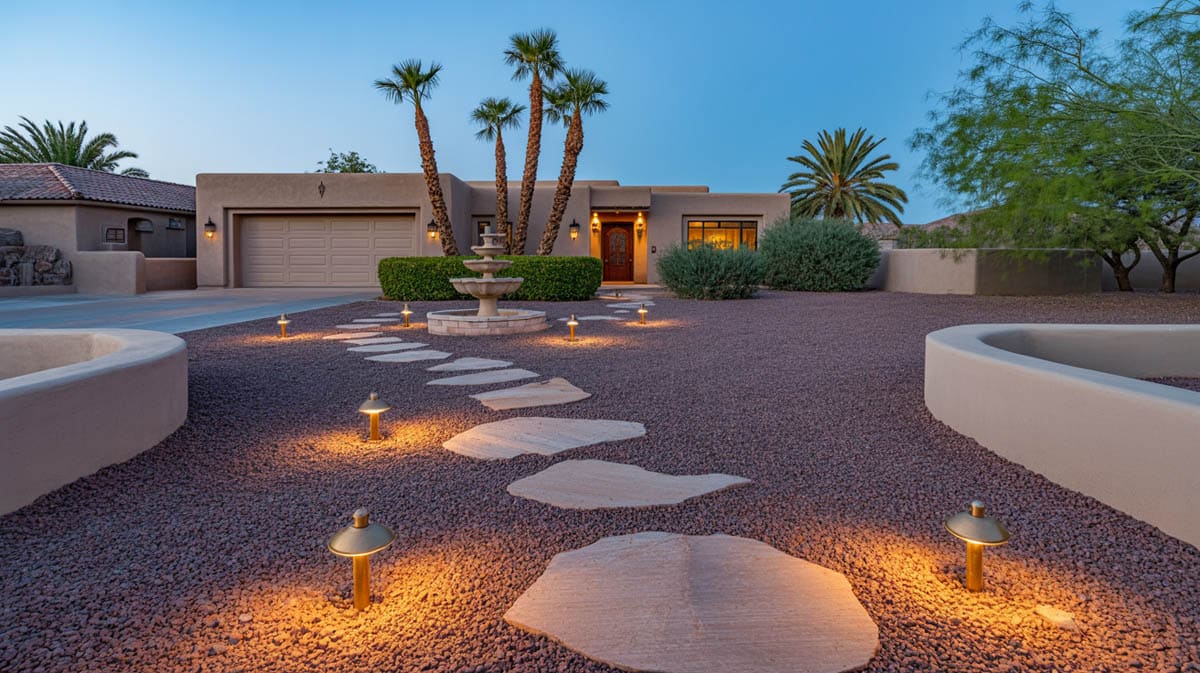
For stepping stone spacing, go for spacing of 16-18 inches center to center so a natural walking stride lands comfortably on each one. The main entry paths should be at least 36-48 inches wide. Lighting along a path pulls double duty for both safety and looks. Low bollard lights or in-ground LEDs placed every 4-6 feet do the job without overwhelming the space. Solar options work well in desert yards since the sun is rarely in short supply.
Accent Walls
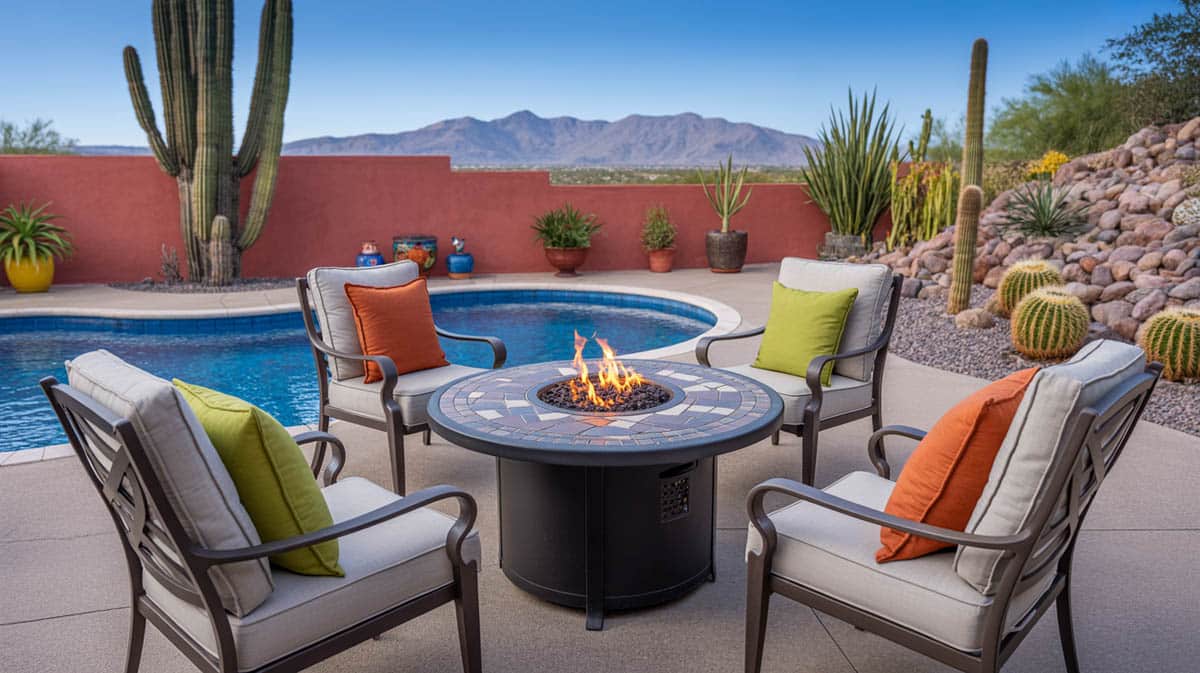
An accent wall doesn’t necessarily serve any structural purpose but offers a visual effect. They may serve a functional purpose, such as offering some privacy or as a pool waterfall, but many are used as a backdrop for other features, such as a garden or bed of ornamental grasses. These walls are also a great way to add a pop of unnatural color to your landscape design. For instance, a popular choice is to add an accent wall and paint it a rich, warm color such as rusty orange.
Stucco over CMU block is the most common choice because it’s durable and easy to paint. Adobe brick gives a more traditional Southwest character. While Corten steel is popular in contemporary desert designs because it weathers to a warm rust tone that complements the natural landscape. When it comes to costs, stucco is the most affordable, and Corten is the most expensive.
When it comes to the height for your wall, it’s a practical decision as much as an aesthetic one. A 3-foot wall defines a space without blocking the views. A 6-foot wall gives some privacy. You’ll find that most decorative backdrop walls sit around 4 feet, which is tall enough to backstop a planting bed without cutting off any sightlines.
Planting against an accent wall is one of the best ways to soften it up. Use plants like agave, yucca, or tall ornamental grasses at the base to add scale and texture. Bougainvillea can be trained up a taller wall over time for some seasonal color.
Dry Creeks
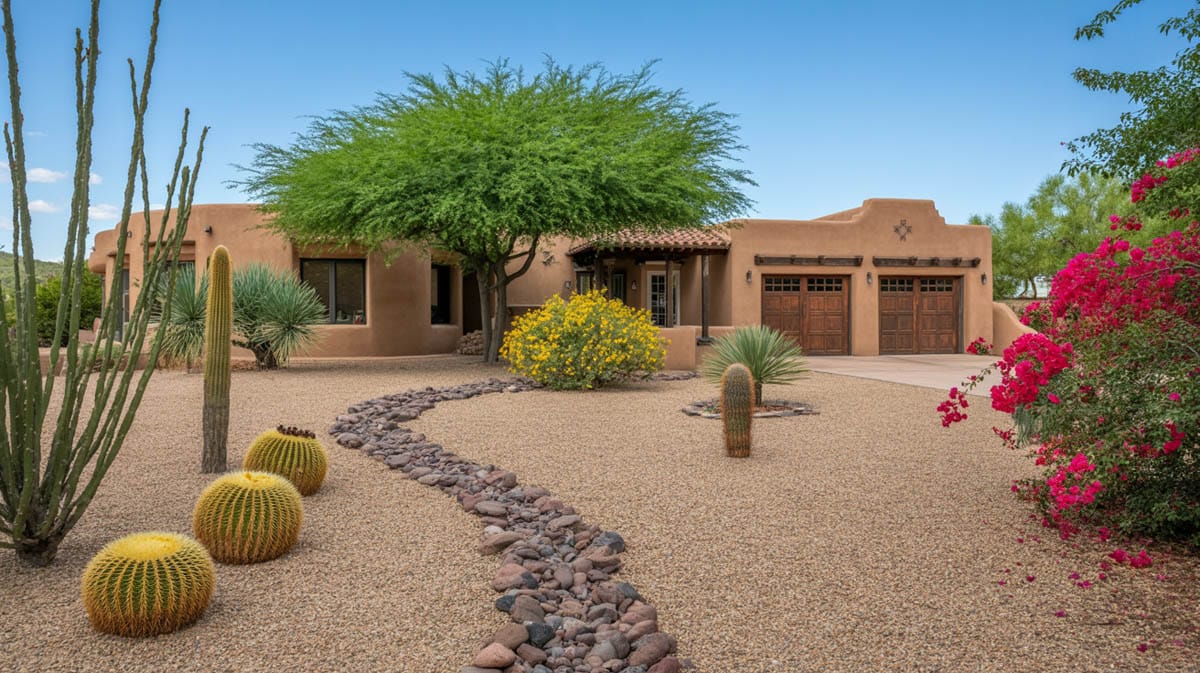
If there’s one defining feature of the desert, it’s the arid environment. Deserts aren’t well-known for their large water supply, which can be used to your advantage in landscape design. One of the best ways to denote a desert-like landscape is to imply a lack of water, just as much as you worry about designing what is in your garden. This can be accomplished by using a dry creek bed in your design.
Rock size makes a big difference in how natural a dry creek looks. Using large boulders at the bends shows where water would slow naturally and deposit heavy material. Mid-size cobbles fill the main channel, and small pea gravel works along the edges where the current would have been gentler. Using all three sizes together looks far more realistic than a single size throughout.
If you want the creek to also function for drainage, grade it carefully so it flows away from the house. A purely decorative creek has more flexibility in placement since it just needs to look plausible. Use plants like desert willow, salvia, and penstemon along the edges to look natural near a dry creek bed. These plants suggest a slightly moister zone without needing any extra irrigation.
Water Features
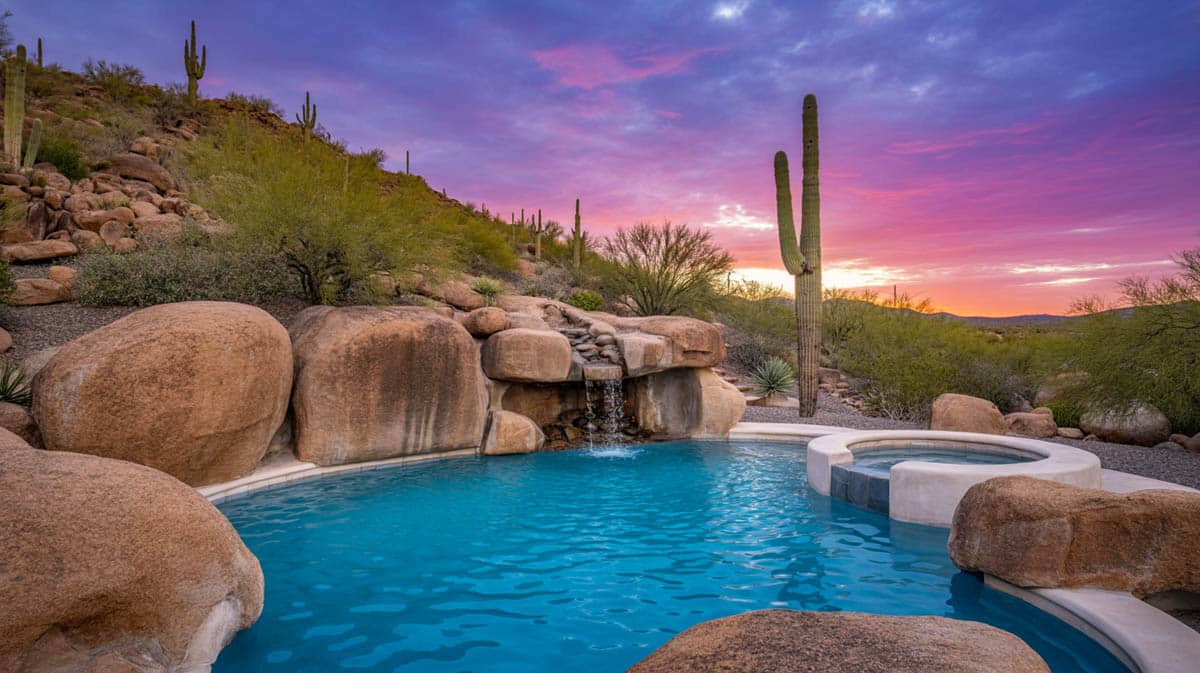
When you think of a desert landscape, you might not think of water right away. However, water is essential for life and is often used as a showcase in desert landscapes as an oasis of sorts. These are often limited and ecologically considered. Proper desert landscaping isn’t going to waste a high amount of water. After all, it’s often in limited supply in these climates.
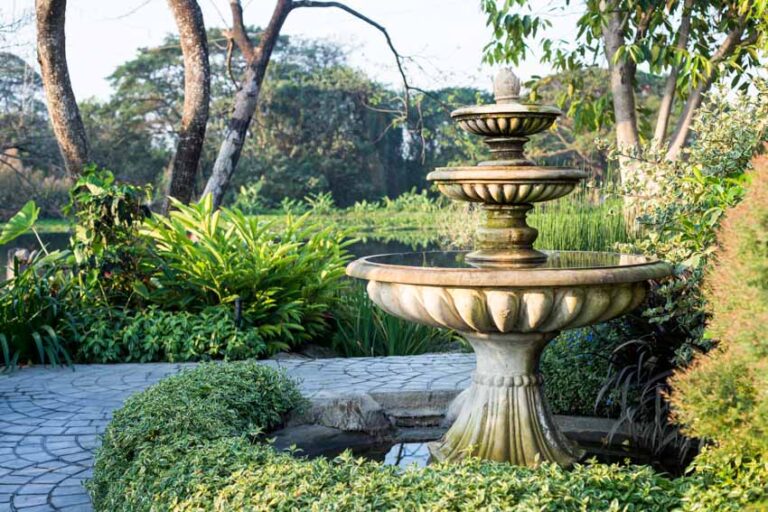
One of the best patio water feature ideas is to have a small fountain in your yard. Recirculating fountains are particularly popular because they don’t easily fall prey to excessive evaporation. Additionally, many homes with swimming pools have water features such as waterfalls, bubblers, and fountains.
The most common types are tiered fountains, wall-mounted fountains, pondless waterfalls, and bubblers. Tiered fountains are classic and widely available with many styles. Wall-mounted fountains work well on accent walls and take up minimal floor space. Pondless waterfalls look the most natural in a desert landscape and are surprisingly low-maintenance. Bubblers are a good low-profile option if you want water movement without a large structure.
One concern is evaporation, which is a real factor in a hot, dry climate. A recirculating pump helps, but you’ll still need to top off the water regularly. Another caution is that mineral buildup from hard water and algae are the main maintenance issues. An enzyme treatment and occasional light scrubbing keep most features clean. Budget-wise, small tiered or tabletop fountains start around $100-$300. You can get a professionally installed pondless waterfall or a custom wall feature, which typically runs $1,500-$5,000 or more, depending on its size.
Pergola
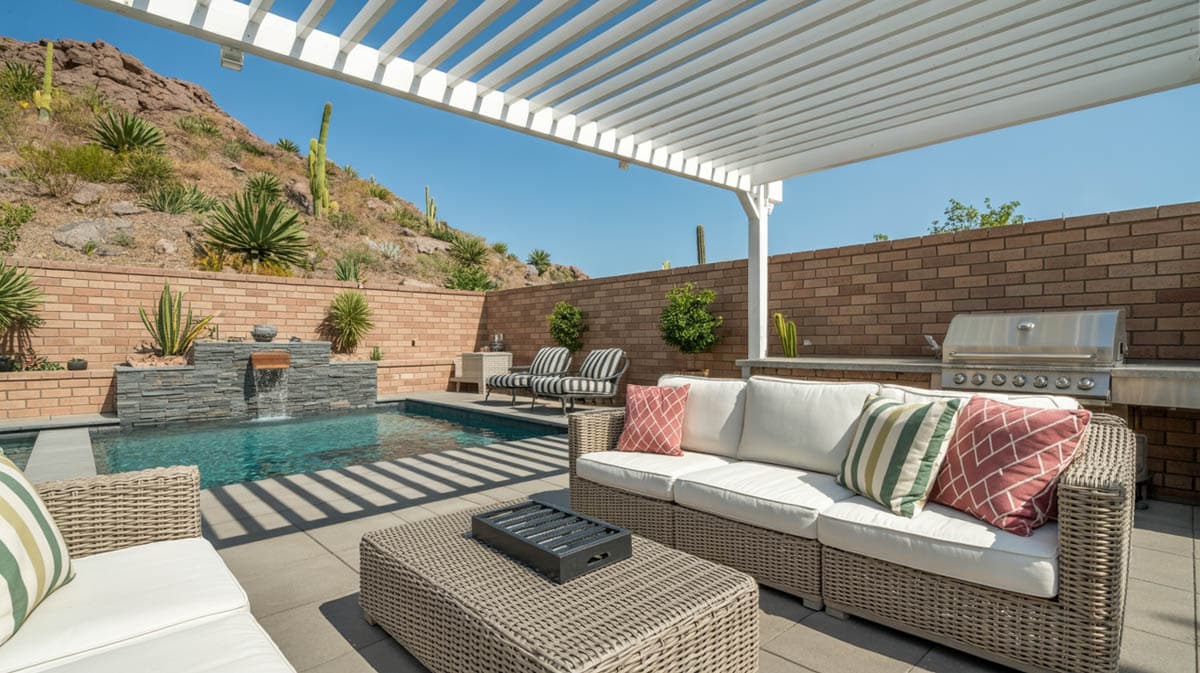
While beautiful, the desert can be deadly hot. The last thing you want is to spend an afternoon lounging in direct sunlight. This could easily lead to problems like sunburns alongside probable discomfort. By using a shade structure like pergolas in your landscape, you can give yourself some refuge from the sun when you need it.
For materials, wood is the traditional choice and looks the most natural in a Southwest setting, but it needs sealing and occasional maintenance. Aluminum is the low-maintenance option and holds up well in heat and sun without warping. Vinyl is affordable and weather-resistant, but it can look a bit plasticky when placed next to natural desert plantings.
When it comes to structure sizing, a 10×10 pergola is a good practical minimum for a small seating area. A 12×16 or larger works better if you want a dining table and chairs placed directly underneath. Arranging it so the long side goes east-west blocks the harshest overhead sun during the midday and afternoon. If you want more coverage than an open pergola provides, a ramada with a solid roof, a pavilion, or a shade sail is worth considering.
Fire Pit
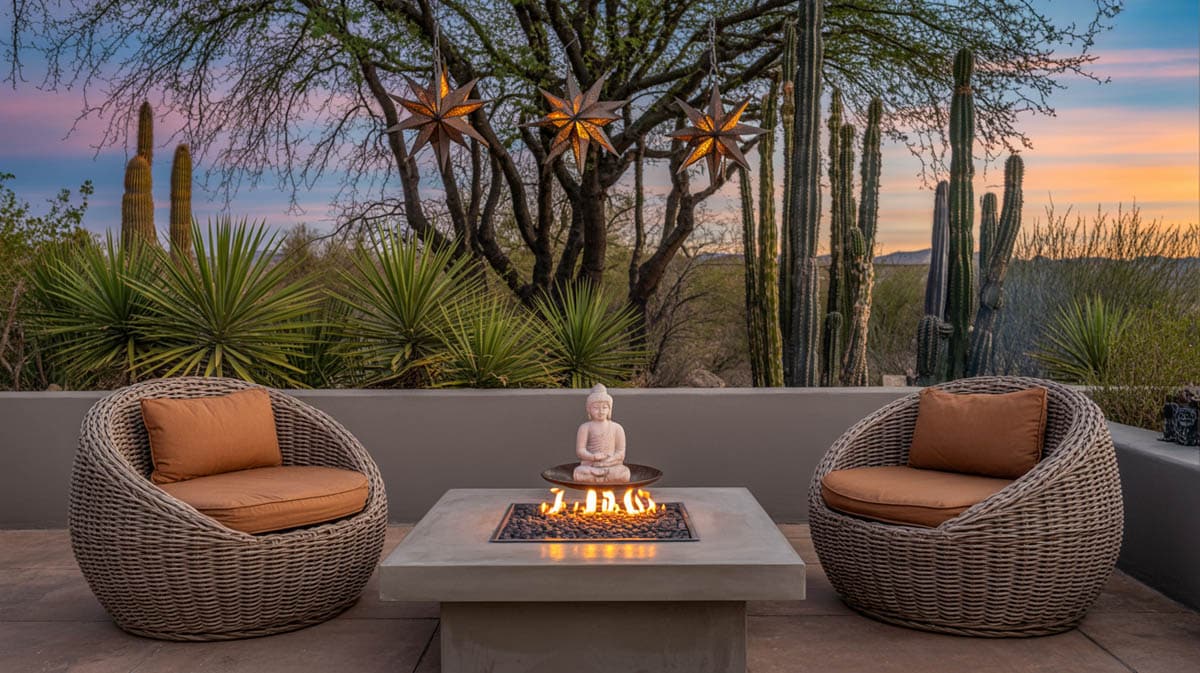
While the daytime sun heats the desert up to intense temperatures, that temperature drops rapidly after sunset. Yet, you might not want to abandon your carefully-designed landscape the minute the sky starts to darken. A great way to add a little warmth and plenty of ambiance is to add a fire pit to your yard. Fire pit designs can be installed in-ground or above ground and work well with plenty of seating around them.
For materials, for your firepit, using brick and concrete block are the most DIY-friendly options. Natural stone looks great, but it will cost more. Steel fire pit rings or bowls are portable and popular for above-ground setups. Gas-burning fire pits are cleaner and more convenient than wood-burning ones, though they don’t quite match the same experience. A fire pit between 36 and 44 inches in diameter is the sweet spot size for most backyards. Keep at least 10 feet of clearance from any structure or overhanging branch. For seating, a radius of about 7 feet from the center is comfortable without getting too hot.
Shade Trees
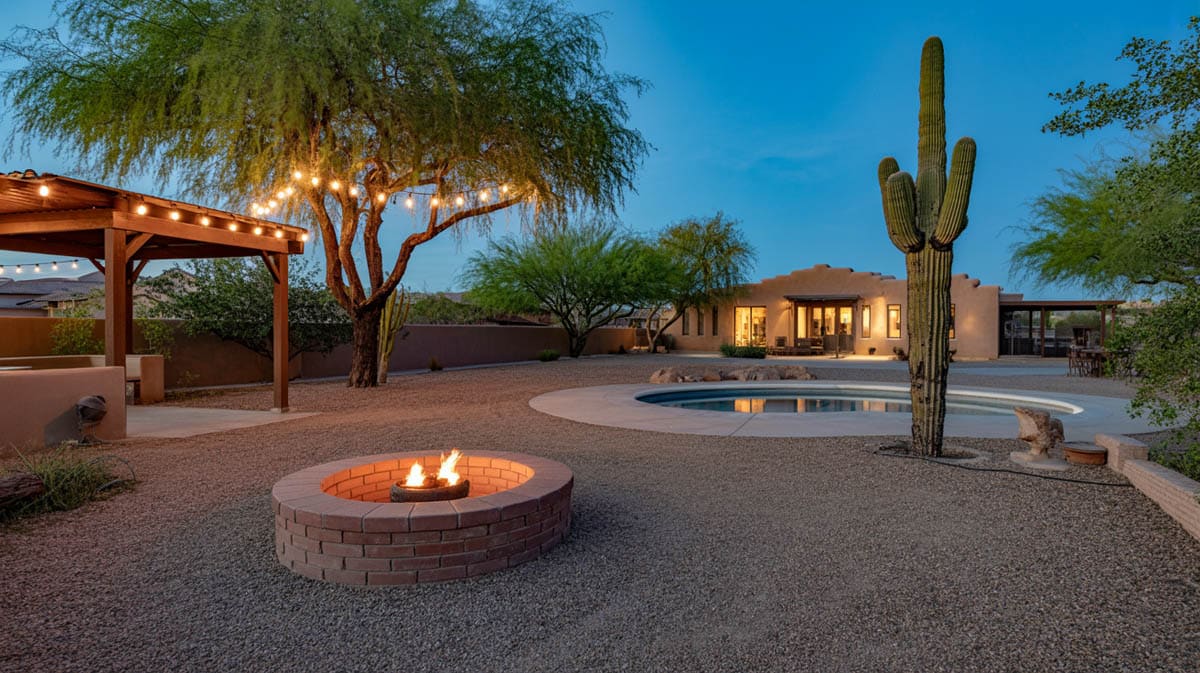
As we’ve covered already, desert days are hot. The sun beats straight down, and there isn’t a lot of water to offer relief. To make your yard a place that you want to spend time in, you’re going to want to make it comfortable. One of the best ways to combat the heat is to plant leafy trees to offer you plenty of shade. Desert willow and mesquite options are great places to start.
Palo verde is one of the best choices for a desert yard. It’s drought-tolerant, grows reasonably fast, and the yellow spring blooms are hard to beat. Blue palo verde has a slightly more refined look and can reach 20-30 feet at maturity. Ironwood grows slowly but provides one of the densest canopies of any native desert tree and is essentially maintenance-free. Chilean mesquite grows quickly and develops a beautiful, wide, spreading canopy. Plant shade trees on the west and southwest sides of your house or patio if you can. That’s where the afternoon sun hits the hardest. A well-placed tree can drop surface temperatures under its canopy significantly, making the difference between a patio you actually use and one you avoid.
Decor
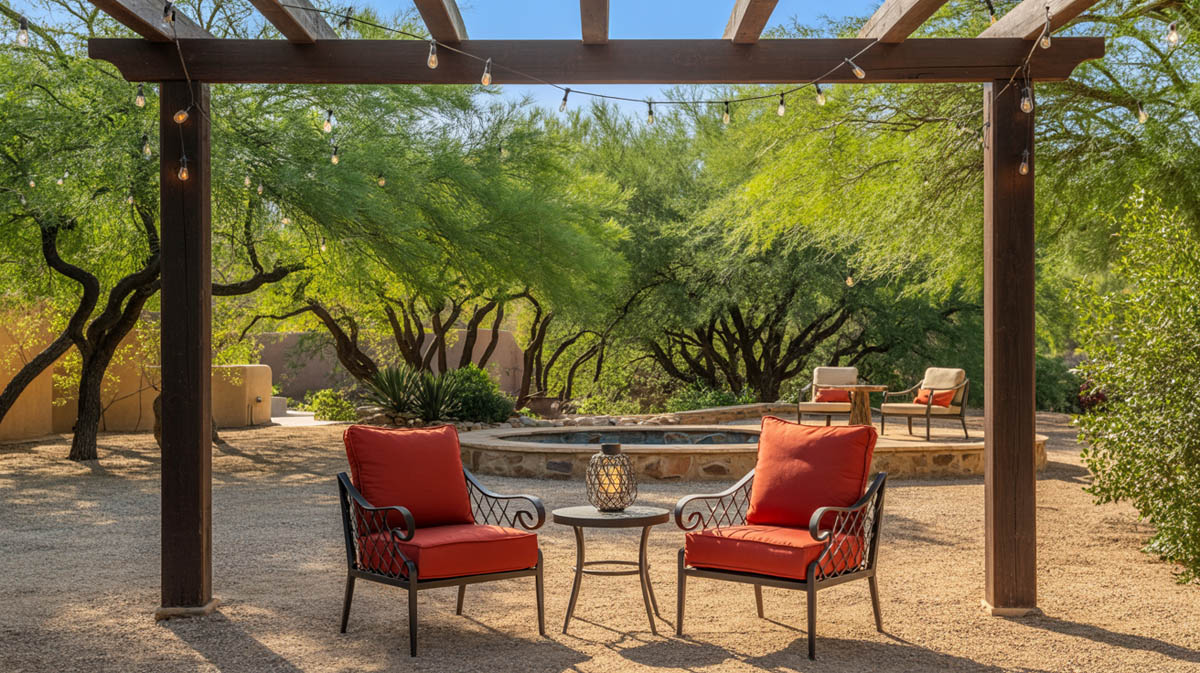
For decor, you can use iconic symbolism that has become a traditional choice in desert landscapes over the years. This can include natural elements like plants and bleached skulls. Alternatively, you can use man-made items that capture the environment, such as Native American woven patterns. More contemporary desert landscape ideas sometimes use materials like metal to create sculptures and other modern decor.
Pottery is one of the easiest ways to add warmth to a desert landscape. Large terracotta or glazed ceramic pots planted with agave or cactus serve as both decor and planting vessels. Metal yard art like saguaro silhouettes or geometric sculptures holds up well in desert conditions and adds personality without much upkeep. Saltillo tile and ceramic accents on steps or walls bring color that feels native to the region.
The overall scale matters a lot when designing your outdoors. A piece that looks large inside can look very different in a yard. Plan to use at least one anchor element that’s 24 inches or taller in any given area, and cluster smaller items in groups of three rather than spacing them out individually. When purchasing your decor pieces, stick to weather-resistant materials: powder-coated steel, glazed ceramic, cast stone, and sealed concrete all hold up well in intense heat and UV. Painted wood or anything untreated will need regular maintenance or will start to look rough within a season or two.
Lighting
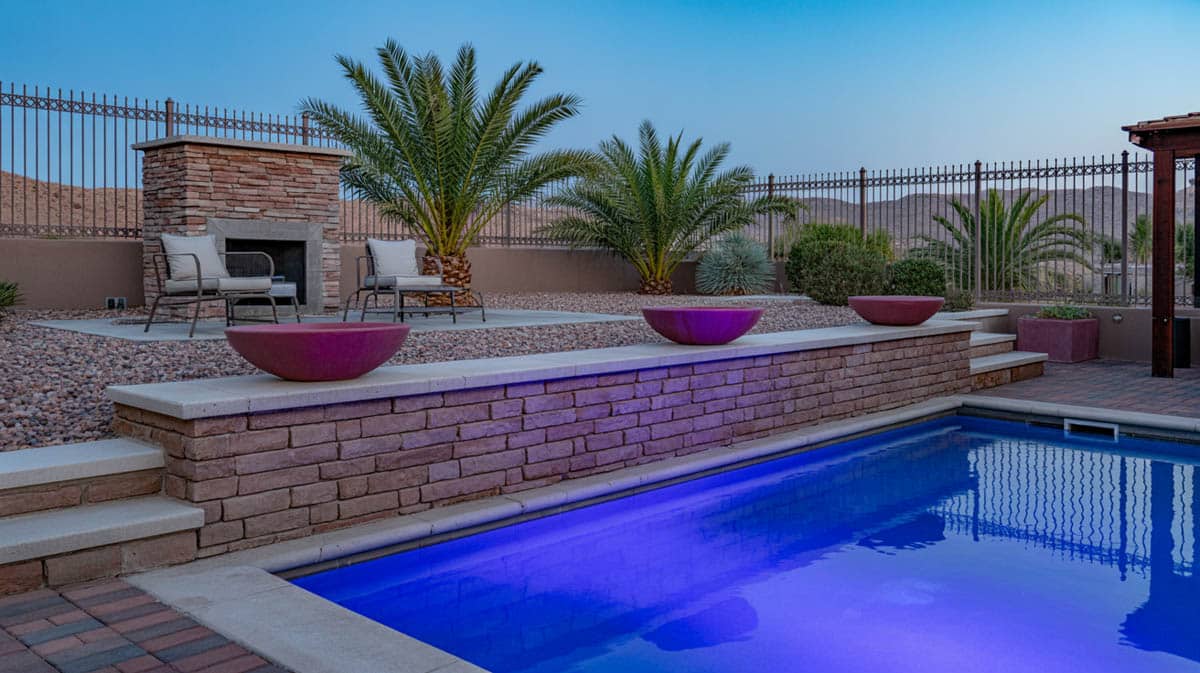
Outdoor lighting can be used to provide ambiance and highlight areas you want to use as a focal point. From string lights to those that illuminate the pathway to dramatic accent lighting, they all can make a big impression in the yard. The main fixture types for desert landscapes are bollard lights, in-ground uplights, pathway stake lights, string lights, and wall-mounted sconces. Bollard lights work well along paths and driveways. In-ground uplights are ideal for highlighting specimen plants or accent walls. String lights add warmth to pergola and patio areas. Stake lights are the easiest to install but tend to look more casual.
A good approach: light the path first, then add accent lighting for one or two focal points. Too many lit-up areas, and the yard loses visual focus. Less is usually more with landscape lighting. Solar fixtures work fine for pathway and accent lighting in a desert yard since sun exposure is rarely the problem. For main patio areas or anything you want consistently bright, a hardwired, low-voltage LED is more reliable. The upfront install cost is higher, but the long-term performance is much better.
Front Yard Desert Terrain Landscaping Ideas
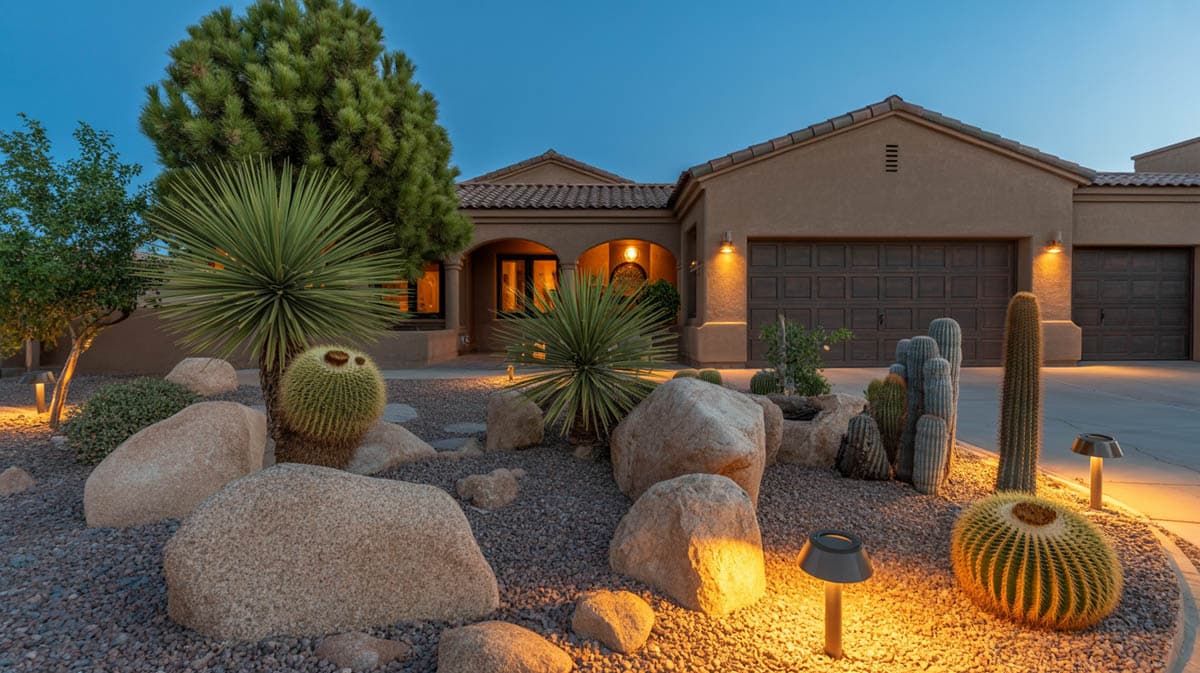
When landscaping your front yard, you might not be as worried about having places to entertain. This is often a task relegated to the backyard. Yet, the appearance of your front yard is the first thing someone sees when they visit or even drive past your house, and it’s essential to your home’s curb appeal. The front yard is a great place to add plenty of plant life. You’ll also want to ensure you have a walkway guiding visitors to your door.
List of landscaping elements and plants:
| Landscaping Element | Description |
|---|---|
| Cactus Garden | Various cacti shapes and blooms. |
| Desert Wildflower Bed | Colorful flowers e.g., Desert Marigold. |
| Gravel & Stone Pathways | Gravel paths with stone borders. |
| Succulent Arrangements | Mix of agaves, aloe, and sedums. |
| Native Shrubs | Desert shrubs like sagebrush. |
| Rock Gardens | Plants among boulders and pebbles. |
| Raised Planting Beds | Terracotta or stone-raised beds. |
| Desert Grasses | Grasses like Blue Grama. |
| Xeriscape Design | Drought-tolerant plants & efficient irrigation. |
| Water Feature | A small recirculating oasis. |
| Desert Trees | Trees like Palo Verde or Mesquite. |
| Yucca Plants | Spiky statement plants. |
| Natural Mulch | Crushed stones, pebbles, decomposed granite. |
| Art & Sculptures | Desert-themed yard art. |
| Night-time Lighting | Lights for pathways, plants, and boulders. |
Desert Arid Landscape Backyard Ideas
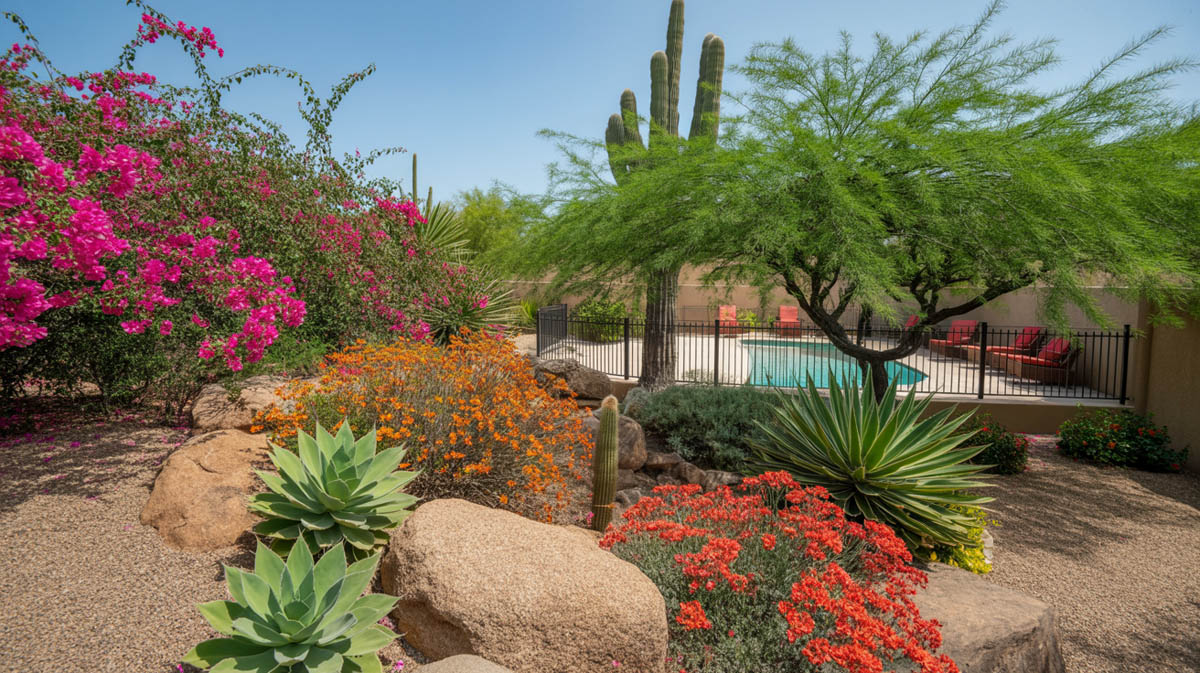
When you’re creating a landscape design for your backyard, you want something that isn’t only nice to look at but comfortable to relax and entertain in as well. This is why many homeowners opt for more lavish features in their backyards such as fire pits, pools, or even just additional seating. These all offer not only something aesthetically pleasing but give homeowners the chance to enjoy their landscape with friends and family.
Desert Rock Landscaping
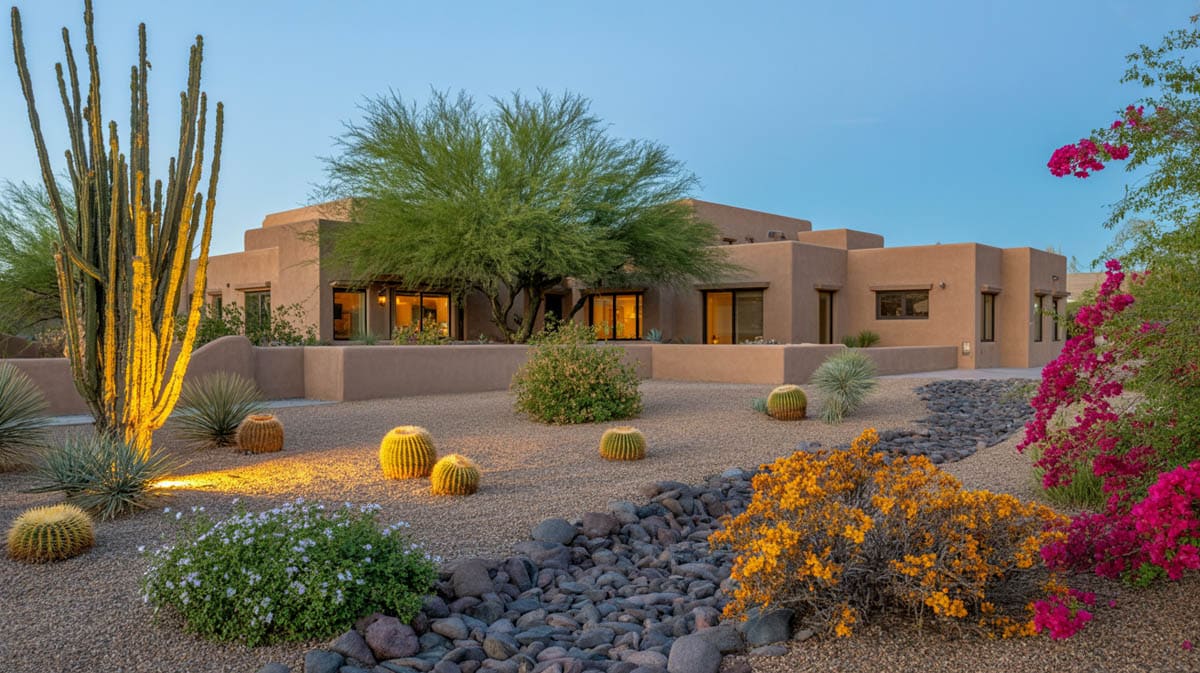
Rocks and stone work well in desert landscapes because they’re naturally occurring materials that enhance the appearance of your yard. These stones and rocks can be used in a variety of ways, too. The idea that comes to mind first for many is stone walkways or gravel driveways, but these materials can be used for much more. They can be incorporated into dry creek beds, gardens, fire pits, and more. Different sizes, colors, and types are a good way to add some variety to your landscape.
The most commonly used rock types in desert landscaping are decomposed granite, river rock, lava rock, flagstone, and boulders. Decomposed granite is the go-to ground cover because it’s affordable, stays in place reasonably well, and looks natural. River rock has a rounder, smoother look that works well along dry creek beds or as a border material. Lava rock is lightweight and adds dark contrast that makes plants stand out. Large boulders anchor a design and create a sense of permanence that plants alone can’t achieve.
For the most natural result, mix at least two or three rock sizes in any given area. Pairing large boulders with medium cobbles and fine gravel ground cover mimics how rocks actually occur in nature. One uniform size throughout tends to look artificial. Always lay a weed barrier fabric under decorative rock. It won’t eliminate weeds entirely, but it dramatically reduces the workload. Use heavy-duty landscape fabric rather than thin plastic sheeting, which breaks down quickly and becomes its own maintenance problem.
Desert Drought Tolerant Plants
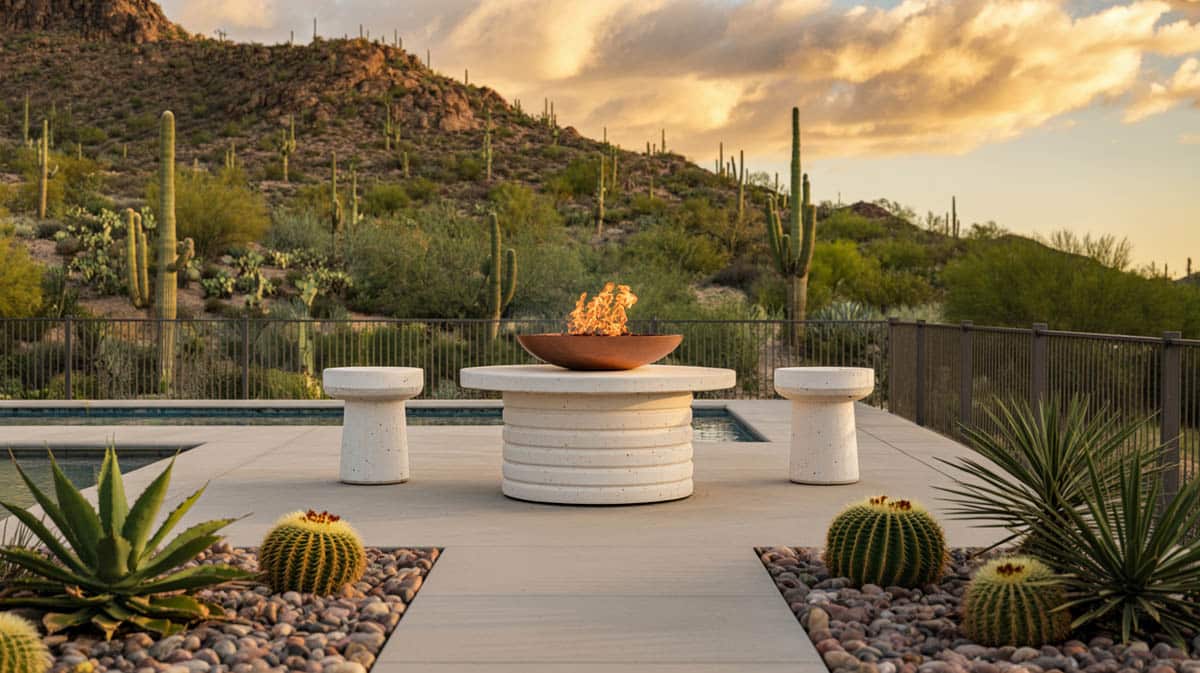
There are many different types of gravel one can use for desert landscape ideas. An assortment of gravel can give your design a more natural look or help create visual interest. The backyard above uses a gravel light feature with cacti for an alluring focal point.
Flowering Desert Plants for Landscaping
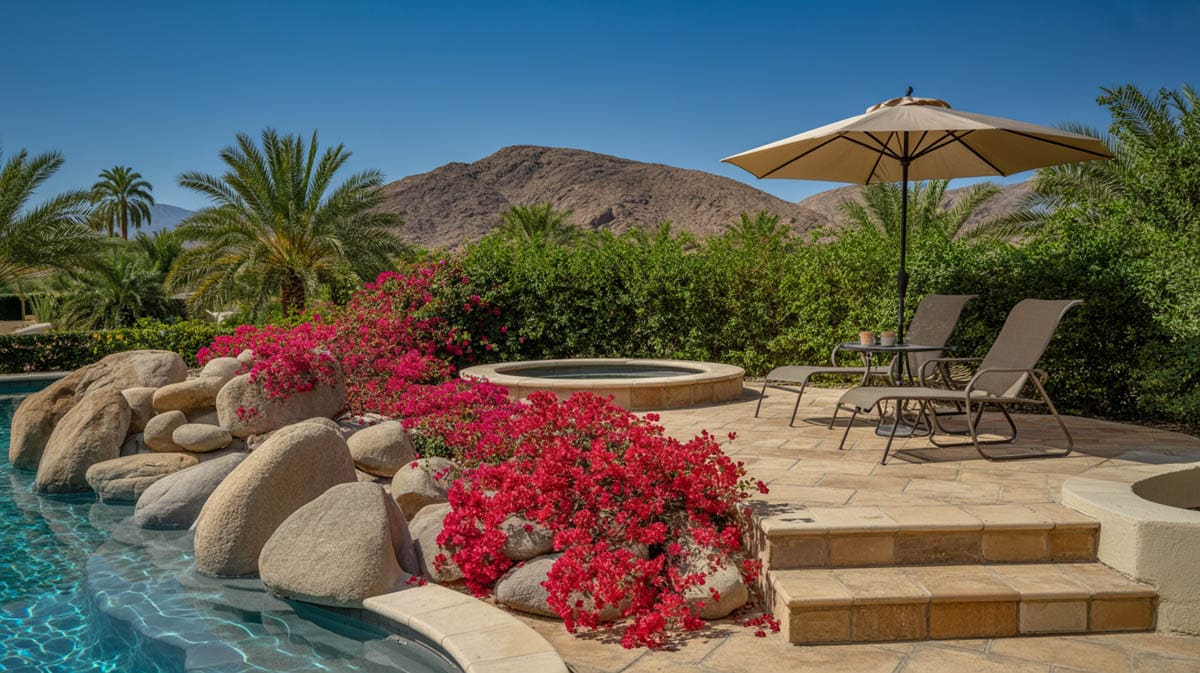
When you’re considering flowering plants, it’s a good idea to keep the color of those blooms in mind. Using blue, purple, or even silver plants like shrubby germander (Teucrium fruticans) works well because they add a cooling effect to the landscape. Plants that change hue with the seasons are also great, such as the skunkbush sumac (Rhus trilobata). Bougainvillea is a hardy vine that needs full sun and provides vibrant colors to the yard. They are a vine that can reach 30 feet tall and can readily climb an arbor or trellis. Remember, whatever plants you use in your desert landscape need to be able to survive drought weather.
Beyond bougainvillea and germander, there’s a solid lineup of flowering plants that do well in desert landscapes. Desert marigold (Baileya multiradiata) blooms bright yellow for most of the year and reseeds itself. Penstemon, especially Penstemon parryi, produces tall pink spikes in spring that hummingbirds love. Autumn sage (Salvia greggii) blooms red or pink from spring through fall and is one of the most reliable performers in the Southwest. Lantana is nearly indestructible, blooms all summer in yellow, orange, and pink, and is highly drought-tolerant. Blackfoot daisy (Melampodium leucanthum) is a compact white-flowering ground cover that blooms repeatedly with minimal care.
Most of these are perennials, so they’ll come back year after year without replanting. They’re drought-tolerant once established but benefit from a deep watering every couple of weeks during the hottest months.
Desert Trees
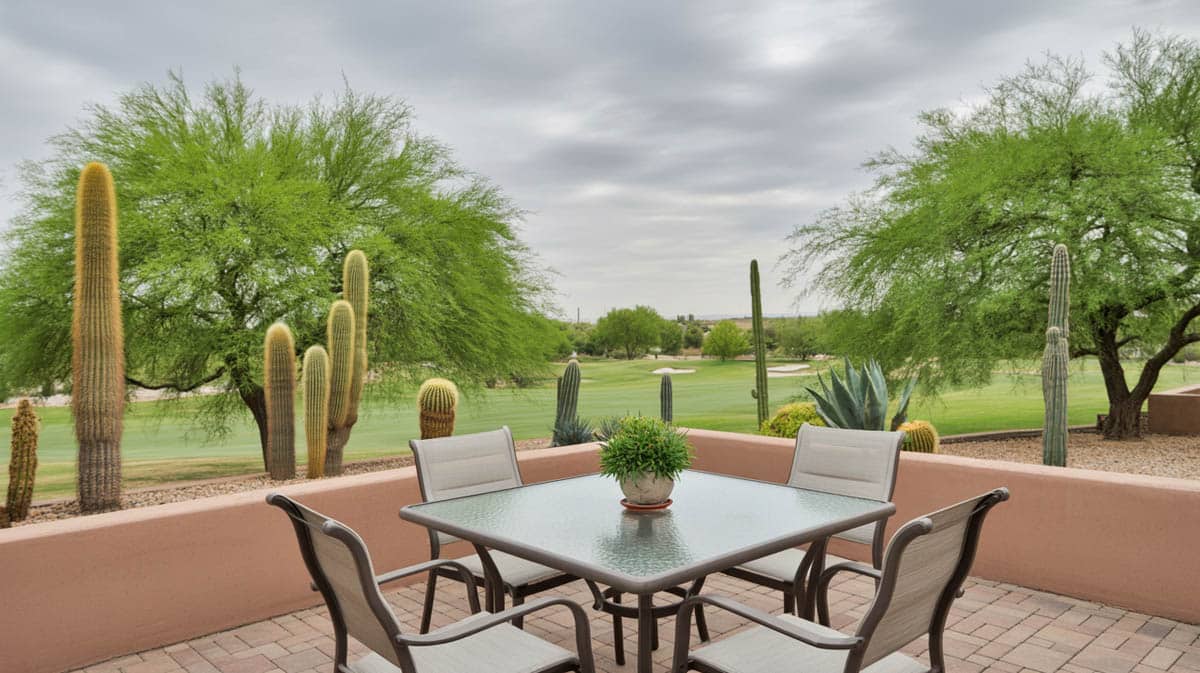
We’ve already discussed trees for shade, but you don’t have to limit this plant to functionality. Trees are beautiful and are often used to add aesthetic value as well as shade to your yard. Palo verde, ironwood, and mesquite are the workhorses of desert landscaping. Palo verde grows fast, tolerates drought, and produces bright yellow flowers each spring. Ironwood is slower growing but can live for centuries and provides one of the densest native canopies available. Mesquite is a little messier with its seed pods but supports local wildlife and casts excellent dappled shade. For something more ornamental, desert willow produces showy trumpet-shaped flowers through summer and reliably attracts hummingbirds.
Desert Shrubs for Landscaping
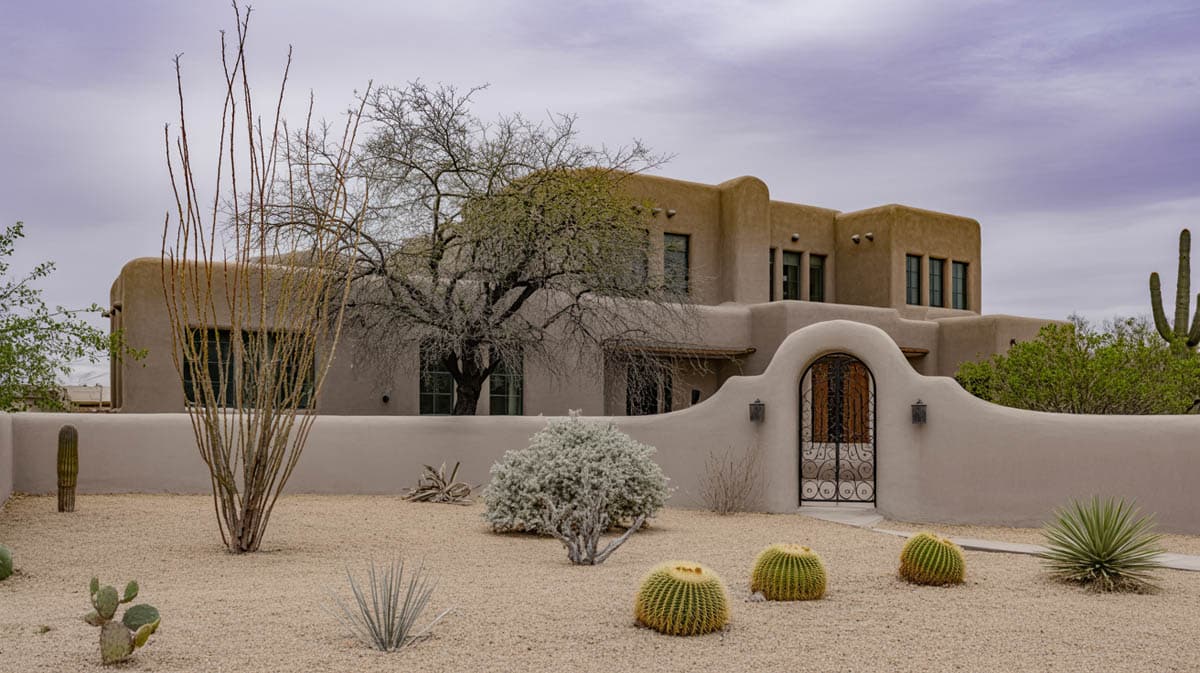
Again, the best way to add plant life to your garden is to use plants that already tolerate a desert environment. This means you’ll want to look for drought-resistant shrubs that won’t suffer for the lack of water outside of your home. If you don’t do this, you’ll struggle to keep these plants alive. Plants like Ruby Muhly Grass (Muhlenbergia reverchonii) and Gray Creeping Germander (Teucrium aroanium) are good examples of what could work.
Texas sage (Leucophyllum frutescens) is one of the most popular choices: it blooms lavender after rain, stays compact, and needs almost no attention. Brittlebush (Encelia farinosa) turns bright yellow in spring and its silvery foliage looks good year-round. Yellow bells (Tecoma stans) grows larger, up to 6 feet, and produces bright yellow trumpet flowers throughout summer. Creosote bush is the most quintessentially desert shrub of all, instantly recognizable by its smell after rain, and requires zero supplemental water once established. Lantana works well as a low spreading shrub and blooms continuously through the heat. Most desert shrubs establish best when planted in fall. The cooler months give them time to develop roots before their first summer.
Convert Lawn to Desert Rock Landscape
The best way to convert your standard lawn into a desert landscape is to switch it out with xeriscaping, a type of irrigation-free landscaping. Xeriscape doesn’t require as much water, which will help you not only achieve a more desert-like appearance but it’ll also save you money on watering your lawn later on.
Of course, the more perplexing step to many is how to “get rid” of your old lawn. This is often accomplished easiest by killing the grass through a process such as solarization, sheet covering, or vinegar. Alternatively, you can manually dig and remove the lawn. Another way to convert your lawn to get a more drought resistant backyard is to install artificial grass. While artificial grass can be expensive at first, it can pay for itself by cutting maintenance costs.
Examples of Xeriscaping for reducing water demand.
| Xeriscaping Element | Examples/Description |
|---|---|
| Drought-Tolerant Plants | Cacti, Succulents, Grasses, Shrubs, Trees |
| Irrigation | Drip systems, Soaker hoses, Early morning watering |
| Mulching | Organic (bark, straw), Inorganic (gravel, crushed rock) |
| Soil Improvement | Enhance soil for water retention and use compost. |
| Limiting Grass Areas | Ground covers, Native grass replacements |
| Water Features | Recirculating fountains, Efficient ponds |
| Pervious Paving | Gravel paths, Permeable pavers |
| Zone Planting | Group by water needs, Separate water-use zones |
| Maintenance | Check for leaks, Prune plants, Remove weeds |
| Design | Capture rainfall. Use berms and terraces |
Desert Landscaping Ideas with a Pool
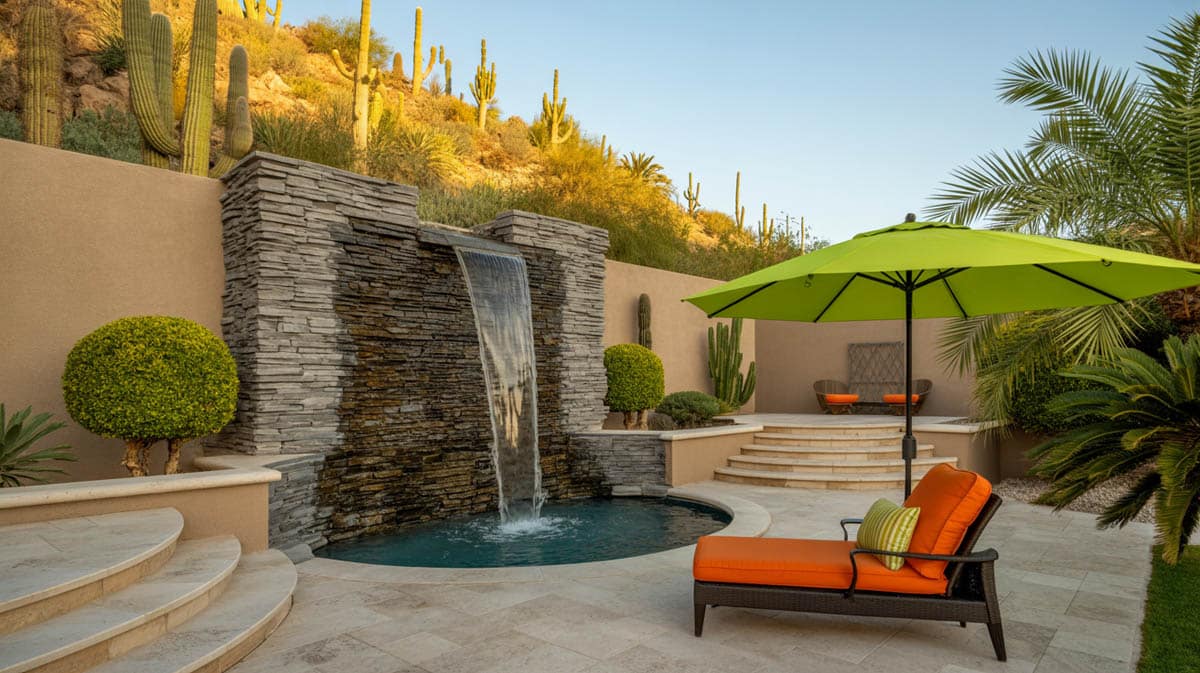
As mentioned earlier, desert landscapes are often conservative with water features. After all, there isn’t a lot of water to waste in waterless environments. However, if you want to go a step beyond and install a pool in your landscape, you can use a small pool to blend in with the landscape design. Plus, this is a great way to cool off on hot days!
One of the best ways to add desert landscaping around a pool is by adding drought-tolerant plants. Choose plants that don’t drop their leaves or needles, which is helpful to minimize the amount of pool cleaning required. Examples of plants to use include Agaves, Aloe, and many different types of cacti like the Barrel Cactus. Also, consider a raised planter bed with an assortment of succulents. These are durable, require little water, and provide interesting colors and textures.
For maximum enjoyment, make sure to install a shade structure or canopy. You can build a pergola, cabana, gazebo, or hang a shade sail to provide a place to get away from the intense heat of the sun. Just because you live in the desert doesn’t mean that you have to settle for a dreary landscape. You can use any or even all of these ideas to upgrade your landscape into the yard of your dreams. You can use one of the available landscape design software programs to help visualize your ideas.
To showcase highly specific designs, some images on this website use advanced AI-generation software to illustrate ideas and room inspiration. See our editorial policy to learn more.