Copper Kitchen Countertops Pros & Cons And How They Compare to Other Materials

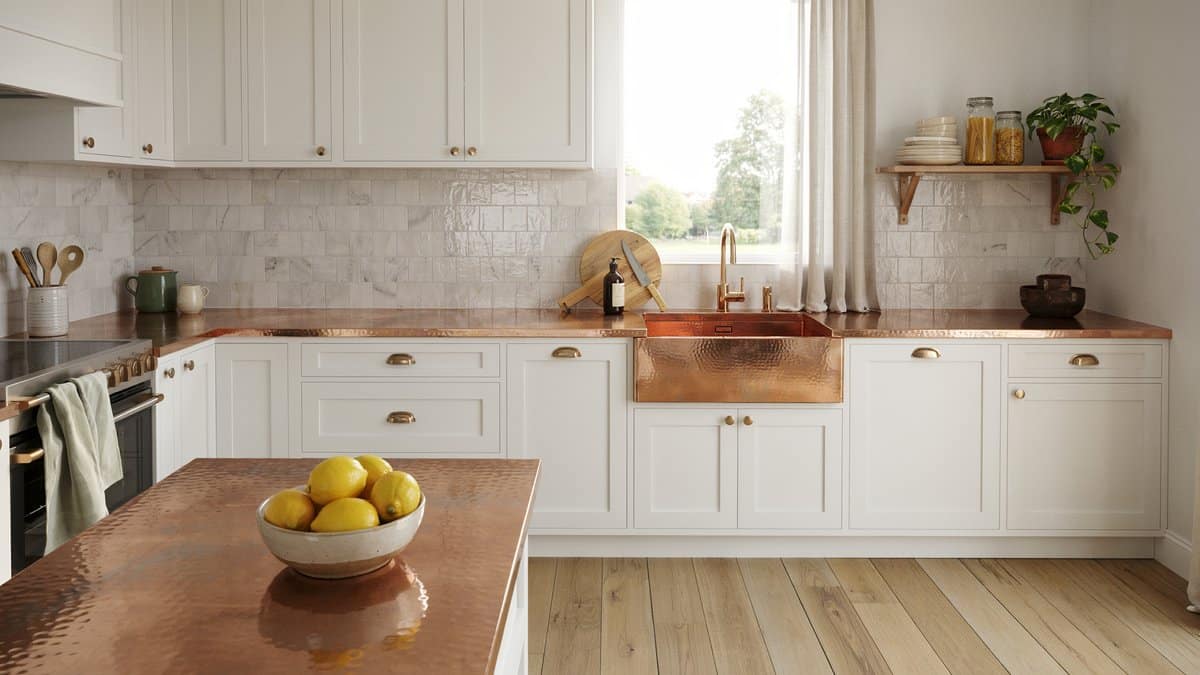
The copper kitchen is back, and it’s here to make a statement. In the last decade, copper has become an increasingly popular material choice within interior design. This much-loved metal which made its debut as an accent and accessory, is emerging from the side-lines to take center stage as a statement piece in kitchen interiors. And it’s not hard to see why copper kitchen countertops are sought after.
To begin with, the rich auburn color of copper is synonymous with a warm, inviting space. It oozes glamour, style, and attention. The practicalities of copper are also a huge selling point. Its malleability means it’s ideal for crafting bespoke units, and its antimicrobial and antibacterial properties mean it removes any nasty bacteria on its own.
Pros of Copper Counters
Here’s a few things you should consider before you purchase:

Antibacterial properties – This one isn’t marketing. Copper is the first solid surface material the US Environmental Protection Agency registered as an antimicrobial public health material, a registration granted back in 2008. Lab testing shows that when they’re cleaned regularly, EPA-registered copper alloy surfaces kill more than 99.9 percent of MRSA, VRE, Staphylococcus aureus, Enterobacter aerogenes, Pseudomonas aeruginosa and E. coli O157:H7 within two hours of contact. They keep killing more than 99 percent even after being contaminated again.
Two honest caveats. Only EPA-registered copper alloys carry that guarantee, so ask your supplier. And a copper counter supplements normal kitchen hygiene, it doesn’t replace it. Cleaning is still simple: a mix of lemon juice and salt brings the shine back fast.
Durability – It’s durable, which means it won’t corrode over time. A copper countertop will be a good investment piece to last for years to come.

Sustainability – It’s 100% recyclable. Copper is a sustainable material, so if the reality of your bold copper countertop proves too much to handle, you can rest assured that once it’s hit the scrap yard it won’t go to waste.
It’s copper – Apart from being a rich, elegant color on its own – the natural properties of the metal are particularly sensitive to oxidation. The result is a transformation of the metal to a more green, blue and reddish color. This is called a patina and arguably adds to the character of your kitchen, reflecting your true lived experience.
Cons of Copper Counters

It can be easily damaged – While the malleability of copper is ideal for molding the material to fit where required, the extent of its malleability leaves it vulnerable to dents and scratches. Some may think this adds to the character, but if you’re looking for a polished, ever smooth finish on your countertop, this won’t be for you. If you want many of the benefits of copper but with more durability, stainless steel countertops may be another option.
It’s copper – Yes, this is indeed Deja-vu. There’s no getting away from the fact that the ‘living surface’ of copper means it is going to discolor. If this bothers you, then you should really consider whether copper is the right material for your project.

It’s noisy – The metallic nature of copper means that when it comes into contact with other metals, for example pots and pans – it can be noisy.
It needs waxing – If you want to keep the original shine, you’ll be sealing it. The article used to send you off to research this yourself, so here’s the actual process instead.
Copper vs Other Countertop Materials
Copper sits at the expensive end, and it asks more of you than anything else on this list. Here’s how it stacks up against the other types of kitchen countertops people usually cross-shop it against.
| Material | Installed / Sq Ft | Maintenance | Best For |
|---|---|---|---|
| Copper | $100 to $200 | Wax every 1 to 2 months | A kitchen people remember |
| Stainless steel | $70 to $225 | Minimal, but shows fingerprints | Metal look with more toughness |
| Butcher block | $40 to $150 | Periodic oiling, sandable | Warmth on a smaller budget |
| Granite | $40 to $90 entry level | Seal every 1 to 3 years | Heat resistance and durability |
| Quartz | $60 to $120 mid tier | None, never needs sealing | Lowest upkeep, widest color range |
Non-copper figures from 2026 installed countertop ranges by material. Niche surfaces like soapstone and epoxy are worth a look if copper feels like too much commitment. If you want the metal look without the upkeep, stainless is the honest recommendation. If you want the counter to be the thing people comment on, that’s copper, and no other material on this list competes.
Copper Countertop Cost

Copper is one of the priciest counters you can put in a kitchen, and the number has moved a lot in the last few years. Installed, you’re looking at roughly $100 to $200 per square foot with materials and labor together. A typical kitchen job lands between $6,650 and $8,400, with $7,500 being the figure most people end up near. Labor by itself accounts for about $30 to $50 per square foot, or $40 to $90 an hour depending on who you hire.
If you’re pricing the copper sheet alone, before anyone touches it, that runs closer to $100 to $140 per square foot. The gap between those two numbers is the part that surprises people. Copper is difficult to cut and fit, so fabrication is a real line item, not a rounding error. Figures here come from Angi’s 2026 copper countertop cost data.
What It Costs By Kitchen Size
Standard kitchen counter runs measure somewhere between 30 and 50 square feet, so most people land in the second row here.
| Counter Area | What That Looks Like | Installed Cost |
|---|---|---|
| 10 to 20 sq ft | Small kitchen or a bar area | $1,000 to $4,000 |
| 30 to 50 sq ft | Average kitchen | $3,000 to $10,000 |
| 60 to 80 sq ft | Large kitchen or a big island | $6,000 to $16,000 |
| 100+ sq ft | Custom or extended surfaces | $10,000 to $20,000+ |
Copper Isn’t One Product
This is the part most cost guides don’t cover. Solid sheet copper is what you see in the photos, but it isn’t the only way to get a copper counter, and the cheaper routes are really good. A copper tile counter costs about half what a solid sheet does.
| Type or Finish | Cost Per Sq Ft | The Tradeoff |
|---|---|---|
| Solid sheet | $100 to $200 | Seamless and durable, but heavy and the most expensive |
| Overlay | $80 to $150 | Lighter and cheaper, but seams can show |
| Tile | $60 to $120 | Cheapest and DIY friendly, but you live with grout lines |
| Hammered finish | Add $20 to $40 | Hides scratches better than anything else. Worth it. |
| Patina finish | Add $10 to $30 | Aged look from day one, no blotchy waiting period |
| Integrated copper sink | Add $1,000 to $1,500 | Looks incredible, costs accordingly |
Copper Gauge: The Spec That Makes a Difference
If two quotes come back thousands of dollars apart, gauge is usually why. Copper sheet is sold by weight per square foot, and there are really only two numbers you need.
16 ounce copper weighs one pound per square foot and works out to about 23 gauge. 20 ounce copper is 22 gauge and roughly 25 percent thicker. For a standard perimeter counter, 16 ounce is usually enough, and its softness is arguably the point if you want a worn, rustic surface. For an island, a bar top, or anything that takes daily abuse, spec 20 ounce. It costs more and it’s meaningfully harder to dent. Thickness guidance from BasicCopper’s sheet thickness guide.
Ask your fabricator which gauge is in the quote. If they don’t volunteer it, that tells you something.
DIY or Hire It Out
DIY materials run $30 to $120 per square foot, and doing it yourself saves $400 to $1,500 or more in labor on an average kitchen. That’s real money.
Here’s the honest split though. Copper tile is a legitimate weekend project. Solid sheet copper isn’t. It’s hard to cut cleanly, it needs specific adhesives and tools, and a bad seam or a dented sheet costs more to fix than you saved. Anything with an integrated sink, a curved run, or a custom edge belongs with a fabricator who’s done it before.
What copper costs to own. Budget $50 to $150 annually for cleaners and sealant if you do the upkeep yourself, or $100 to $300 if you’d rather a pro handle the waxing and polishing. Refinishing or dent repair runs $200 to $600 per visit. Keeping copper bright costs noticeably more over time than letting it patina.
Does Copper Pay You Back?
Copper countertops return an estimated 50 to 70 percent of their cost at resale, which puts them right alongside granite or quartz. The number doesn’t capture the whole picture though. Copper makes a kitchen memorable, and in a market full of white quartz and gray cabinets, memorable has value that doesn’t show up in an ROI calculation.
Sealed Copper vs a Living Finish
This is the decision that determines how your counter looks in three years and how much work it is between now and then. Most guides skip it entirely.
A copper counter is what’s called a living surface. It reacts to what touches it. Left unsealed, it oxidizes into a mottled patina of reds, browns and greens that keeps shifting for years. Sealed with a clear coat or wax, it holds that bright penny finish much longer, though the seal isn’t permanent and needs refreshing.
There’s a third option nobody mentions: professionally patinated copper, where the finish is aged evenly at the shop before it’s installed. That’s the answer if you love the aged look but don’t want to live through the awkward stage. Because unsealed copper does go through an awkward stage, and it catches people off guard.
If that 1 to 3 month window sounds stressful, pre-patinated copper skips it entirely.
Copper Countertop FAQs
Skip harsh chemicals and disinfectants entirely. They break down the wax and then react with the copper underneath, which is a worse problem than the one you were solving. Care guidance adapted from copper surface care recommendations.
Is Copper Food Safe?
Yes, and it kills bacteria faster than stainless steel or plastic. What copper doesn’t tolerate is acid sitting on it. Lemon, vinegar, wine and tomato sauce will etch bright spots into an unsealed top if you leave them. On a sealed top, acidic cleaners with citric acid, bleach or ammonia will discolor the finish. The fix isn’t complicated: wipe spills when they happen, and clean with mild soap and water only.
Worth noticing the flip side here. That lemon juice and salt trick for shining copper works precisely because it’s acidic. Which means it strips patina wherever you use it. Great for a bright sealed counter, not what you want on a top you’ve spent two years aging.
Do copper countertops scratch and dent easily?
Yes. Copper is softer than stone, so knives leave marks and a dropped pot leaves a ding. Cutting boards and trivets aren’t optional here. A hammered finish hides damage far better than a smooth one, which is exactly why it exists.
Are copper countertops food safe?
They are, and EPA-registered copper alloys actively kill bacteria on contact. Just don’t let acidic foods sit. Citrus, vinegar and tomato will stain if you leave them.
How long do copper countertops last?
Decades. Copper doesn’t corrode, and a dented or scratched top can usually be refinished for $150 to $600 rather than replaced. It’s one of the few counters that gets more interesting as it ages instead of just looking worn.
Can you put hot pans on a copper countertop?
Copper handles heat, but it conducts it beautifully, which means the surrounding surface and the substrate underneath get hot too. Use trivets.
How much do copper countertops cost?
Around $100 to $200 per square foot installed. A typical kitchen runs $6,650 to $8,400, with $7,500 being the common landing spot.
Do copper countertops need to be sealed?
No, but unsealed copper will patina and keep changing. Sealed or waxed copper holds its shine, and you’ll be rewaxing every one to two months to keep it that way.

Installing copper kitchen countertops will no doubt transform your whole space, so it’s important that you feel completely happy with your choice. It really boils down to your tastes and what you want from your kitchen.
Do you want your kitchen to be a conversation starter? Or perhaps you simply value the real, ‘lived in’ look that this beautiful metal brings out in a design? Consider your values too. You may well appreciate the rustic look, in which case you don’t need to feel so anxious about keeping the countertop scratchless. If you’re the complete opposite, it really depends on how committed you are to taking the time out to maintain it, and clean it, whilst retaining your own sanity too. Good luck, and we hope some of you take the plunge and become copper converts!
To showcase highly specific designs, some images on this website use advanced AI-generation software to illustrate ideas and room inspiration. See our editorial policy to learn more.