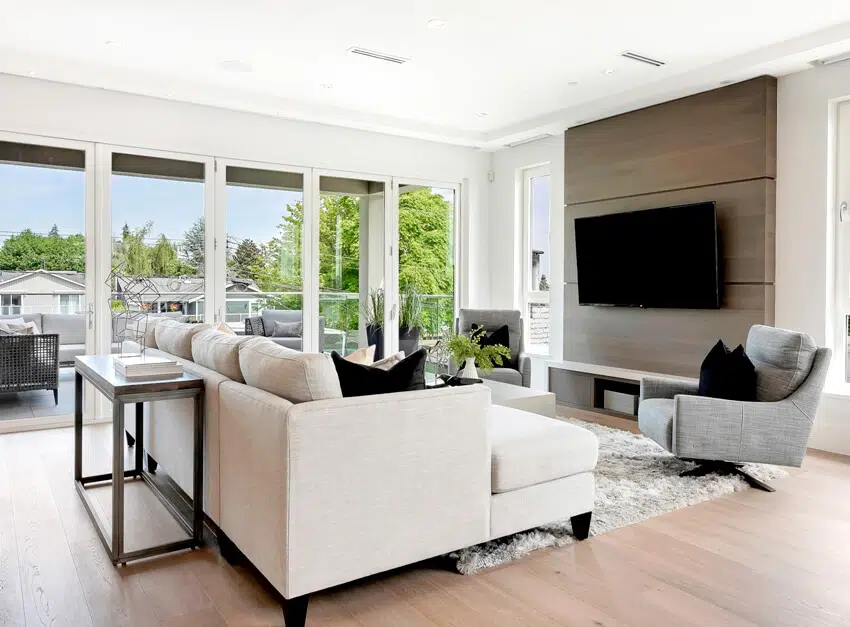
Open Concept Living Room vs. Closed Living Room

If you’re designing or remodeling a home, you may be faced with the question of whether to go with an open concept or a closed living room design. Each of these has its own advantages and disadvantages, and the one you select will depend primarily on you and your family’s needs. Below, I’ll break down the major differences between an open concept living room vs. a closed living room to help you decide what will work best.
The quick take

Upload a photo and get instant before-and-after room designs.
No design experience needed — join 2.39 million+ happy users.
👉 Try the AI design tool now
- Go with an open concept if you want an easy flow with longer sightlines and shared light between different zones. But get ready for a louder space that’s more challenging to zone and trickier to style and still pull off a cohesive look.
- A closed living space excels at coziness, sound control, and ease of styling. The downsides are that they can feel smaller, darker, and disconnected from the rest of the house.
Open concept: Advantages
- Airy sightlines: With an open plan, the areas borrow light from each other, creating a brighter space overall. Small homes feel bigger.
- Flexible hosting: If it’s a shared kitchen and living space, the cook isn’t isolated. There’s easier circulation for families and guests.
- Family supervision: You have clear views of the kids while you’re in the kitchen.
- Multifunctional: Zones can expand or contract depending on the need, for holidays and gatherings.
- Design continuity: You can create one cohesive color palette across the living, dining, and/or kitchen that gives a high-end feel.

Open concept: Disadvantages
- Noise travel: If you work from home or want privacy, you’ll notice that without acoustic planning, the sound bounces.
- Smells & grease: If it’s attached to a kitchen, the cooking odors migrate throughout the room.
- Visual clutter: Clutter can accumulate and make the whole house look messier. Storage and styling discipline are required to keep things tidy.
- Scale challenges: You’ll need larger rugs, art, and fixtures to anchor zones and make each space stand on its own.
- Temperature balance: It may be more difficult to heat and cool throughout the year.
Designer tips for an open concept room
- Zone with size: Choose rugs that fit underneath furniture with all front legs of seating on top. Go with rugs of 8’×10′ or 9’×12′ as a minimum.
- Layer lighting: Utilize lighting with ambient (recessed), task (lamps), and accent (picture lights). Put each zone on its own dimmer for more direct control.
- Acoustics: Add soft surfaces like area rugs, drapery, upholstered pieces, and acoustic art panels to give more sound control.
- Ventilation: If a kitchen is part of the room, use a 600+ CFM range hood that’s ducted outside for cooking to keep odors away.
- Traffic: Keep 36″ to 42″ walkways between furniture so there’s no feeling of overcrowding.
Closed living room: Advantages
- Coziness: A closed-off room is much easier to control the mood, warmth, and light.
- Sound control: Doors and walls keep phone calls private and kids’ play contained there.
- Purpose-built: It’s great for a library, music room, or TV/media area with fewer glare issues from different angles and light fixtures.
- Tidy: Any clutter stays out of sight from the kitchen or dining area making it easier to contain.

Closed living room: the tradeoffs
- Light isolation: Fewer borrowed windows can make the room feel smaller and darker.
- Choppy flow: Entertaining requires more doorways and detours to manage.
- Less flexible: Furniture layouts are more limited by the size, doors, and walls.
- Underused risk: If it’s “too formal,” it may become a pass-through or museum-type room you’re afraid to use.
Designer tips for closed living rooms
- Right-size openings: Widen the doorways to 48″ to 60″ to improve their flow without a full demo.
- Borrowed light: Add transoms, interior windows, or glass doors to more efficiently share daylight.
- Media first: If it’s your TV room, plan for 8′ to 10′ seating distance to a 65″ screen.
- Windows treatments: Control glare in TV and media rooms with layered window treatments.
- Built-ins: Use wall depth units for cabinets, shelves, and concealed media wiring.
Layout & measurement cheat sheet
- Conversation grouping: Ideal seat-to-seat span 8′ to 10′; coffee table 16″ to 18″ from sofa.
- Rug sizing: Open concept, then go bigger; closed room, then leave 8″ to 12″ floor revealed around the rug.
- Clearances:
- Pathways: 36″ to 42″
- Between sofa & coffee table: 16″ to 18″
- Dining pull-back: 36″ from table edge to wall/furniture
- TV placement: Center at eye height at 42″ seated, and limit any potential side-window glare.
Budget & build realities
- Open concept costs rise when walls are load-bearing, the house has complex ducting, or you need new flooring across a larger continuous area.
- Closed room upgrades are cost-efficient and can add built-ins, a wider casing, glass doors, or sound-absorbing finishes without major structural work to increase the resale value.
Resale perspective
- Family-centric suburbs: Open kitchen-living remains a strong expectation of many buyers.
- Urban condos/historic homes: Semi-separation or a “broken-plan” often tests better in sales data.
- Best of both: Hybrid solutions (see below) appeal to the broadest buyer pool.
Hybrid solutions (my go-tos)
- Cased openings instead of a full demo go for a visual connection, and benefit from better acoustics.
- Half walls or pony walls with built-ins, possible storage, and subtle separation. (This may feel outdated if not done properly.)
- Glass partitions or steel-framed doors offer better light flows and sound reduction.
- Room dividers: Bookcase walls, double-sided fireplaces, and slatted screens can be considered.
- Ceiling and floor zoning: Coffered ceiling over living space, and use different rug textures to define the areas.
- Smart drapery: Use track-mounted sheers to “soft close” an open plan for afternoon glare on a dining area or on movie night.
When to choose an open concept
- You host often and need space to mingle.
- Your main floor is under 1,200 sq ft and starved for light.
- Supervision of kids is a daily need.
- You’re ready to invest in ventilation, acoustics, and scaled furnishings.
When to choose closed living
- You prioritize quiet, focused activities.
- You need a dedicated media or library vibe.
- You have strong solar gain or screen-glare issues.
- You want a high-impact room makeover without heavy structural costs.
Common mistakes (and easy fixes)
- Undersized rugs in open plans → Upsize to anchor seating; align rug edge with sofa width.
- Noisy echo → Add a big rug pad, lined drapes, and one upholstered accent wall or acoustic art.
- Aimless lighting → Put each zone on dimmers; add two lamp layers minimum.
- Furniture against walls in closed rooms → Float the sofa; use a console table to maintain a 36″ path.
Pros and Cons Of An Open Vs Closed Living Room Layout
| Layout Type | Pros | Cons |
|---|---|---|
| Open Concept |
|
|
| Closed Living Room |
|
|
| Hybrid / “Broken-Plan” |
|
|
How to evaluate your space
To determine what will work best for your needs, let’s examine six key elements to consider.
- Daily routines: Who will use the room, when, and for what?
- Acoustics & privacy: Will it be used for making calls, taking naps, homework, or late-night TV?
- Lighting: Are there natural light sources? What’s the room orientation, and will there be glare?
- Furniture planning: Will there be a lot of conversation distance, awkward traffic paths, or a need for storage?
- Mechanical realities: How about HVAC, return air, kitchen ventilation, or smoke paths?
- Resale & budget: What are the neighborhood norms, will there be additional structural costs, and permits needed?
Here’s a breakdown to help you choose based on the above criteria.
| What’s Important | Open Concept | Closed Living Room | Hybrid / “Broken-Plan” |
|---|---|---|---|
| Daily routines Who uses it, when, and for what? |
Best if: lots of overlapping activities |
Best if: focused, single-purpose use |
Best if: routines vary day-to-day |
| Acoustics & privacy Calls, naps, homework, late-night TV? |
Watchouts: blender + Zoom clash |
Advantage: quiet on demand |
Middle ground: better, not perfect |
| Lighting Natural light, orientation, glare? |
Pro: brightens small homes |
Fix: dimmers + lamps + drapery |
Balanced: light + separation |
| Furniture planning Conversation distance, traffic, storage? |
Scale up to avoid “floating” |
Easy: purposeful groupings |
Tunable: form follows function |
| Mechanical realities HVAC, returns, ventilation, smoke paths? |
Plan: airflow + make-up air |
Simpler to tune |
Moderate complexity |
| Resale & budget Neighborhood norms, structural cost, permits? |
High appeal; higher demo cost |
Value: lower structural spend |
Best of both = strong resale |
| Quick chooser Use this to decide fast |
|
|
|
Designer’s bottom line
Choose an open floor plan if your lifestyle depends on connection with friends and family, and you’ll invest in the necessary sound, ventilation, and scale. Choose a closed layout if you want to maintain calm, control, and cinematic focus without distraction. If you’re not sure? Go hybrid and enlarge the door openings, add glass or dividers, and fine-tune the room with lighting, rugs, and built-ins to properly zone the space.
To showcase highly specific designs, some images on this website use advanced AI-generation software to illustrate ideas and room inspiration. See our editorial policy to learn more.