2 Person Home Office Layouts that Make Sharing Easier: Desk Placement Ideas

If you work from home with your significant other, you may be tasked with designing your home office to accommodate two people. It’s one of those problems that sounds easy until you start moving furniture around and realize that it won’t all fit. For something like this, you’ve got two desks, two monitors, and two people with different schedules that have different tolerances for background noise and work habits. Many shared office setups fail due to the same problems: desks pushed together in a way that feels cramped and arrangements that disrupt productivity. These five 2 person home office layouts share a variety of room floor plans that target the need for collaboration, privacy, and space. Each of the room options below solves the two-person problem in a different way, so you can find the design that fits your room’s dimensions and the way you and your partner work together.
Back To Back Island Bench Home Office Layout
This home office places the two desks in the center against each other back to back so two people share one central area with plenty of room all around to make the most out of a square room layout.
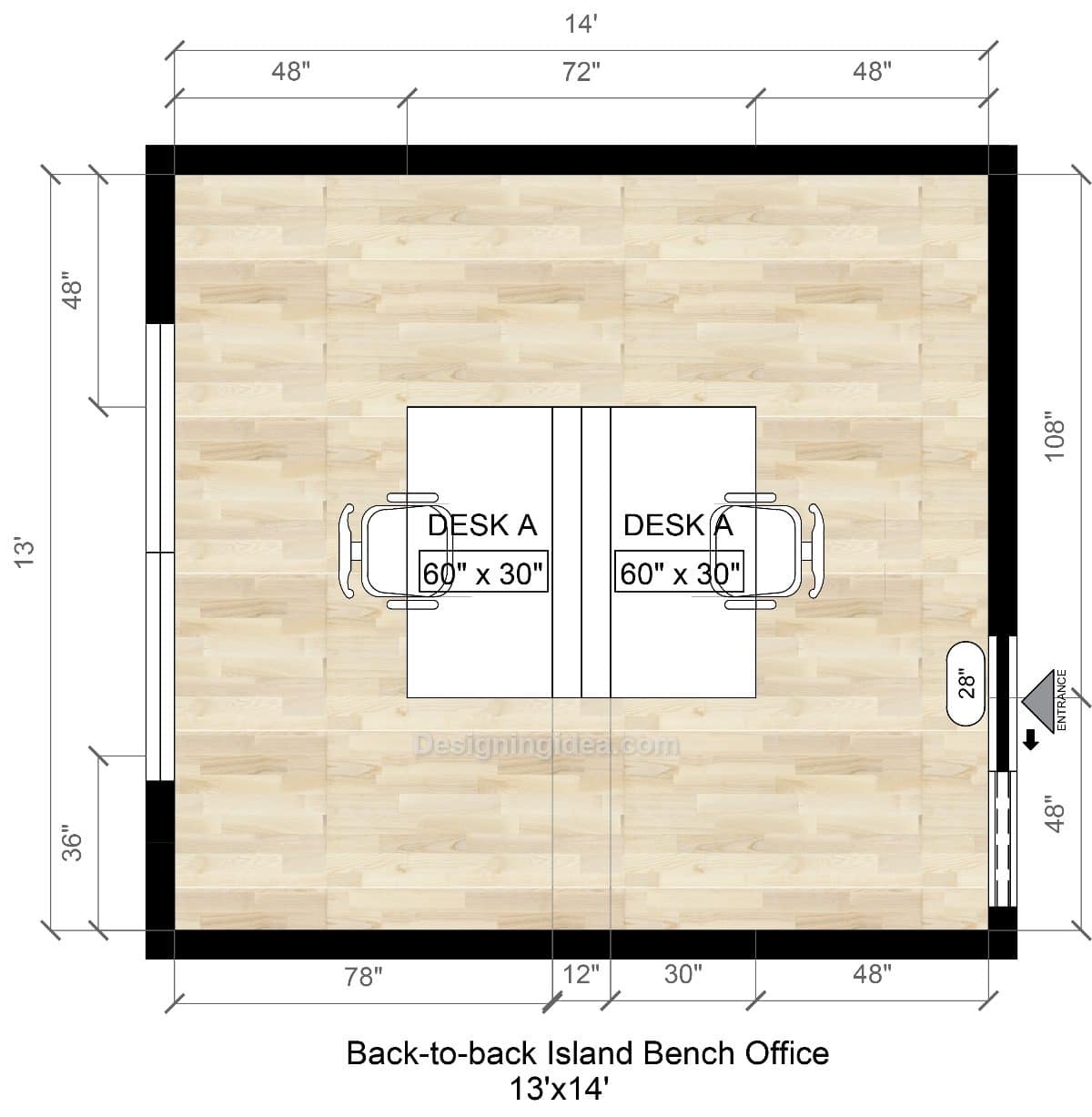
Floor Plan Details: This home office has both desks facing outward from a shared center area, so each person gets their own forward-facing workspace. This works for a few reasons: you’re close enough to talk, but still far enough apart that you have your own sides and designated space. The biggest advantage of going with this arrangement is the perimeter clearance you gain. Since every wall stays open, all four sides are available for use as storage, shelving, or windows, so the room feels bigger than the square footage suggests. This placement works great in a square room, and depending on the size of the space, you may be able to create a secondary zone for a reading chair in a corner.
Dimensions:
- Room size: 13′ x 14′
- Each desk (Desk A): 60″ x 30″
- Walkway beside desks: 48″
- Desks share a center buffer, approximately 12″ wide as a divider between the two surfaces
- Entrance door: 28″ wide, positioned on the right wall
Design Tips:
- Keep the workstations exactly centered to maintain equal walking clearance and provide symmetry, especially in a square room.
- Use the open walls for your storage with a long shelving installation or cabinets along the left. Keep it below eye level to avoid interrupting windows or sightlines.
- Set up a printer station in one corner and potentially seating in another, where it is out of the way.
- If one person takes more client calls or has more interruptions, seat them at Desk A on the right.
- Since each workstation faces outward, put something worth looking at in front rather than having them look at bare walls, which drains focus.
- Cable management matters more in a floating island setup, so plan for a central cable spine or in-desk grommets before the furniture goes in.
Face To Face Opposite Office Wall Collaboration Floor Plan
This setup features two full-size desks positioned facing each other with a pathway in between for additional separation.
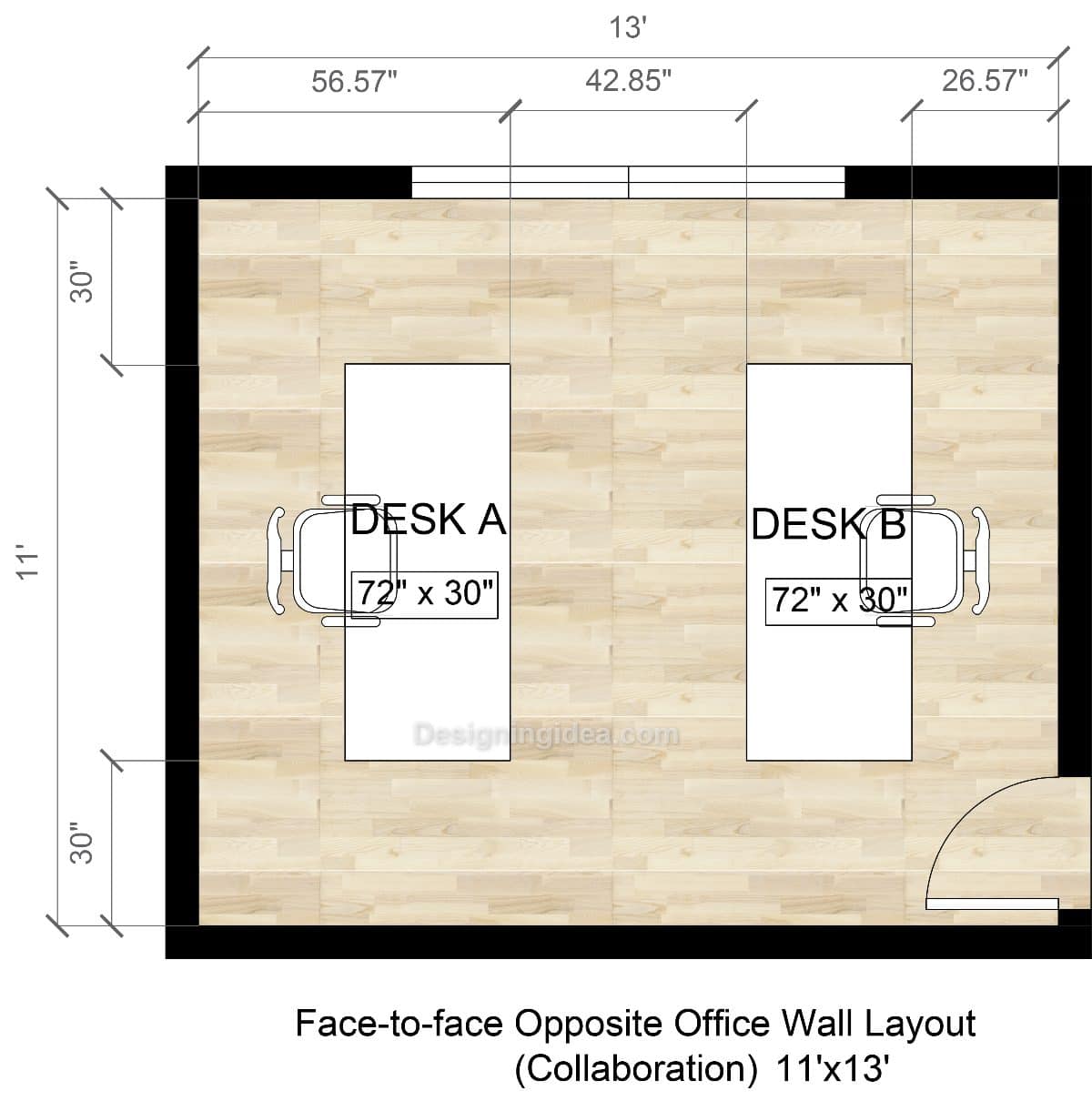
Floor Plan Details: This layout puts Desk A and Desk B parallel to each other, with both oriented facing in with a gap in the middle. This arrangement creates more separation, so you’re not feeling like you’re right on top of your office partner all day. The added space provides room to breathe and space to place a portable dividing wall if necessary. The gap between the two workstations is large enough that neither person feels crowded, yet close enough for frequent collaboration. The door sits in the bottom-right corner, so it’s out of the way and doesn’t interrupt either workspace, and offers an open walkway to either side. The trade-off is that this setup may leave limited room for shelving or a filing cabinet along those walls on either side. Storage has to go somewhere else, so you’ll want to consider that before you move any furniture in.
Dimensions:
- Room size: 11′ x 13′
- Each desk: 72″ x 30″
- Space in-between approx. 43″
- Top wall clearance segments: 56.57″, 42.85″, and 26.57″ (left to right)
- Side wall clearances: 30″ at top, 30″ at bottom
- Door opening: 30′ with swing visible in bottom-right corner
Design Tips:
- Since both desks face in, you may want a divider in the center if you desire more privacy.
- If you value communication between each station, keep that middle zone open to talk, pass documents, or share a screen.
- Hang long floating shelving running the full width of the top wall.
- Keep the workstations symmetrical, and it’ll feel stylish and intentional.
- The 42.85″ gap between the desks is wide enough to slide in a narrow rolling cart or a shared printer stand.
- With the door on the lower right, desk B gets more foot traffic past it every time someone enters. If one person is more easily distracted, put that person at Desk A on the left.
- Put acoustic panels or a bookshelf on the wall behind each desk, so sound on video calls bounces off hard surfaces. A fabric panel or tall shelving unit can also have a sound-dampening effect.
Opposite Corner L-Desk Office With Privacy Focus Layout
By placing each desk at opposite corners, two people can share one square room without being in each other’s space.
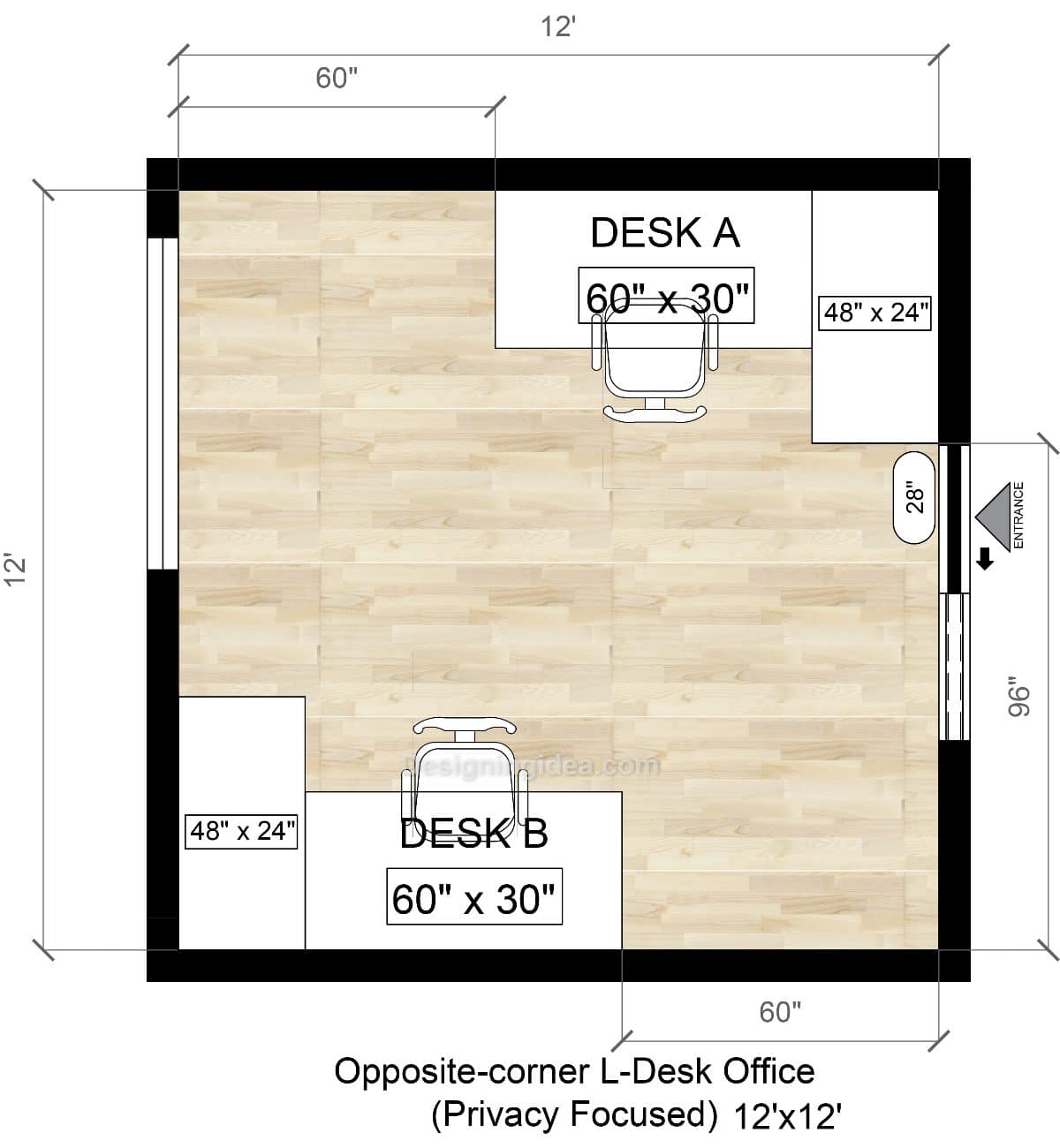
Floor Plan Details: If you want to work alongside someone in a shared office and find yourself constantly distracted by their screen, calls, or just their presence, this layout addresses that directly. Each person gets a corner of their own facing a wall, with open floor space between them that acts as a natural buffer. Desk A sits in the upper-right, facing the top wall, with a 48″ x 24″ storage unit tucked beside it. Desk B sits on the lower-left, facing the bottom wall, with its own matching 48″ x 24″ storage unit. Each desk has its own storage, giving both people their own designated space for filing and work tasks. The entrance is on the right side, so anyone walking in enters closer to Desk A, while the person at Desk B gets a bit more natural insulation from foot traffic. See more single-user L-desk layouts on this page.
Dimensions:
- Room size: 12′ x 12′
- Desk A: 60″ x 30″, positioned at the upper-right facing the top wall
- Desk B: 60″ x 30″, positioned lower-left facing the bottom wall
- Two storage/credenza units: 48″ x 24″ each
- Door opening: 28″
- Desk A offset from left wall: 60″
- Desk B offset from right wall: 60″
Design Tips:
- Keep the center of this room open and empty with two rugs that define each person’s zone without meeting in the middle. This reinforces the privacy feel and deadens sound between the two workstations.
- Both people face walls, which means voices and sounds bounce back into the room. Hang acoustic panels mounted on the wall directly in front of each desk, right in each corner zone, to help muffle sounds.
- Position the storage units beside each desk rather than behind them, so sightlines stay open and everyday items remain close at hand.
- Since both desks face in, whoever’s at Desk A will have a natural view toward the entrance. That spot is useful if one person handles more interruptions or deliveries.
- Put the person who needs to stay focused the most at Desk B, with their back to the door and facing their own corner.
Perimeter U-Shaped Dual-Zone Office Design
This home office places the two desks along one top corner wall, keeping the center completely clear and leaving the room feeling spacious.
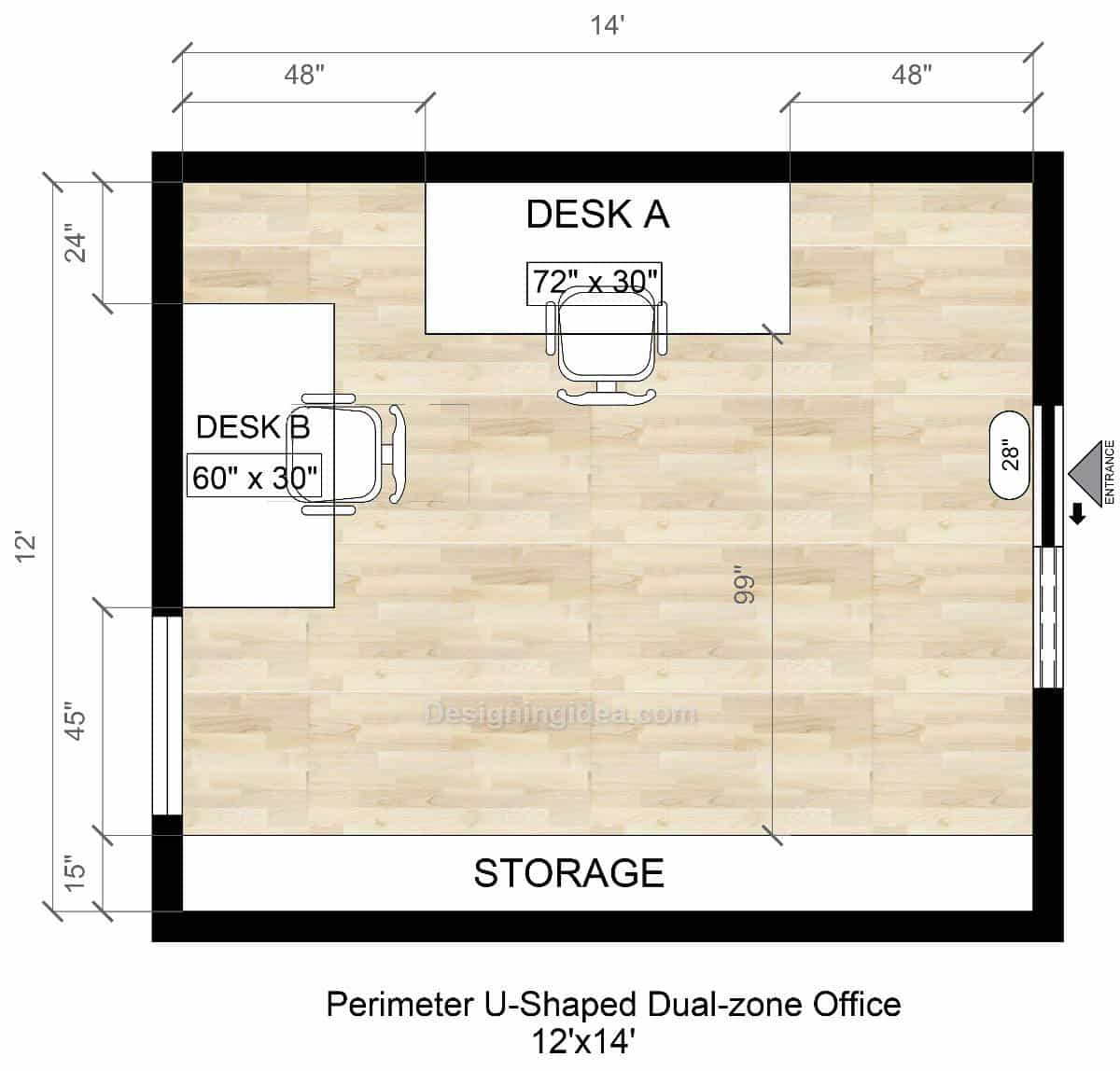
Floor Plan Details: This layout solves the hardest part of sharing a home office, which is generally staying out of each other’s way. Desk A sits along the top wall facing in, and the second Desk B runs along the left wall. Each person gets their own visual backdrop, which helps with work focus even without a physical divider. The open floor in the middle helps so you’re not squeezing past someone’s chair to grab a file or get to the door. The entrance is on the right wall, which leaves an open path from it to either workstation. The storage zone runs the full width of the bottom wall, so all of your shared files, printers, and supplies have a home instead of taking over someone’s desk. The one trade-off is that neither desk faces the door, so if one person takes a lot of video calls, you don’t have adequate background management that you may want to consider.
Dimensions:
- Room size: 12′ x 14′
- Desk A (top wall): 72″ x 30″
- Desk A (left wall): 60″ x 30″
- Top wall desk alcoves: 48″ wide each side
- Left wall upper section: 24″ depth
- Left wall lower section: 45″ height
- Storage zone depth: 15″ across lower wall
- Entrance door: 28″ wide
- Center open floor depth: approximately 99″
Design Tips:
- The left-wall desk is slightly smaller at 60 inches, so give that spot to whoever needs fewer monitors or does more writing than screen work. The smaller workstation is a natural fit for a secondary user.
- Both desks face walls, which is great for those needing focus. Adding a low open shelf or a plant where the two desk zones meet gives the room a shared center point without blocking the workflow.
- Build out the storage wall with closed lower cabinets and open shelving above; this way, you can keep the shared printer, router, and supplies off both desks.
- Move the desks further away if each user needs additional elbow room.
Side-by-Side Shared Office Wall Layout
By going side-by-side along one wall, you benefit from two equal workstations with identical setups so the rest of the room stays open and inviting.
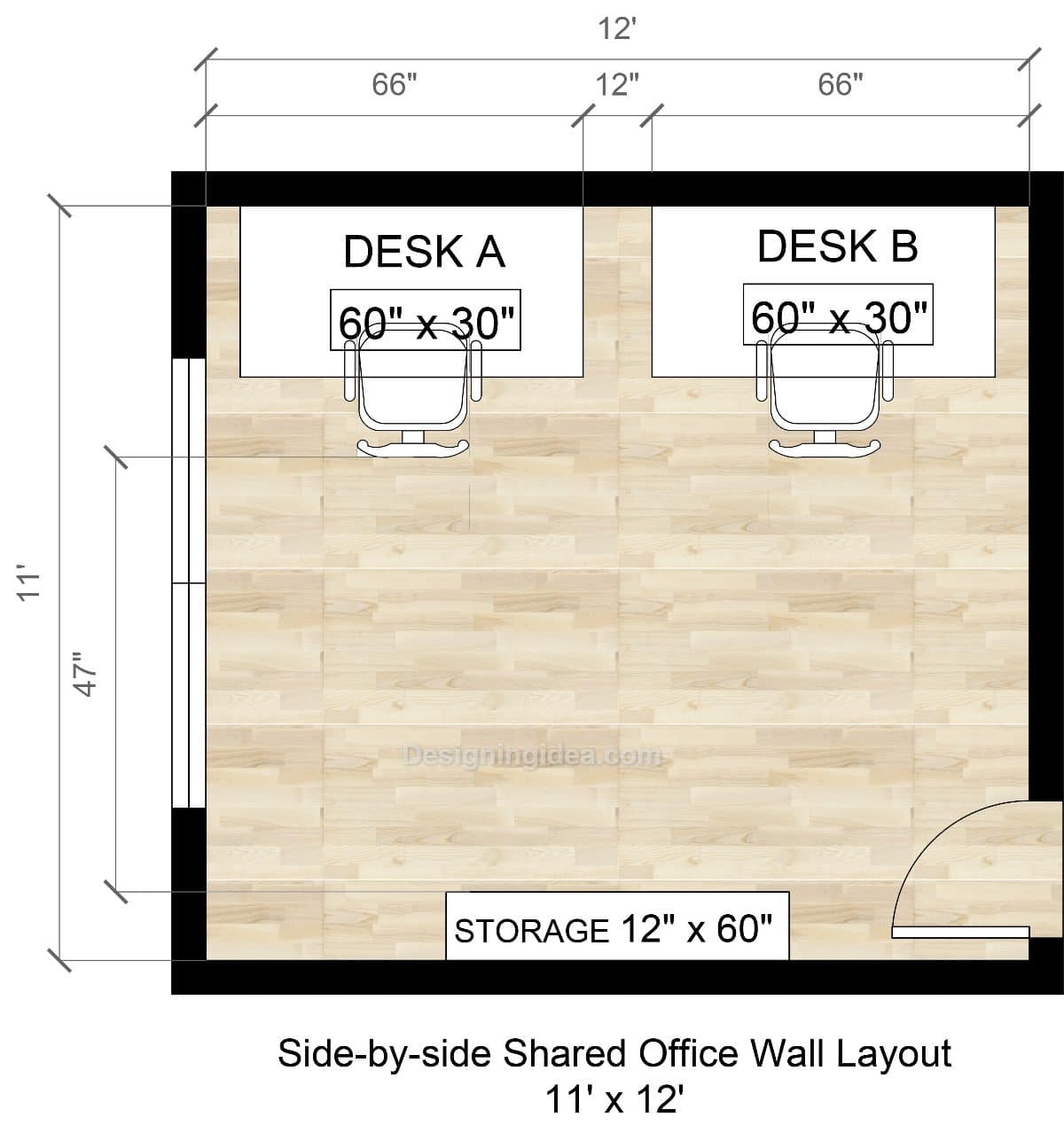
Floor Plan Details: If you’re sharing a home office and want to work side-by-side, this layout offers the perfect opportunity. Both desks face the same wall and sit side by side, with a 12-inch gap between them. Each person gets their own zone, which makes it easy to talk without spinning your chair around. Since there’s no furniture crowding the middle, the room feels bigger than the 11 by 12 feet dimensions may suggest. The door sits in the bottom right corner, which means you enter naturally without cutting through anyone’s workspace. There is also a storage unit on the bottom, for both to share. The trade-off is that one storage piece for two people means you’ll need to agree on how its organized and divided. For more plans like this, see our 10ft by 12ft office designs.
Dimensions:
- Room size: 11′ x 12′
- Desk A: 60″ x 30″
- Desk B: 60″ x 30″
- Gap between the desks: 12″
- Storage unit: 12″ x 60″ on the lower end
Design Tips:
- The 12-inch gap between the desks is tight and not enough to block sound. If both people are on calls at the same time, you may want a small acoustic panel or even a narrow bookshelf placed vertically in that gap to dampen sound.
- Use the shared storage along the bottom wall and divide it physically with bins or boxes in distinct colors, one per person.
- Avoid filling the open floor space with a couch.
- Shared items go in the storage along the lower wall.
- Video calls may be awkward with this layout. A simple fix is a small acoustic panel or room divider that folds out just for calls.
To showcase highly specific designs, some images on this website use advanced AI-generation software to illustrate ideas and room inspiration. See our editorial policy to learn more.